AI Agent Development Company: How to Choose (2026)

Choosing an AI agent development company in 2026 is a strategic call, not a procurement checkbox. The market is crowded with service pages promising “powerful, tailored” agents and ranking lists that tell you who scores well on Clutch. What they don’t tell you is how to actually decide. So this is a neutral buyer’s guide instead - concrete evaluation criteria, cost models, the questions worth asking, and the red flags that separate a senior engineering partner from an expensive mistake.
If you treat software as a strategic investment rather than a cheap deliverable, this is written for you.
TL;DR: An AI agent development company designs, builds, and maintains autonomous AI systems for your workflows. Choose one based on senior technical ownership, agentic architecture skill, governance and data security, transparent pricing, and post-launch accountability - not on rankings or hype.
What an AI Agent Development Company Actually Does
An AI agent development company designs, builds, integrates, and maintains autonomous AI systems that reason, use tools, and execute multi-step tasks - going far beyond chatbots or scripted automation.
The distinction matters. A chatbot answers a question. An agent decides what to do, calls the right tools, checks its own output, and completes a workflow. If you want the fundamentals first, we cover what AI agents are in detail elsewhere.
A serious partner handles the full lifecycle: discovery, agent architecture, model selection, orchestration, guardrails, integration with your stack, evaluation, and ongoing maintenance. Every one of those steps carries technical decisions that shape reliability for years.
There’s also a fork in the road. Platform vendors sell you something to buy; custom development partners build around your workflows. That difference decides who owns the resulting IP - and ownership shapes everything downstream.
Should You Build In-House or Hire a Partner?
Build in-house when AI is your core IP and you can hire senior talent; hire a partner when you need speed, proven agentic patterns, and accountability without a two-year hiring runway.
The honest decision factors: internal AI/ML seniority, speed to production, opportunity cost, and the long-term maintenance burden. Most growth-stage companies badly underestimate that last one.
Hiring senior engineers is slow and expensive, and the McKinsey State of AI research shows adoption outpacing the supply of experienced practitioners. Already have a strong team? Our guide on hiring and scaling software developers is worth a read before you commit headcount.
A hybrid model often wins: a partner builds and hardens the first agents, then transfers ownership to your team. What you should never do is treat agent development as a cheap one-off deliverable. Agents drift, integrations break, models change. The build is the beginning, not the end.
Types of AI Agent Development Partners Compared
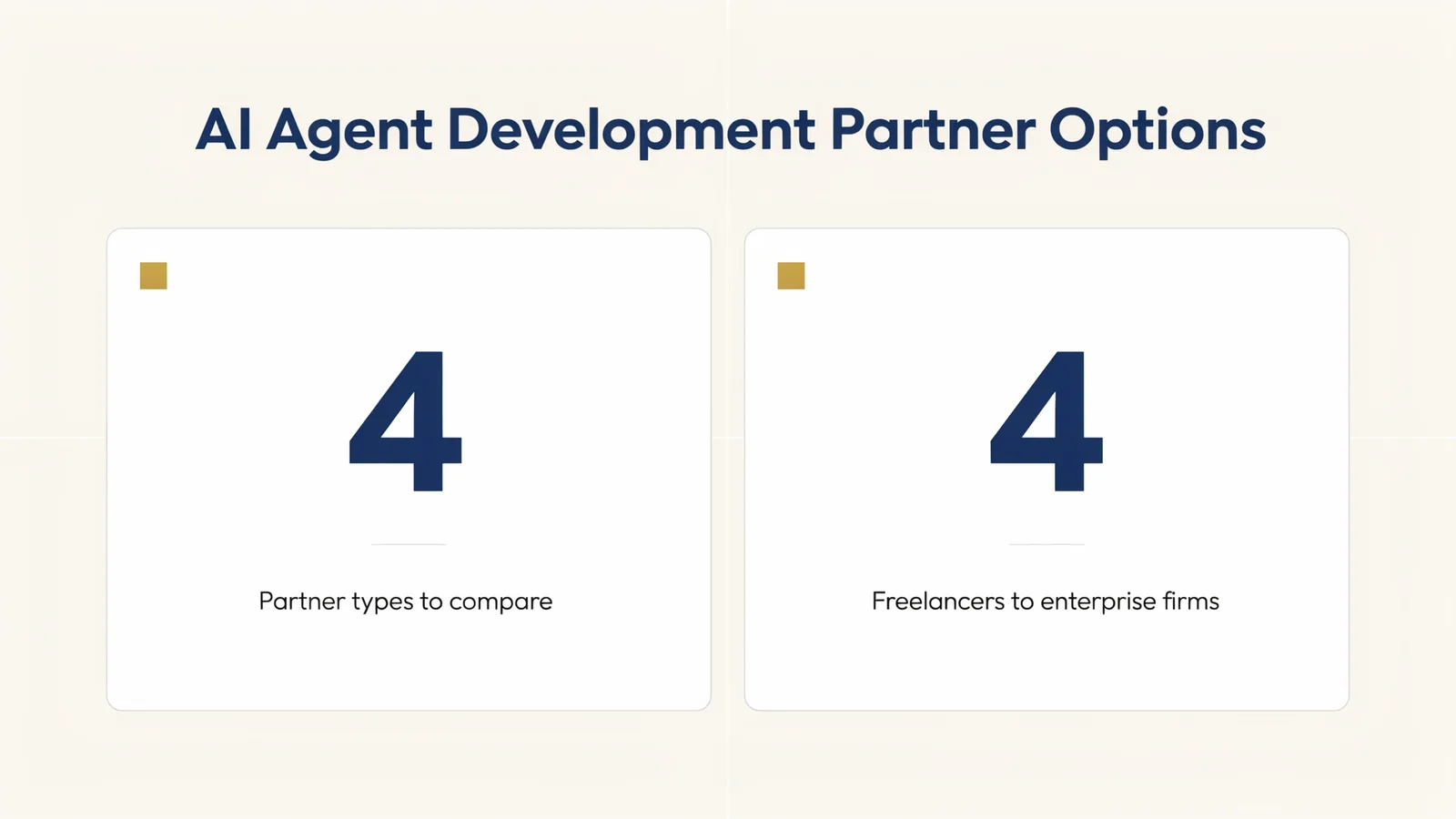
There are four practical options: freelancers, boutique senior studios, large enterprise/IT service firms, and no-code platforms. Each trades cost against accountability, technical depth, speed, and lock-in.
| Partner type | Cost | Accountability | Technical depth | Speed | Best fit |
|---|---|---|---|---|---|
| Freelancers | Low | Low | Variable | Fast to start | Prototypes, throwaway experiments |
| Boutique senior studio | Mid | High | High | Fast | Series A-C, scale-ups, strategic agents |
| Enterprise/IT firm | High | Governed but diffuse | High | Slow | Large regulated enterprises |
| No-code platform | Subscription | You own it | Low | Very fast | Simple internal automations |
Freelancers look cheap until a production agent hallucinates in front of a customer and nobody is accountable. Enterprise firms bring governance but move slowly and price accordingly. Boutique studios sit in between: senior, named ownership plus speed, which is exactly why they suit growth-stage companies.
If cost is pushing you toward distributed teams, weigh the offshore development trade-offs carefully - timezone gaps and communication overhead erode the savings on complex agentic work. Match the partner type to your stage, and to how strategic the agent really is to your business.
10 Criteria to Evaluate an AI Agent Development Company
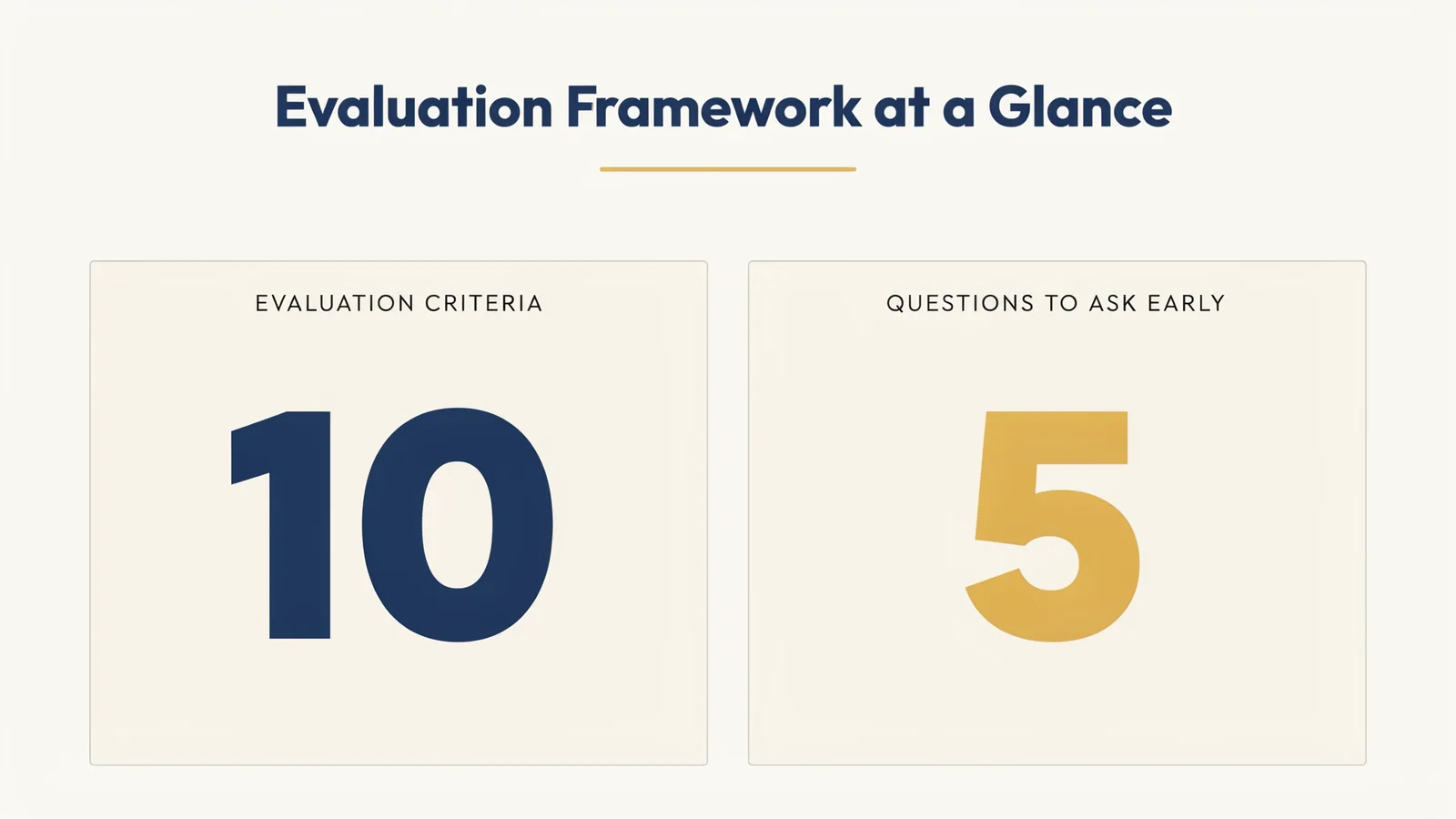
Evaluate partners on senior ownership, architecture skill, evaluation discipline, governance, and post-launch accountability - not on polished decks.
- Senior technical ownership. You want named engineers who own the build, not account managers who forward emails.
- Agentic architecture competence. Ask about orchestration, tool calling, memory, and multi-agent design. Vague answers here are disqualifying.
- Model-agnostic approach. A partner tied to one provider will build you a dependency, not a system.
- Evaluation and testing discipline. Real eval sets, regression testing, and observability separate production agents from demos.
- Guardrails and human-in-the-loop design. How does the agent fail safely, and when does a human take over?
- Data governance and compliance readiness. Security, data residency, and alignment with the NIST AI Risk Management Framework matter from day one.
- Integration experience. Can they work inside your existing stack and workflows, not just a greenfield sandbox?
- IP ownership and documentation. You should own the source code, prompts, and eval datasets - with docs to match.
- Verifiable production deployments. References to live systems beat testimonials every time.
- Post-launch support model. Who is accountable in month six, when the agent starts drifting?
Questions to Ask in Your First Conversations
Ask ownership, reliability, and support questions early - the answers reveal seniority faster than any portfolio.
- Who owns the code, prompts, and evaluation datasets after the engagement ends?
- How do you test agent reliability before production, and how do you monitor it after?
- Which frameworks and models do you use, and how do you avoid lock-in?
- How do you handle hallucinations, escalation, and human oversight?
- What does support and maintenance look like six months post-launch?
If a vendor stumbles on ownership or evaluation, treat it as a signal, not a detail.
AI Agent Development Cost Models and Budgeting
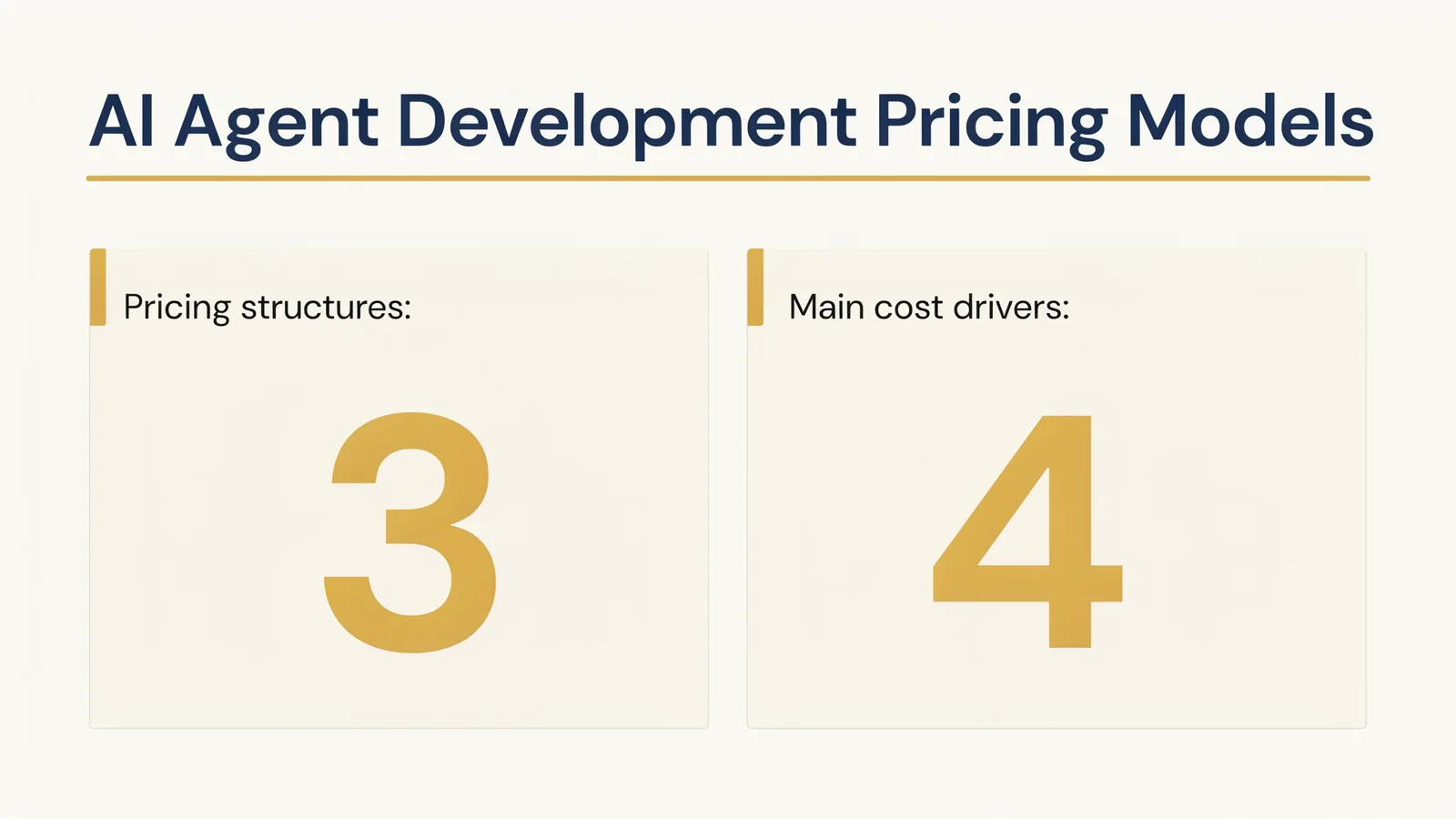
AI agent development cost depends on complexity, integrations, and compliance - budget for both the build and the ongoing operation, because agents are never truly “done.”
Three pricing structures dominate:
- Fixed price fits a well-defined proof of concept with clear scope.
- Time and materials fits evolving scope where requirements sharpen as you learn.
- Monthly retainer fits ongoing agent operations, tuning, and monitoring.
The main cost drivers are agent complexity, the number of integrations, compliance requirements, and ongoing model and inference costs. That last one surprises people. Every request an agent makes carries a token cost that scales with usage.
Budget for maintenance and evaluation, not just the initial build. Agents drift as models update and data shifts, and an agent nobody tunes quietly degrades. A partner who only quotes the build - and stays silent on operations - is pricing half the problem.
Red Flags When Choosing a Partner
The clearest warning signs are vague promises, no testing methodology, and reluctance to hand over your IP.
Watch for these:
- Buzzwords like “powerful” and “tailored” with no concrete architecture reasoning behind them.
- No evaluation or testing methodology for agent reliability.
- Reluctance to grant IP ownership or share source code.
- Over-reliance on a single model provider with no lock-in strategy.
- No post-launch accountability or hand-off plan.
- Selling AI-generated code patches instead of senior engineering ownership.
That last point deserves emphasis. Anyone can prompt a model into generating an agent that demos well. Hardening it for production - the edge cases, the failures, the security - is the actual work, and it needs senior engineers who stay accountable.
The Engagement Process: From Discovery to Go-Live
A sound engagement moves through five stages, and each one gates the next so you never overinvest in an unproven idea.
- Discovery and use-case scoping. Define measurable business outcomes first. Mapping your workflow against real AI agent examples by industry helps you choose the right use case.
- Proof of concept. Validate feasibility and ROI before committing to a full build.
- Production build. Add guardrails, evaluation, and real integration into your systems.
- Deployment, monitoring, and iteration. Ship, observe, and tune based on live behavior.
- Knowledge transfer and support. Documentation, handover, and a clear long-term support model.
Skipping the PoC to save time is a common and costly mistake. A focused pilot costs little and stops you from building the wrong thing at scale.
Compliance and Governance in 2026
Governance is now a partner selection criterion, not an afterthought - regulation and enterprise risk frameworks directly shape how autonomous agents get designed.
The EU AI Act regulatory framework introduces risk-tier obligations that affect DACH and global buyers alike. Autonomous agents that make consequential decisions carry documentation, transparency, and oversight requirements you cannot bolt on after launch.
Adoption is accelerating fast. Gartner research on enterprise AI adoption reports that 42% of enterprises expect to deploy AI agents in 2026, up from just 17% in 2025. That surge means more scrutiny, not less - and a partner who treats governance as core design work protects you as adoption spreads.
Ask any prospective partner how they handle risk tiers, audit trails, and human oversight. If governance is an afterthought in the pitch, it will be an afterthought in the build. For the technical detail behind these questions, see our breakdown of autonomy levels and safety guardrails.
Frequently Asked Questions
What is an AI agent development company? It is a firm that designs, builds, integrates, and maintains autonomous AI agents - systems that reason, use tools, and execute multi-step tasks - tailored to your workflows. It goes well beyond chatbots or scripted automation.
How much does it cost to build a custom AI agent? Costs vary widely with complexity, integrations, and compliance needs. Expect fixed-price PoCs, time-and-materials for evolving scope, and retainers for operations. Inference and maintenance are ongoing costs, not one-time fees.
How long does it take to build an AI agent? A focused PoC can take a few weeks. A production-ready agent with integrations, guardrails, and evaluation typically takes 2-4 months, depending on scope and compliance requirements.
Should I choose a boutique studio or an enterprise firm? Boutique senior studios offer speed and named technical ownership; enterprise firms offer scale and governance but move slower and cost more. Match the choice to your company stage and how strategic the agent is.
Who owns the code and IP when working with a development partner? Confirm upfront that you own the source code, prompts, and evaluation datasets. Unclear IP ownership and missing documentation are major red flags.
How do I know if an AI agent is production-ready? It needs an evaluation methodology, regression testing, guardrails, human-in-the-loop escalation, and observability in place - both before and after launch.