Best Zapier Alternatives in 2026: Ranked for Teams

Zapier gets most teams into automation. Then the invoice arrives, or the run-limits bite, or a compliance questionnaire lands on someone’s desk - and it pushes them right back out. If you lead operations, RevOps, or engineering at a growth-stage company, you’ve probably hit at least one of those ceilings already. This guide ranks the best Zapier alternatives in 2026 by what actually matters once automation stops being a convenience and starts being infrastructure: price at volume, developer control, data handling, and governance.
TL;DR: Make and n8n win on cost and control, Pipedream serves developer-first teams, and Workato or Power Automate fit enterprise governance requirements. Once a workflow becomes business-critical, a purpose-built custom system usually beats every off-the-shelf option.
Why Teams Outgrow Zapier in 2026
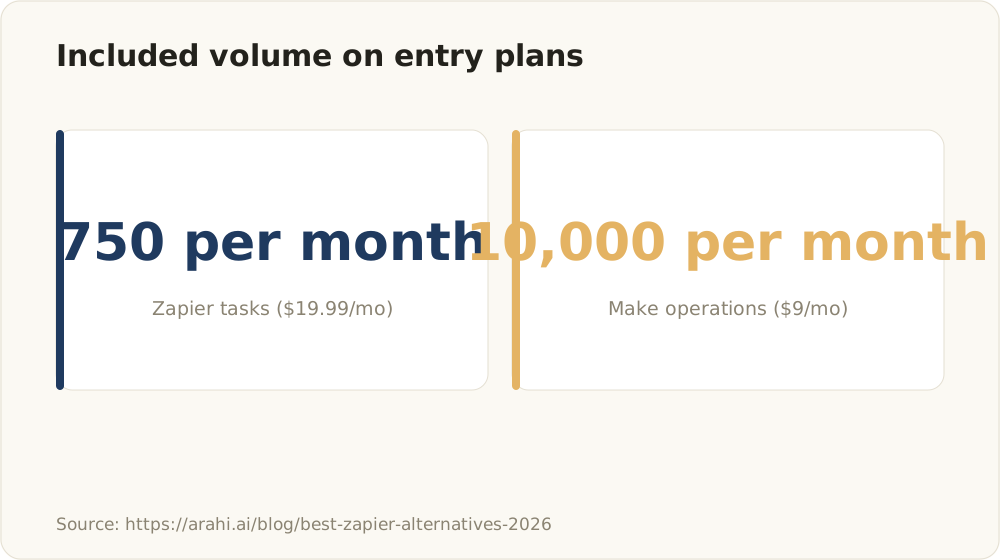
Entry-plan included volume: Zapier counts tasks, Make counts operations.
Three breaking points push teams toward Zapier alternatives. They arrive in a predictable order.
First, task-based pricing stops scaling. Zapier counts every action as a task. Task-based pricing becomes cost-prohibitive at scale - Celigo’s analysis notes that a single workflow processing 10,000 orders monthly can consume your entire task limit and force expensive tier upgrades. The math compounds fast, too: each step in a multi-step workflow counts separately, so a simple lead-processing flow that qualifies a lead, writes it to the CRM, and sends a notification burns three tasks per run. And the $19.99/month plan includes only 750 tasks.
Second, failures stay invisible. Zapier provides limited visibility into what went wrong and no built-in error lifecycle management - broken workflows go undetected until they hit operations. A silently failed invoice sync. A lead that never reached sales.
Third, governance hits a wall. Security certifications like SOC 2 and HIPAA, granular access controls, and audit logging remain less mature in Zapier’s offering than most procurement teams expect - and enterprise buyers notice fast.
The real decision is not finding a cheaper Zapier clone. It is matching your automation maturity to the right tier of tool - and recognizing when no tool is the right tier at all.
How We Ranked These Zapier Alternatives

We judged every candidate on five axes: price and pricing model (per-task, per-operation, flat, or self-hosted), scalability under real volume, developer control (code access, version control, custom logic), data handling (residency, self-hosting, compliance), and governance and observability (audit trails, error visibility, access control).
One pattern stands out in the automation communities we analyzed: when practitioners discuss alternatives, they rarely mean the same thing. Some want a cheaper like-for-like swap, some want self-hosting for data control, some want to stop fighting a no-code UI and just write code. A flat top-10 list serves none of them. So we compare four distinct categories like-for-like: no-code, low-code, code-first, and self-hosted open-source.
We judge each tool below on where it genuinely wins - not on connector counts or feature checklists. The goal is a decision, not a directory.
The Best Zapier Alternatives, Ranked
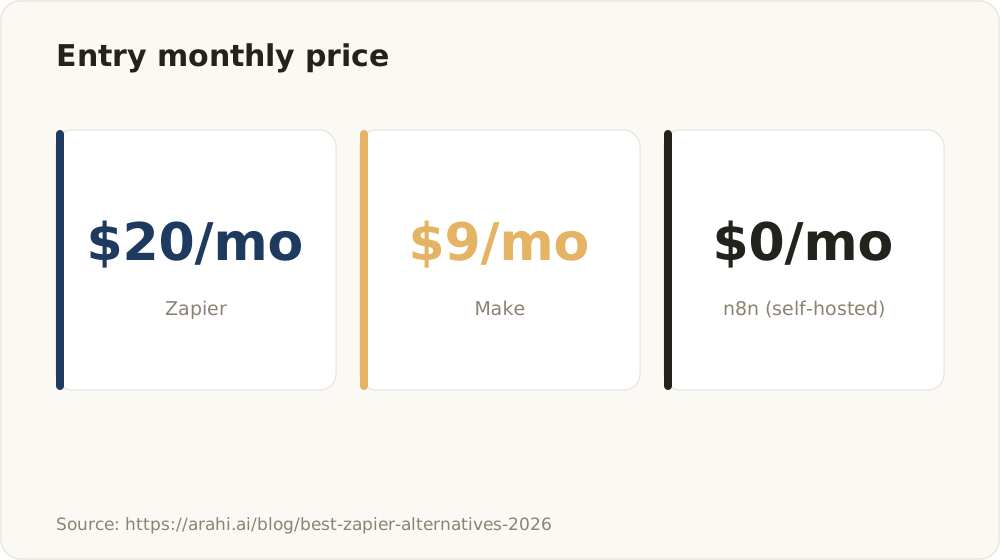
Entry monthly price: Make and self-hosted n8n undercut Zapier’s baseline plan.
We ordered this shortlist by team maturity, not raw popularity - from the easiest like-for-like swap to platforms built for serious engineering or enterprise governance needs. Three variables decide your pick: monthly volume, in-house engineering depth, and how much governance your industry demands. Bring your own numbers to the ranking.
Make: Best No-Code Alternative for Cost and Visual Logic
Make is the strongest direct swap for teams that like Zapier’s model, not its bill. It delivers visual workflows with complex branching at lower cost than Zapier, with a free tier and paid plans from $9/month.
The pricing model is the real difference. Make counts operations, not tasks, and $9/month buys 10,000 operations - compare that with Zapier’s 750 tasks at more than twice the price. Because multi-step scenarios consume operations more efficiently than Zapier consumes tasks, the same budget stretches much further once your workflows grow beyond two steps. Make also ships advanced error handling and execution history - directly addressing one of Zapier’s weakest points.
Where it loses: Make carries a steeper learning curve than Zapier, and performance degrades with extremely complex scenarios. It also remains a hosted SaaS - your data flows through Make’s infrastructure, and deep custom error handling still has a ceiling. Best for ops-led teams that want visual logic and predictable cost without engineering support.
n8n: Best Open-Source, Self-Hostable Alternative
n8n is the answer when the question shifts from “cheaper” to “ours.” It is a self-hosted option for technical teams that want control over data and infrastructure, and free when self-hosted.
Three things make it the top pick for engineering-led teams. It gives you full code access in JavaScript and Python, self-hosting for data sovereignty, and zero ongoing software costs - which decouples your automation bill from task volume entirely. For DACH and EU companies with data-residency requirements, running n8n on your own European infrastructure resolves the compliance conversation before it starts. And because n8n natively supports custom code, external libraries, and connections to internal APIs, it handles the internal-tool integrations that connector marketplaces never cover.
Where it loses: self-hosting shifts maintenance, scaling, upgrades, and uptime onto your team. If nobody owns the n8n instance, you have traded a pricing problem for an operations problem. Best for teams with at least one engineer who treats the automation layer as real infrastructure.
Pipedream: Best for Developer-First Teams
Some teams do not want a friendlier canvas - they want code, version control, and API-native building.
Pipedream targets code-first workflows: like n8n, it natively supports custom code, external libraries, and internal APIs, so engineers build integrations the way they build software instead of dragging boxes. That makes workflows testable, reviewable, and versionable - properties no pure no-code tool offers.
Where it loses: it rewards engineering literacy. An ops-only team will find the learning curve steep and the payoff slower. If your team is heading in this direction anyway, our ranked comparison of the best AI coding tools covers the tooling side of that shift toward code-first ownership.
Workato and Power Automate: Best for Enterprise Governance
At enterprise scale, the buying criteria invert: governance, auditability, and vendor accountability outweigh entry price. Both platforms appear consistently among the alternatives offering distinct strengths in security and workflow complexity.
Workato builds around recipe-based workflows and workbots that bring human-in-the-loop approvals into chat tools - useful when a payment release or contract step needs a person to sign off inside the automation. It is aimed squarely at large enterprises, which tells you the target buyer.
Power Automate wins on one axis: fit. For a company already standardized on Microsoft, keeping automation inside the same vendor relationship is usually the path of least resistance - fewer new contracts, fewer new security reviews, one less tool to justify.
Where they lose: enterprise licensing cost and deep platform lock-in. A 40-person scale-up fighting a task ceiling does not need an iPaaS procurement cycle - it needs Make or n8n. Choose these when audit requirements, not invoices, drive the evaluation.
Quick Comparison Table: Price, Scale, Control, Data
| Tool | Pricing model | Scales under volume | Developer control | Data handling | Best for |
|---|---|---|---|---|---|
| Zapier (baseline) | Per task; free tier, paid from $19.99/month | Weak - costs escalate with volume | Low | Hosted SaaS only | Simple, low-volume workflows |
| Make | Per operation; free tier, from $9/month | Good - operations stretch further | Medium | Hosted SaaS | Ops-led teams wanting visual logic at lower cost |
| n8n | Free self-hosted; paid cloud | Excellent - cost decoupled from volume | High (JS/Python code nodes) | Self-hosted, full data sovereignty | Engineering-led teams, EU data residency |
| Pipedream | Tiered plans | Good | High - code-native, versionable | Hosted SaaS | Developer-first teams building API-heavy workflows |
| Workato | Enterprise-focused | Strong | Medium | Enterprise-grade governance | Enterprises needing approvals and audit trails |
| Power Automate | Via Microsoft licensing | Strong within Microsoft stack | Medium | Microsoft cloud | Microsoft 365-centric organizations |
The Build-vs-Buy Tipping Point

Every ranking above assumes an off-the-shelf platform is the right answer. Above a certain threshold, it is not.
The tipping point arrives when a workflow becomes business-critical: it touches revenue, its failure modes are unacceptable, and “the Zap didn’t fire” is no longer an anecdote but an incident. At that point, the off-the-shelf platform becomes the risk rather than the shortcut - because there are things no hosted automation tool gives you:
- A real error lifecycle. Detection, alerting, triage, retry, resolution - not a red icon in a dashboard nobody checks.
- Idempotent retries. Replaying a failed run without duplicating an invoice or a customer email.
- Observability. Metrics, traces, and logs you query, not an execution history you scroll.
- Audit trails and ownership. Your logic in your repository, your data on your infrastructure, no per-task meter attached.
The hidden costs compound quietly. Zapier’s community-managed connectors often have limited functionality or require technical knowledge to set up, so teams pile workarounds on workarounds. And leaving is not free either: migrating away from Zapier requires careful planning, testing, and a phased cutover to minimize disruption - lock-in grows with every workflow you add.
Seen this way, a custom-built automation system is not a feature upgrade. It is an investment decision: senior technical ownership of a system you control, instead of a rented black box with a usage meter.
When a Custom Automation System Is the Right Call
Use a concrete checklist rather than instinct. Custom automation earns its cost when at least two of these apply:
- High transaction volume - per-task or per-operation pricing dominates your tooling budget.
- Compliance and data-residency requirements - GDPR, industry regulation, or customers who ask where their data lives.
- Complex multi-system orchestration - workflows spanning your CRM, ERP, internal tools, and internal APIs that connector marketplaces do not cover.
- Accountability requirements - you need to know, provably, that every order, lead, or invoice was processed exactly once.
A well-built custom system includes what the platforms leave out: a proper error lifecycle, monitoring and alerting, idempotent retries, and a clear architecture your team actually owns. Some companies build this in-house. Others bring in senior technical ownership. That’s the work we do at alloq: AI automation and workflow systems for founders and SMBs, focused on long-lived, business-critical systems rather than one-off jobs, running GDPR-compliant on European infrastructure with a stack that includes n8n itself. Who writes the code matters less than treating automation as core infrastructure, not glue.
To be clear: most teams should not build first. Start on Make or n8n, prove the workflows, then graduate selectively. Only the business-critical ones need to move into a system you own.
FAQ
What is the best free Zapier alternative?
Self-hosted n8n is the strongest free option - free when self-hosted, with no task metering and full data control. Make’s free tier suits low-volume visual workflows without any infrastructure work.
Which Zapier alternative is cheapest at scale?
Self-hosted n8n, in most cases - zero ongoing software costs mean your bill stops tracking task volume. For hosted use, Make’s 10,000 operations for $9/month beats Zapier’s per-task economics. At true scale, a custom system escapes per-task SaaS pricing entirely.
Is Make or n8n better than Zapier?
Both beat Zapier on cost predictability; they solve different problems. Make wins for ops-led teams: stronger visual branching at lower cost with no code required. n8n wins for engineering-led teams: code access, self-hosting, and data sovereignty. Pick by who will own the tool, not by feature count.
When should we build custom automation instead of using a Zapier alternative?
Build custom when a workflow is business-critical, high-volume, or compliance-sensitive, and when it needs observability and error handling that hosted tools cannot provide. The tipping point is the moment platform limits shift from inconvenience to operational risk - when a silent failure costs revenue or trust.
Do Zapier alternatives handle errors better?
Some do. Zapier offers limited failure visibility and no built-in error lifecycle management. Make adds advanced error handling and execution history, and code-first platforms expose retries and logs. But full idempotency, alerting, and audit trails only exist fully in a purpose-built system you own.