15+ Real AI Agent Examples by Industry (2026)

Most AI agent listicles recycle the same tired props: a smart thermostat, a Roomba, a vague chatbot. None of that helps you decide whether to build one. This guide does the opposite - it shows 15+ production deployments with real numbers, each broken down the same way so you can judge the fit for your own business.
These are ai agent examples that actually ship. Lyft cut resolution time by 87%. Danfoss automated over 80% of its B2B order processing. AtlantiCare saved 66 minutes per provider per day. Every entry follows one anatomy and is grouped by industry, so you can jump straight to your use case.
If you need the foundation first, our pillar covers what an AI agent actually is. This is the practical middle of a three-part cluster: definition, then examples, then how to build. Let’s get into the examples.
How to Read These Examples: Agent → Task → Tools/Data → Outcome
Every example below uses a repeatable anatomy: the agent, the concrete task it owns, the tools and data it touches, and the measurable outcome. That structure is exactly what thin roundups skip.
- Agent - the named system or agent type doing the work.
- Task - the concrete, multi-step job it completes autonomously.
- Tools/Data - APIs, CRMs, EHRs, code repos, and knowledge bases it reads and writes.
- Measurable Outcome - time saved, cost reduced, or resolution and conversion lift, where the numbers are public.
Every figure here comes from public company case studies and analyst data, not marketing claims. For a broader educational frame, IBM’s overview of cross-industry AI agent use cases maps how the same patterns repeat across support, finance, and operations.
Customer Support AI Agent Examples
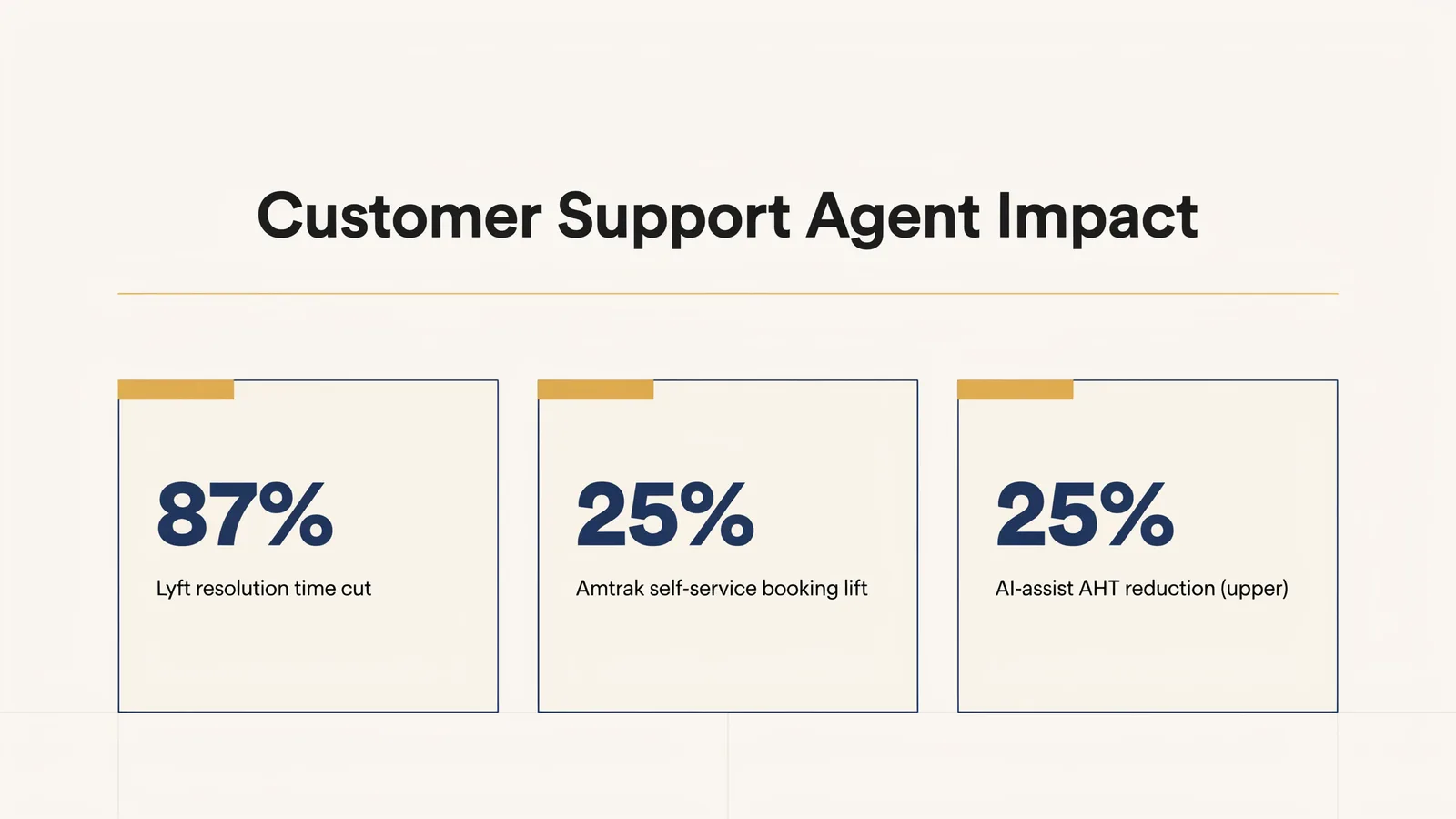
The best support agents resolve tickets end to end against live account data, not just deflect questions - Lyft’s agent cut average resolution time by 87%.
Lyft support agent. It resolves rider and driver tickets by reading the knowledge base and account data, then taking action or escalating. Tools/Data: ticketing system, knowledge base, account and trip APIs. Outcome: 87% reduction in average resolution time.
Amtrak’s virtual assistant “Julie.” It handles booking questions and guides travelers through reservations. Tools/Data: booking engine, schedule data, FAQ knowledge base. Outcome: over 5 million questions handled per year and a 25% lift in self-service bookings - figures Amtrak reported as early as 2012, which makes Julie one of the longest-running deployments on this list.
Klarna’s AI assistant. Built on OpenAI models, it resolves customer inquiries, manages refunds and returns, and updates records in real time. Tools/Data: order and payment systems, customer records, knowledge base. Outcome: handled two-thirds of customer service chats in its first month - work equivalent to roughly 700 full-time agents. The follow-up matters just as much: in May 2025, Klarna started hiring human agents again for complex cases, with CEO Sebastian Siemiatkowski admitting the company had focused too heavily on efficiency and cost. That course correction confirms the pattern this guide keeps returning to - disciplined escalation to humans, not full automation, is what lasts.
Sierra. Enterprise customer-experience agents that handle voice and text support end to end, integrating with backend systems to process returns, check inventory, and resolve multi-step conversations autonomously. Tools/Data: CRM, order management, inventory and logistics APIs. Outcome: autonomous resolution of routine cases with human handoff on the exceptions.
Across support teams, AI-assist typically drives 15-25% reductions in average handling time when scoped to high-frequency ticket types. The pattern that keeps these agents reliable is disciplined escalation: the agent owns the routine 80% and hands off edge cases to a human with full context. For a deeper strategy walkthrough, see our guide to automated customer service with AI agents.
Sales AI Agent Examples
The strongest sales agents own a narrow slice of the pipeline - enrichment, outreach, and CRM hygiene - so reps spend more time selling and less time on admin.
SDR/prospecting agent. It enriches inbound and outbound leads, writes personalized outreach sequences, schedules meetings, and keeps the CRM clean in a continuous loop. Tools/Data: CRM (HubSpot or Salesforce), enrichment APIs, email and calendar, web search. Outcome: faster lead response and cleaner pipeline data, with rep hours reclaimed for actual conversations.
Sales research agent. It compiles account briefs before calls, pulling context from the web, LinkedIn, and CRM history into a single summary. Tools/Data: web search, CRM, professional network data. Outcome: reps walk into calls prepared without an hour of manual research each.
The caution here is real: outbound tone and data accuracy need guardrails. An agent that hallucinates a prospect’s job title or fabricates a fact damages trust faster than a slow SDR ever could. Constrain the agent to verified data sources and review templates before they go live.
Research & Data AI Agent Examples
Research agents replace hours of manual searching with an autonomous loop that plans queries, reads sources, and synthesizes an answer - the pattern behind most “deep research” tools.
Perplexity Deep Research. Given a question, it runs dozens of searches in parallel, iteratively reads and cross-checks sources, and produces a structured report with citations. Tools/Data: web search, browsing, source ranking. Outcome: research that once took hours compressed into minutes, with traceable sources.
OpenAI Deep Research. A research mode in ChatGPT that plans a multi-step research task, browses the web autonomously over several minutes, and synthesizes a long, cited answer. Tools/Data: web browsing, document reading, source citation. Outcome: analyst-grade briefs from a single prompt, with sources you can verify.
The reliability lever here is grounding: an answer is only as trustworthy as the sources it cites and the freshness of the data it queries. Research agents that show their sources are auditable; ones that don’t are just confident guesses.
Operations & Supply Chain AI Agent Examples
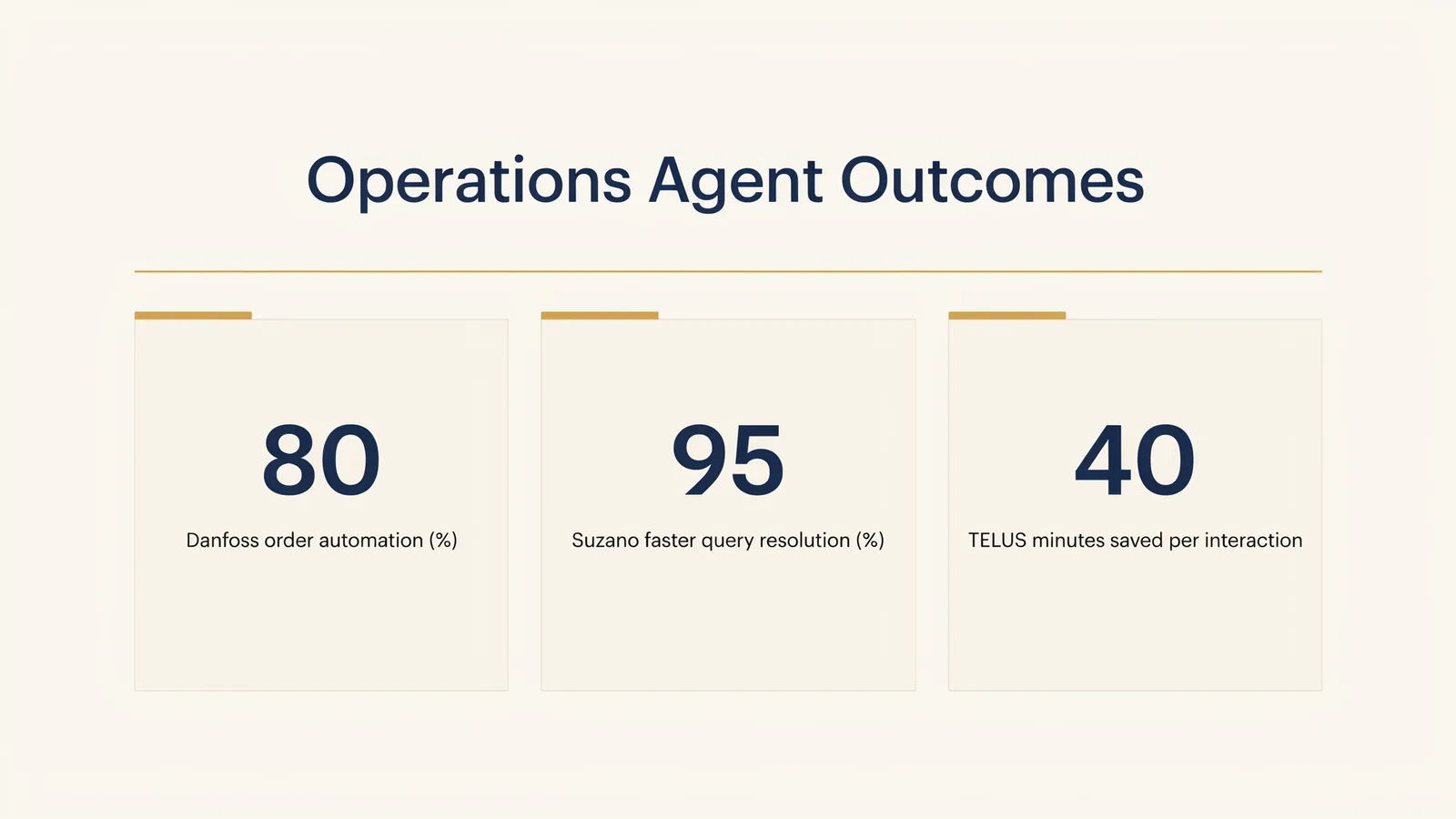
Operations agents win on throughput and cycle time, not headcount - they process high-volume, rules-heavy work that would otherwise queue.
Danfoss. Its agents automated over 80% of B2B order processing, reading incoming orders and pushing them through the order management system. Tools/Data: ERP, order management, email intake. Outcome: 80%+ order automation.
Suzano. A text-to-SQL agent built on Gemini Pro turns natural-language questions into SQL queries against supply chain data, replacing hours of digging through documentation. Tools/Data: structured supply chain databases, natural-language-to-SQL layer on Gemini Pro. Outcome: 95% reduction in query time.
TELUS. Agents deployed across 57,000+ employees handle internal requests and information lookups. Tools/Data: internal knowledge bases, ticketing, HR and IT systems. Outcome: roughly 40 minutes saved per AI interaction.
The common thread: these agents attack cycle time on repetitive internal work. They don’t replace teams - they remove the queue that slows teams down.
Finance AI Agent Examples
Finance agents compress hours of document and data work into minutes while keeping a full audit trail - the non-negotiable in regulated workflows.
JP Morgan COiN. Back in 2017, this classic machine-learning system reviewed legal and loan documents, a task that once consumed lawyers thousands of hours. Tools/Data: document stores, contract templates, risk models. Outcome: review time dropped from thousands of hours to a fraction, with higher consistency. That precursor has since grown into JP Morgan’s LLM Suite, which now serves 230,000+ users across 450+ use cases.
Uber’s financial data agent. It answers finance-team data questions across internal systems using a natural-language-to-query layer. Tools/Data: structured financial databases, internal data platforms. Outcome: self-serve analytics that removes the analyst bottleneck. You can cross-check this and other named deployments in these documented agent deployments from top companies.
For regulated finance, compliance and audit trails aren’t optional. Every action the agent takes needs to be logged, explainable, and reversible - design that in from day one or the pilot never reaches production.
Software Engineering AI Agent Examples

Coding agents now plan and execute multi-step development tasks, but human review still owns every merge - that division is what makes them safe to ship.
Devin. An autonomous coding agent that plans and executes end-to-end dev tasks, from setup to implementation. Tools/Data: code repositories, terminal, browser, CI/CD. Outcome: faster feature scaffolding on well-scoped tickets.
Cursor. An AI coding agent operating inside the editor with full codebase context. Tools/Data: local codebase, git, language servers. Outcome: faster edits and refactors across large repos.
KaneAI (by TestMu AI, formerly LambdaTest). It automates software testing from natural-language intent, turning plain-English test cases into executable suites. Tools/Data: test frameworks, CI/CD, issue trackers. Outcome: broader test coverage with less manual authoring.
GitHub Copilot coding agent. Assigned a GitHub issue, it investigates the codebase, implements a fix on its own branch, runs the tests, and opens a pull request for human review. Tools/Data: code repository, GitHub Actions/CI, issue tracker. Outcome: routine, well-scoped issues cleared without a developer starting from a blank editor.
If you want to explore working code across frameworks, a curated repository of 500+ AI agent projects collects production and experimental examples in one place. The principle to hold onto: agents draft, humans approve. A senior engineer still owns the merge and the architecture around it.
Healthcare AI Agent Examples
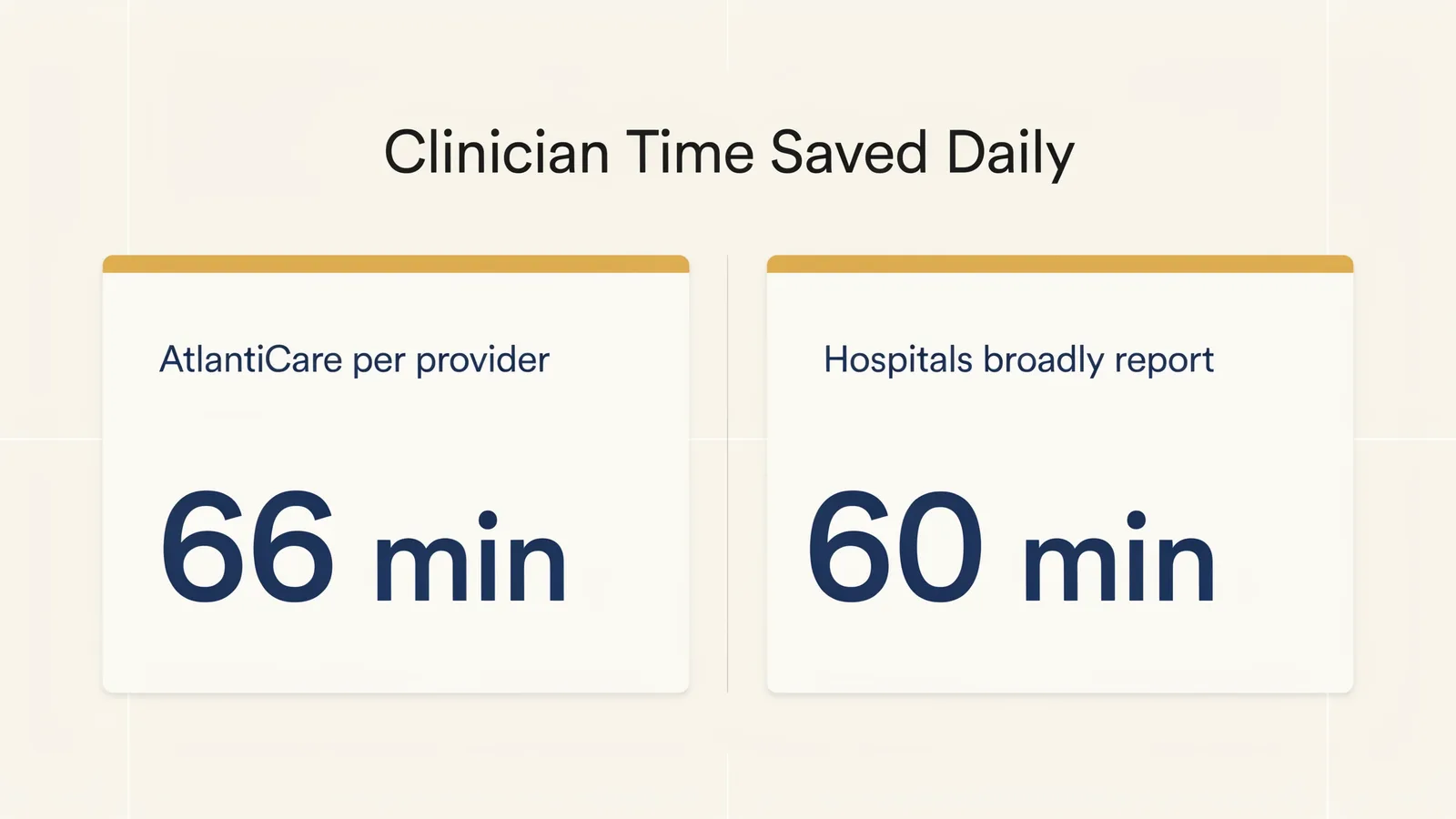
Healthcare agents cut documentation burden and speed prioritization while keeping the clinician firmly in the loop - the human never leaves the decision.
Clinical documentation agents (Oracle Health Clinical AI Agent; ambient scribes like Nabla and Microsoft Dragon Copilot, formerly Nuance DAX). The agent listens to a patient-provider conversation and writes structured notes directly into the EHR. Tools/Data: patient-provider audio, EHR, structured SOAP note templates. Outcome: AtlantiCare documented 66 minutes saved per provider daily with Oracle’s Clinical AI Agent - a 41-42% cut in documentation time across 6,000+ analyzed visits. Ambient scribes deliver more modest but real gains: a randomized trial with 238 physicians measured roughly 10% less documentation time.
Imaging triage agent. It acts as a first-pass filter, flagging urgent scans so radiologists see them first. Tools/Data: imaging systems, prioritization models. Outcome: faster prioritization of critical cases - the agent triages, the radiologist diagnoses.
Data privacy and human oversight are the hard constraints here. Patient data demands strict access scoping, and no agent makes a clinical decision alone. These systems assist; they never replace judgment.
E-commerce AI Agent Examples
E-commerce agents lift self-service resolution and support conversion by acting on catalog and order data - not just answering, but doing.
Product-knowledge/shopping assistant. It answers product questions and guides purchase decisions from live catalog data. Tools/Data: product catalog, inventory, customer history. Outcome: higher conversion support and fewer abandoned carts.
Order and returns agent. It handles order status, refunds, and exchanges against commerce and payment systems. Tools/Data: order management, payment and logistics APIs, customer records. Outcome: higher self-service resolution and lower cost-to-serve.
The critical design note: scope read and write actions tightly. An order agent that can issue refunds needs strict limits and confirmation steps - one loose permission and it processes refunds nobody approved. Read access is cheap; write access earns its guardrails.
15+ AI Agent Examples at a Glance
Here are all the examples mapped to their tools and measurable outcomes in one scannable view.
| Industry | Agent / Task | Tools & Data | Measurable Outcome |
|---|---|---|---|
| Support | Lyft ticket resolution | Ticketing, KB, account APIs | 87% faster resolution |
| Support | Amtrak “Julie” bookings | Booking engine, FAQ KB | 5M+ questions/yr, +25% self-service (2012 figures) |
| Support | Klarna AI assistant | Order/payment systems, KB | 2/3 of chats, ~700 agents’ work |
| Support | Sierra CX agents | CRM, order/inventory APIs | Autonomous multi-step resolution |
| Sales | SDR/prospecting agent | CRM, enrichment, email/calendar | Faster response, cleaner pipeline |
| Sales | Account research agent | Web, LinkedIn, CRM | Call-ready briefs, hours saved |
| Research | Perplexity Deep Research | Web search, source ranking | Hours of research → minutes, cited |
| Research | OpenAI Deep Research | Web browsing, citation | Analyst-grade cited briefs |
| Operations | Danfoss order processing | ERP, order management | 80%+ orders automated |
| Operations | Suzano text-to-SQL agent | Supply chain DBs, Gemini Pro | 95% faster query time |
| Operations | TELUS internal agents | KB, ticketing, HR/IT | ~40 min saved per interaction |
| Finance | JP Morgan COiN (2017) | Document stores, risk models | Thousands of hours → minutes |
| Finance | Uber financial data agent | Financial DBs, NL-to-query | Self-serve analytics |
| Software | Devin coding agent | Repos, terminal, CI/CD | Faster feature scaffolding |
| Software | Cursor editor agent | Codebase, git | Faster refactors at scale |
| Software | KaneAI (TestMu AI) testing | Test frameworks, CI/CD | Broader coverage, less manual work |
| Software | GitHub Copilot coding agent | Repo, CI, issue tracker | Issues cleared to a review-ready PR |
| Healthcare | Oracle Health Clinical AI Agent | Audio, EHR, SOAP templates | 66 min/provider/day saved (AtlantiCare) |
| Healthcare | Imaging triage | Imaging systems, models | Faster urgent-case prioritization |
| E-commerce | Shopping assistant | Catalog, customer history | Conversion support |
| E-commerce | Returns agent | Order, payment, logistics APIs | Higher self-service, lower cost |
Gartner expects 40% of enterprise apps to feature task-specific AI agents by 2026, up from under 5% in 2025 - which is why this shift is moving from experiment to standard practice.
What the Best AI Agent Examples Have in Common
The best ai agent examples share four patterns, and none of them is about picking a fancier model.
- A narrow, high-frequency task. Winners own one repetitive job well - resolving tickets, processing orders - not “do everything.”
- Real tool and data access. They read and write to systems of record through APIs. A chat wrapper with no data access is not an agent.
- Guardrails and human-in-the-loop. High-stakes actions - refunds, merges, clinical notes - keep a human on the decision.
- A measurable baseline. You can only prove an 87% improvement if you measured the “before.”
Here’s where most pilots stall, and it’s worth stating plainly: the model is rarely the problem. Integration and evaluation are. Connecting an agent to your CRM, ERP, or EHR - and proving it works against a real baseline - is the hard, senior engineering work that separates a demo from production.
From Example to Implementation: Getting an Agent Built
Start by finding your highest-frequency, rules-heavy task and mapping the exact tools and data an agent would need to touch. If that task has a measurable baseline and clear inputs, it’s a candidate.
Then decide build, buy, or partner. Off-the-shelf agents fit generic workflows, but anything tied to your proprietary data and processes needs custom integration. For growth-stage teams that treat software as an investment, the deciding factor is ownership: architecture, integration, evaluation, and accountability after launch. Weigh that against hiring senior engineers to build and scale it in-house versus partnering with a studio that stays accountable.
Whichever path you choose, the outcome depends on senior technical ownership - not cheap freelancers or AI-generated code fixes. The next article in this cluster walks through getting a working system built, from scoping the first agent to shipping it.
Frequently Asked Questions
What is an example of an AI agent? Devin is a clear one: an autonomous coding agent that plans and executes an end-to-end development task - reading a repository, writing code, running tests, and opening a pull request for review. Unlike a chatbot that only answers text, an agent takes multi-step actions across real tools and data to complete a job.
Who are the big 4 AI agents? There is no official “big four,” but the agents cited most often in 2026 span four categories: coding (Devin, GitHub Copilot coding agent, Cursor), customer experience (Sierra, Klarna’s assistant), research (Perplexity and OpenAI Deep Research), and enterprise data (Uber’s financial data agent). Which “four” matter depends entirely on the task you are automating.
What are the 5 types of AI agents? Classic AI theory defines five: simple reflex agents, model-based reflex agents, goal-based agents, utility-based agents, and learning agents. The modern LLM-powered agents in this guide are mostly goal-based and learning agents - they pursue an objective, use tools and data, and improve against feedback.
Is ChatGPT an AI agent? Plain ChatGPT is a chatbot: it answers from text. In agent mode - with browsing, code execution, or tool use - it plans and takes multi-step actions across real systems, which makes it function as an agent. The dividing line is whether it only responds or actually does work against external tools and data.
What is an AI agent example in real life? A clinical documentation agent is a clear one: it listens to a patient visit and writes structured EHR notes automatically - AtlantiCare measured 66 minutes saved per provider daily with Oracle Health’s Clinical AI Agent. Unlike a static chatbot that only answers text, an agent takes actions across real tools and data.
What is the difference between an AI agent and a chatbot? A chatbot answers questions from text. An agent plans multi-step tasks, calls tools and APIs, reads and writes real business data, and completes work - like processing an order or resolving a support ticket end to end. Our pillar on what an AI agent actually is covers the full definition.
What are the best AI agent examples for a business? The best target narrow, high-frequency tasks with clear baselines: support ticket resolution, order processing, lead enrichment, document review, and code testing. Value comes from integration and measurable outcomes, not which model you pick.
Do AI agents actually deliver measurable ROI? Yes, when scoped well. Lyft cut resolution time 87%, Danfoss automated 80%+ of order processing, Suzano cut supply chain query time 95%, and AtlantiCare saved 66 minutes per provider daily with Oracle Health’s Clinical AI Agent. Every one of those numbers required a measured baseline to prove.
Which industries use AI agents the most in 2026? Customer support, sales, operations and supply chain, finance, software engineering, healthcare, and e-commerce lead adoption. Gartner projects 40% of enterprise apps will feature task-specific agents by 2026.