Autonomous AI Agents: Levels, Architecture & Safety

TL;DR: An AI agent is autonomous when it can perceive context, plan multi-step actions, and execute them toward a goal with limited human input. Real autonomy sits on a scale (L0-L5), not a binary. Production-grade autonomy needs an architecture that separates reasoning from execution, plus enforced safety guardrails: pre-action review, policy-as-code, audit logs, and an independent kill switch.
What Makes an AI Agent Autonomous?
Autonomous AI agents combine four capabilities: perceiving their environment, reasoning toward a goal, planning multi-step actions, executing those actions with limited ongoing supervision. Drop any one of the four. What’s left is a tool, not an agent.
A chatbot responds when you prompt it. A scripted workflow runs a fixed sequence. An autonomous agent decides what to do next based on the goal and the current state, then adapts when that state shifts. That decision loop is the whole point. Want the foundational primer first? Start with what AI agents are before diving into autonomy.
This guide covers three things most vendor content skips: a graded model of autonomy levels, the architecture that makes autonomy work in production, and the safety guardrails that keep it under control. We keep it vendor-neutral. If you’re a CTO or founder deciding whether to build autonomous AI agents, you need the underlying model - not a feature list for someone’s platform.
Autonomy vs. Automation: Why Most “Agents” Aren’t Autonomous

The test is simple: can the system decide its next action without a pre-scripted path? If every branch was written in advance, that’s automation. If the system plans, acts, observes the result, and revises its plan, that’s autonomy.
Deterministic automation - the Zapier-style “when X happens, do Y” pattern - is valuable and often the right choice. Predictable. Cheap to run. Easy to audit. But it breaks the moment reality deviates from the script.
The skepticism around “agents” is largely justified. A significant share of products marketed as agents turn out to be LLM wrappers: a prompt, a model call, a fixed post-processing step. We’ve evaluated systems like this for clients, and the tell is always the same - no planning loop, no memory, no ability to recover from an unexpected tool result. Calling that autonomous sets the wrong expectations with your team and your customers.
Autonomy is a spectrum, not a label. That’s the honest framing. Which brings us to the levels.
The 6 Levels of Autonomy (L0-L5)
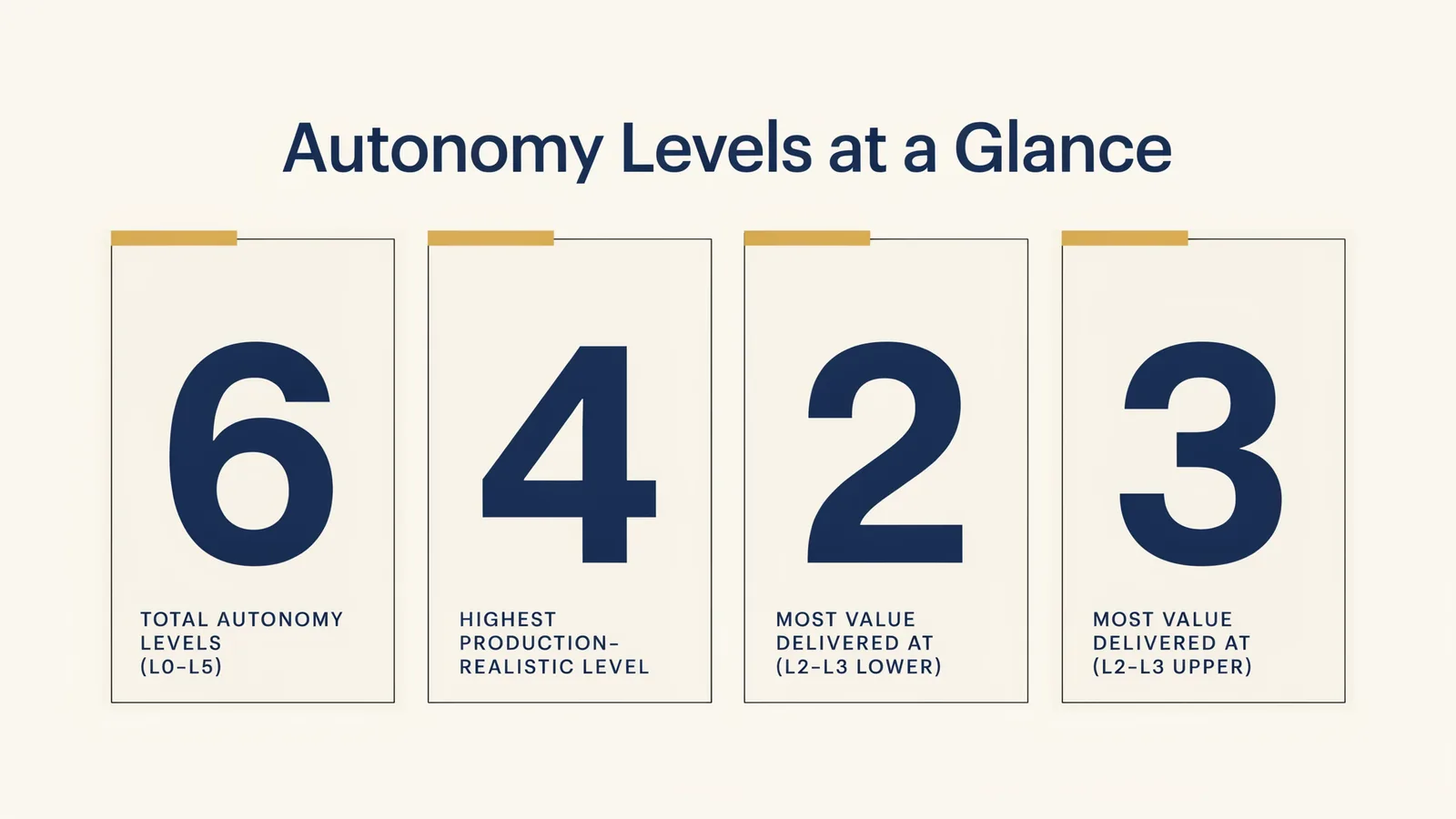
Borrow the six-level framing from self-driving cars and you get a way to grade how much decision authority the agent holds, and how the human role shifts alongside it. The Cloud Security Alliance’s autonomy-level taxonomy is a useful reference here - it ties each level to concrete governance controls rather than marketing tiers.
| Level | Name | Who decides | Human role |
|---|---|---|---|
| L0 | Manual | Human | Does the work |
| L1 | Assisted | Human | Uses AI suggestions |
| L2 | Supervised | AI proposes, human approves | Approves each action |
| L3 | Conditional | AI acts within defined bounds | Handles escalations |
| L4 | Autonomous | AI acts across broad scope | Monitors, handles exceptions |
| L5 | Full autonomy | AI sets goals | Strategic oversight only |
Two points from that taxonomy are worth calling out. At Level 4, the agent operates autonomously across a broad scope; the human role shifts from approving decisions to monitoring and handling exceptions. Level 5 goes further still: full autonomy, an agent that sets its own goals and potentially modifies its own behavior.
Guardrails scale with the level. That’s the critical insight. An L2 agent needs a clean approval UI. An L4 agent needs machine-readable boundary definitions, enforcement mechanisms, escalation workflows, comprehensive logging - because nobody reviews individual actions anymore.
Be realistic about 2026. Practitioners building safety cases for deployed agents reserve true L4 for narrowly scoped, low-consequence actions. L5 stays out of scope for anything production-grade. In our experience, most deployments delivering real value today run at L2-L3. For concrete illustrations of what each tier looks like in practice, see these real AI agent examples by industry.
Core Architecture of Autonomous AI Agents
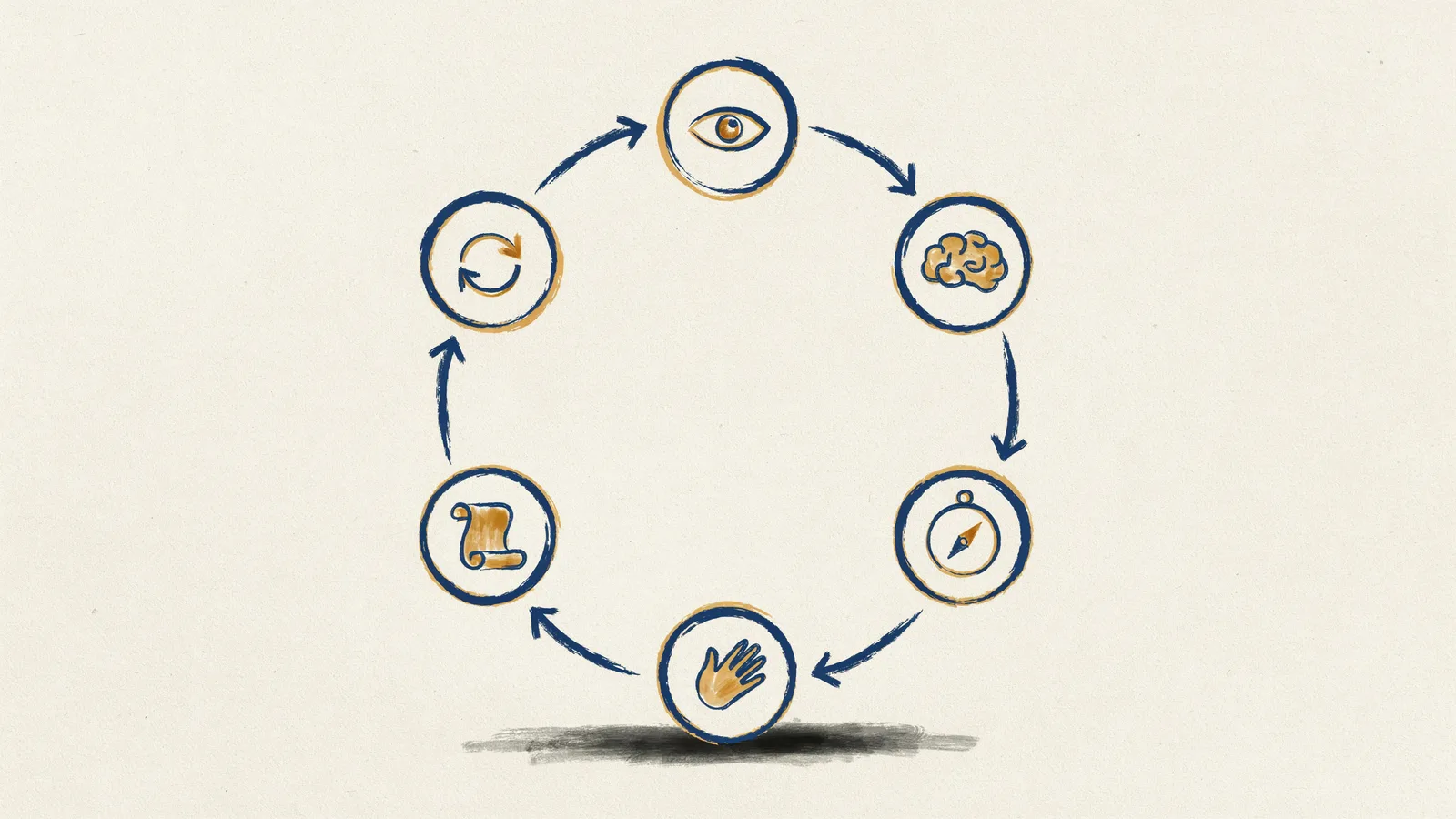
Most autonomous agents run some variant of the same loop: Perception → Reasoning → Planning → Action → Memory → Feedback. Reactive and hierarchical architectures rearrange or collapse some of these stages, but the functions still show up somewhere. The model reasons; the surrounding system is what makes it an agent.
Here’s what each stage does:
- Perception ingests context: user input, retrieved documents, API responses, system state.
- Reasoning interprets the goal against that context and selects a strategy.
- Planning decomposes the goal into concrete steps and orders them.
- Action executes steps through tool use - function calls to APIs, databases, and internal systems. This is the bridge between text and the real world.
- Memory persists what happened. Short-term memory holds the current task context; long-term memory holds facts, preferences, and outcomes across sessions.
- Feedback compares results against expectations and triggers replanning when they diverge.
When teams set out to build autonomous AI agents, the model is rarely the hard part. Context management is. In our work with enterprise clients, the pattern repeats: someone points an agent at fragmented data spread across a dozen systems without a semantic layer, and the agent produces confidently wrong answers because the same field means three different things in three databases. We’ve also watched static ontology projects go stale before they even ship - the business changes what fields mean faster than the modeling team can freeze them. Agents need context that updates continuously, not a knowledge model frozen at design time.
Budget accordingly. In our experience, the bulk of the effort goes into data access, permissions, and context quality - not the agent loop itself.
Cognitive-Executive Separation: Why Reasoning Should Never Directly Act
Structurally separate the component that reasons from the component that executes. That’s the single most important architectural safety principle here. The reasoning model proposes actions; an independent executor validates and performs them.
Think of it this way: safety properties need to hold even if the reasoning model gets compromised - by prompt injection, jailbreaks, or plain hallucination. Three mechanisms broadly deliver that guarantee:
- Independent validators check every proposed action against policy before execution, outside the model’s influence.
- Information flow control restricts what data can reach which tools, so a poisoned input cannot exfiltrate through an outbound call.
- Reversible execution ensures actions can roll back - drafts before sends, staging before production, soft deletes before hard ones.
The practical implication for your team: never hand the LLM direct credentials to production systems. Route every action through a validation layer with its own permission scopes. This one decision separates a demo from a system you can defend in a security review.
Safety Guardrails: Keeping Autonomous AI Agents Under Control

Effective AI agent safety guardrails group into four oversight functions: pre-action review, policy authoring, post-action audit, and an emergency interrupt that operates independently of the agent’s own software stack.
That last point deserves emphasis. A kill switch living inside the agent’s runtime fails exactly when you need it most - when the runtime itself misbehaves. Build the interrupt as a separate control plane. No exceptions.
In practice, the guardrail stack looks like this:
- Policy-as-code: machine-readable rules defining what the agent may do, at what scope, under which conditions - versioned and testable like any other code.
- Authorization scopes: the agent gets the minimum permissions for its task tier, never a service account with broad access.
- Idempotency and replay logging: every action is safely retryable and every decision is reconstructable after the fact.
- Human-in-the-loop escalation: the agent recognizes its own uncertainty and surfaces ambiguous cases proactively. In our view this is itself a safety property that complements external safeguards - an agent that knows when to ask beats an agent that always answers.
Governance frameworks reinforce the same structure. The NIST AI Risk Management Framework and ISO/IEC 42001 both demand documented oversight and risk controls; EU AI Act obligations require human oversight and logging for high-risk systems. Build these four functions from day one and compliance becomes documentation, not re-architecture.
When (and When Not) to Deploy Higher Autonomy
Run a three-factor test: consequence of error × reversibility × scope. High consequence, irreversible, broad scope? Low autonomy, L1-L2. Low consequence, reversible, narrow scope? L3-L4 is fair game.
Start every high-stakes workflow at L2 with human approval. Build evals from real approval decisions. Raise autonomy only when the eval data backs it up. Teams that skip this and launch straight at L4 tend to retreat after the first costly error - and lose organizational trust that takes months to rebuild.
Where does the investment actually go, at least among the enterprises we work with? Internal agents get the early focus - research assistance, ops workflows, reporting - because errors stay inside the building and reversibility is high. Customer-facing agents demand stricter guardrails. If that’s your use case, our guide to automated customer service agents covers the specific escalation patterns that work.
For growth-stage companies, the build-vs-buy question hinges on the architecture above. Off-the-shelf platforms handle L1-L2 assistance well. Once you need L3 autonomy over your own systems and data, though, someone has to build the semantic layer, validators, and guardrails around your specific stack - and that takes senior engineering judgment, in-house or through a partner. Our guide to choosing an AI agent development partner breaks down how to evaluate that decision.
FAQ
What are autonomous AI agents? Autonomous AI agents are software systems that perceive their environment, reason about a goal, plan multi-step actions, and execute them with limited human supervision. They differ from chatbots and scripted automation because they decide their next action dynamically instead of following a fixed path.
What are the levels of autonomy for AI agents? A common scale runs from L0 (manual) to L5 (full autonomy). Human involvement shifts progressively: doing the work (L0-L1), approving each action (L2), handling escalations (L3), monitoring exceptions (L4), and strategic oversight only (L5). In our experience, most production deployments in 2026 run at L2-L3.
Are autonomous AI agents safe? They can be, when guardrails are enforced: pre-action validation, policy-as-code, scoped permissions, audit logging, and a kill switch independent of the agent’s own stack. Safety scales with controls - higher autonomy levels require structurally stronger guardrails, not just better prompts.
What’s the difference between an autonomous agent and workflow automation? Automation follows a fixed, pre-scripted path and breaks when reality deviates from it. An autonomous agent plans its own steps, adapts when a step fails, and handles cases nobody explicitly programmed.
How do you build an autonomous AI agent? Implement the loop of perception, reasoning, planning, tool use, and memory - then separate reasoning from execution, add independent validation and scoped permissions, and build evals before raising autonomy. Expect most of the effort to go into data access and context quality, not the model itself.