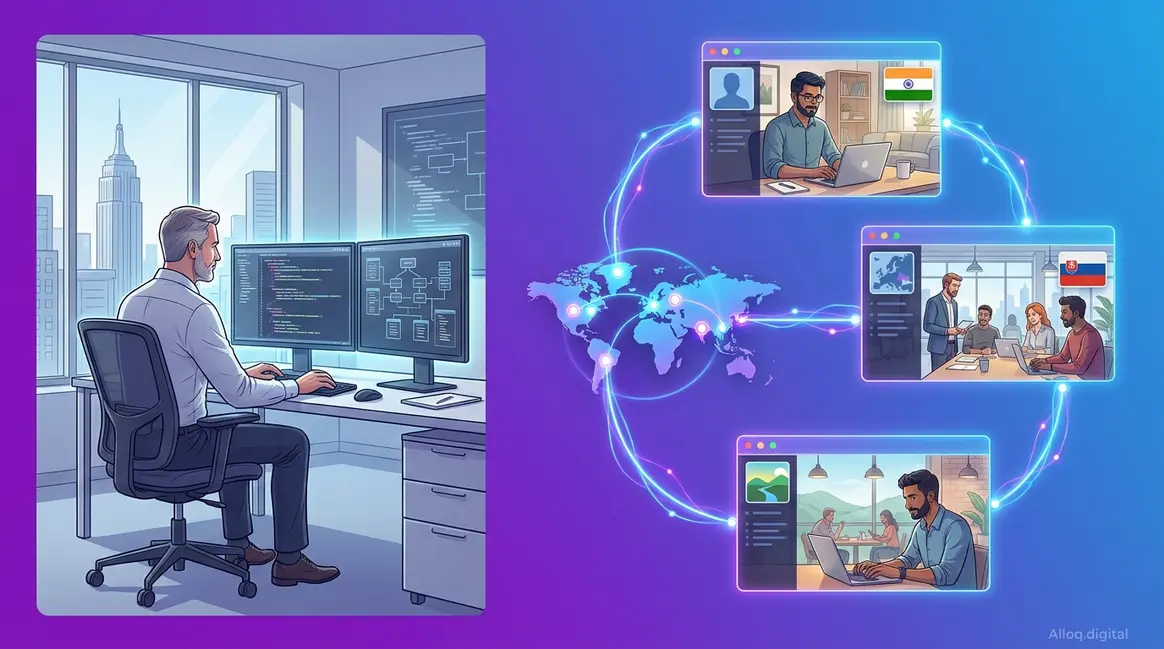
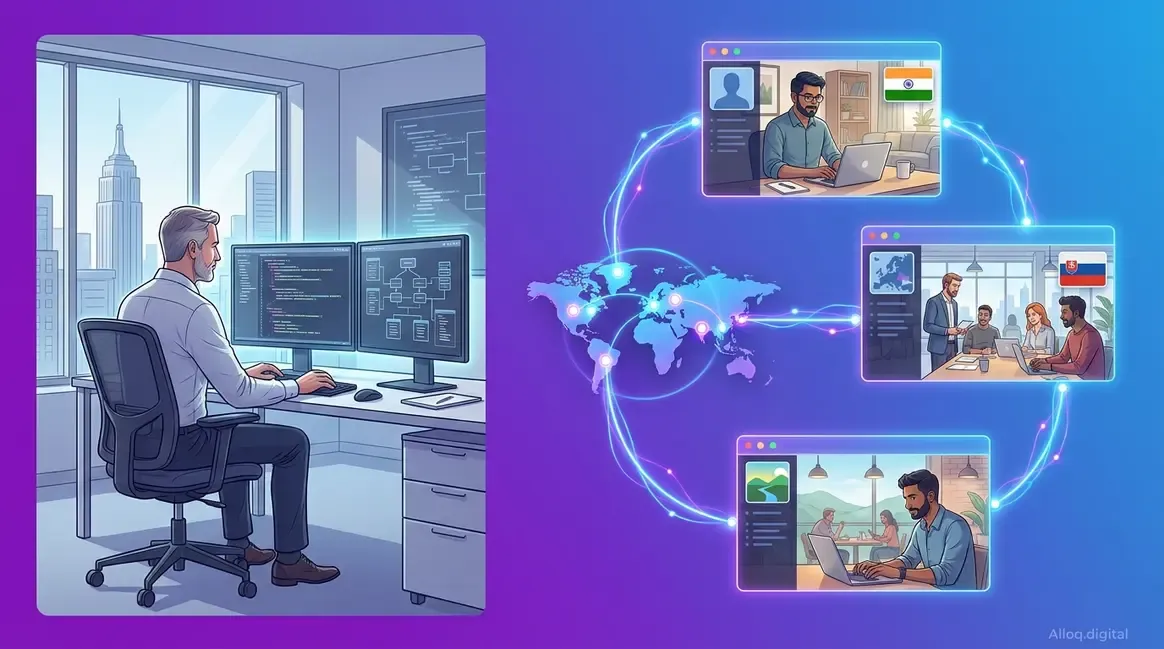
Your US-based senior engineer bills $120–$180 per hour. Your Eastern European counterpart - same experience, comparable output quality - bills $40–$70. For a five-person engineering team, that spread compounds to over $500,000 a year in salary difference. That’s not a rounding error. It’s a strategic lever most CTOs leave untouched because offshore development still carries a reputation built on horror stories from early outsourcing days.
Today, that reputation is largely obsolete. The global IT outsourcing market is valued at $462 billion (Coherent Market Insights) and is growing at 9.3% annually - driven not by desperation but by deliberate, governance-led strategies that leading technology companies use to scale engineering capacity without sacrificing code quality. This guide unpacks exactly how they do it.
You’ll find a plain-English breakdown of what offshore development actually is, how to compare delivery models, what current rates look like by region, which countries lead the market, what you can realistically build offshore, and - critically - a three-layer governance framework that separates the CTOs who get great results from those who write Medium posts warning everyone else.
Key Takeaways
Offshore software development delivers 40–70% cost savings versus onshore teams while giving companies access to a global talent pool of more than 5 million engineers across India, Eastern Europe, Latin America, and Southeast Asia.
- Cost advantage is real but narrow without governance: Offshore teams deliver 40–70% savings (Mismo.team), but hidden costs - onboarding, coordination overhead, management bandwidth - can erode 15–25% of that margin if unmanaged.
- The Offshore Governance Stack matters: A three-layer framework covering Legal, Technical, and Operational controls is what separates repeatable delivery from one-off disasters.
- Three primary models exist: Onshore, nearshore, and offshore serve different business needs; selecting the wrong model is the most common - and most expensive - early mistake.
- Current rate reality: India runs $20–$65/hour, Eastern Europe $30–$80/hour, and Latin America $25–$55/hour - with significant variance by seniority and project type.
What Is Offshore Software Development?
 Offshore software development connects companies with engineering teams worldwide, powered by timezone-agnostic collaboration tools like GitHub, Jira, and Slack.
Offshore software development means contracting software engineers, development teams, or entire engineering departments located in a different country - typically one with significantly lower labour costs - to build, maintain, or scale your digital products. The relationship can take the form of a dedicated team working exclusively on your codebase, a project-based fixed-scope contract, or a hybrid staff augmentation model where offshore developers slot into your existing squads.
The practice is not new. What has changed recently is the combination of mature tooling (GitHub, Jira, Slack, Loom, Figma - all timezone-agnostic), AI-augmented code review, and a generation of offshore engineering managers who trained at Google, Microsoft, or Thoughtworks before returning home. The vendor quality ceiling has risen substantially. The floor, unfortunately, has not. The $634 billion IT outsourcing market confirms this reality - offshore development is now a mandatory scaling lever, not just a budget compromise.
How Offshore Development Works
A typical offshore engagement begins with a discovery phase - the client documents requirements, the vendor sizes the effort, and both parties agree on a delivery model and governance structure. From there, engineers are onboarded to client systems under a signed NDA and IP assignment agreement, access controls are configured, and sprint-based delivery begins.
The client retains a product owner or technical lead internally. The offshore team runs its own daily standups in a shared project management tool, participates in sprint planning and retrospectives, and delivers code via pull requests reviewed by both sides. Communication happens asynchronously for routine updates and synchronously during overlapping hours - typically a two-to-four-hour daily window, depending on the time zone spread.
For the global IT outsourcing market, projected IT outsourcing revenue reaching $634 billion confirms this is no niche practice - it is how a significant share of the world’s software gets built.
Four Benefits Driving the Decision
Cost reduction is the obvious driver. Businesses consistently save 40–70% on labour costs compared to equivalent US or Western European headcount - that’s a first-year saving of $50,000–$100,000 per developer at mid-senior level.
Talent access matters just as much. The US alone faces a shortage of over a million software engineers. India produces more than 1.5 million IT graduates annually; Ukraine has 290,000 tech professionals; Vietnam’s developer pool exceeds 500,000. Offshore development is not a compromise on talent - for many companies it is the only path to finding specialised skills at all.
Speed to scale is the third lever. Hiring two onshore engineers takes three to five months end-to-end. A reputable offshore vendor can staff a five-person dedicated team in four to six weeks.
Time-zone coverage rounds out the list. For products with global user bases, an offshore team in Southeast Asia or Eastern Europe can run overnight CI/CD pipelines, monitor production systems, and respond to incidents while your onshore team sleeps - de facto 24-hour engineering coverage without paying for it twice.
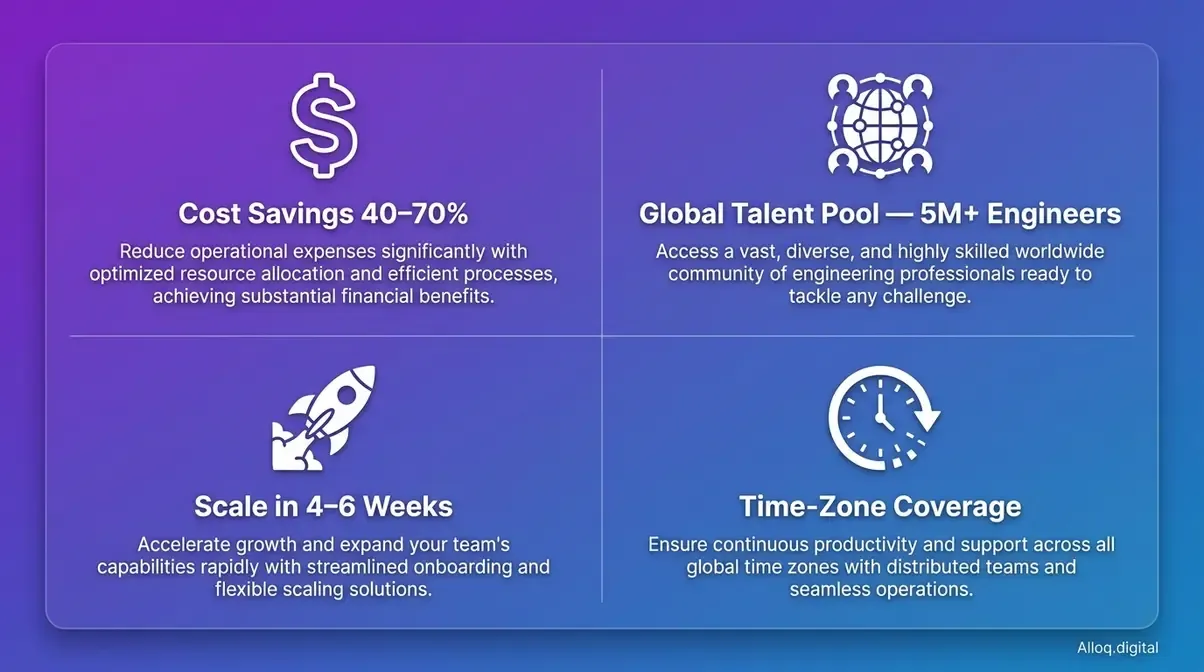 The four strategic drivers behind offshore software development - cost, talent, speed, and coverage - form the basis of every sound offshoring decision.
Onshore vs. Offshore vs. Nearshore
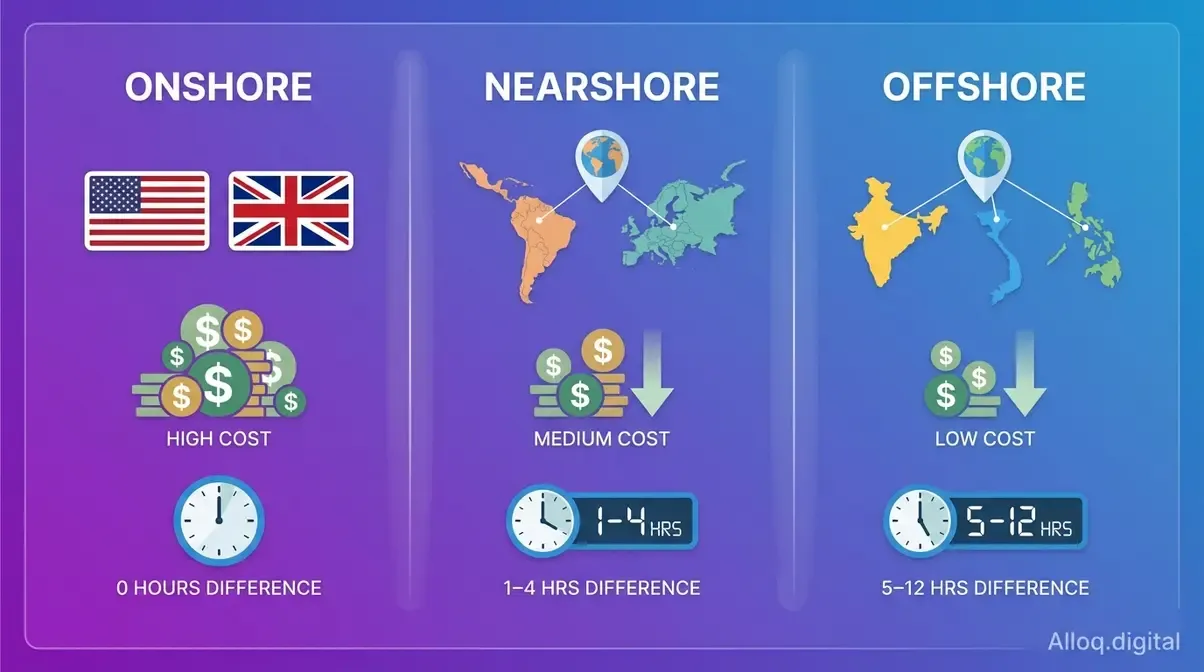 The three delivery models - onshore, nearshore, and offshore - each offer distinct trade-offs between cost, time zone alignment, and coordination overhead.
Choosing the right delivery model is the decision that shapes everything downstream. Get it wrong - say, choosing pure offshore when your product needs daily real-time collaboration - and no amount of governance will fix the structural mismatch. The three primary models serve genuinely different contexts, and each carries cost, quality, and coordination trade-offs worth understanding before you sign a contract.
Onshore development means your engineering team works in the same country. Communication is seamless, legal jurisdiction is simple, and cultural alignment is assumed. The cost is the ceiling: US senior full-stack developers average $130–$180/hour fully loaded; UK equivalents run £600–£900 per day. This model makes sense when compliance requirements mandate domestic data processing, when the product requires daily whiteboard-level collaboration, or when IP sensitivity is extreme.
Nearshore development places your team in a geographically proximate country - for US companies, that typically means Latin America; for UK companies, Eastern or Central Europe. Time zone overlap is near-complete (one to three hours difference), communication is straightforward, cultural proximity is higher than pure offshore, and rates are meaningfully lower than onshore without the coordination cost of a twelve-hour time difference.
Offshore development maximises cost savings by placing teams in high-talent, low-cost markets - India, Vietnam, the Philippines, Ukraine - with significant time zone differences. The coordination overhead is real and must be managed explicitly. For the right projects with the right governance, the ROI is compelling.
The Three Models at a Glance
| Model | Typical Regions | Hourly Rate Range | Time Zone Gap | Best For |
|---|---|---|---|---|
| Onshore | US, UK, Germany | $100–$200/hr | 0 hours | Compliance-critical, real-time-dependent |
| Nearshore | Mexico, Poland, Romania | $30–$65/hr | 1–4 hours | Agile-heavy, collaboration-intensive |
| Offshore | India, Vietnam, Philippines | $15–$50/hr | 5–12 hours | Cost-led scaling, specialised skills |
For companies whose budgets cannot absorb pure onshore rates but whose processes cannot absorb a twelve-hour time difference, expert IT consulting on development models can map the right model to your specific product stage and team structure.
The Hybrid Onsite-Offshore Model
Many mature technology companies now run a hybrid: a small onshore “anchor team” of two to three engineers and a product owner who maintain stakeholder relationships, manage the backlog, and run client-facing demos, while a larger offshore team of five to twelve engineers executes sprint-based delivery. According to Forrester Research projections on global IT services spend, global IT services spend will continue climbing, with hybrid engagement models capturing the majority of net-new outsourcing contracts.
This model captures most of the cost benefit - the offshore engineers represent 70–80% of total engineering spend - while reducing the coordination overhead by keeping decision-making authority within time zone reach.
Agile and Managing Overlap Windows
Agile ceremonies - sprint planning, daily standups, backlog refinement, retrospectives - require synchronous participation. A team working a twelve-hour time difference either adapts its sprint rhythms (offshoring team works 2–6pm local to create a morning overlap for the US client) or accepts that ceremonies happen asynchronously via recorded video, which degrades rapidly sprint by sprint.
The practical minimum is a three-hour contractual daily overlap window, written explicitly into the Statement of Work. This is non-negotiable for Agile delivery. Eastern Europe-to-US East Coast gives five to seven hours of overlap. India-to-US East Coast gives one to three hours - workable but tight. Vietnam-to-UK gives six to eight hours of overlap, making Southeast Asia surprisingly practical for European clients.
Offshore Software Development Costs
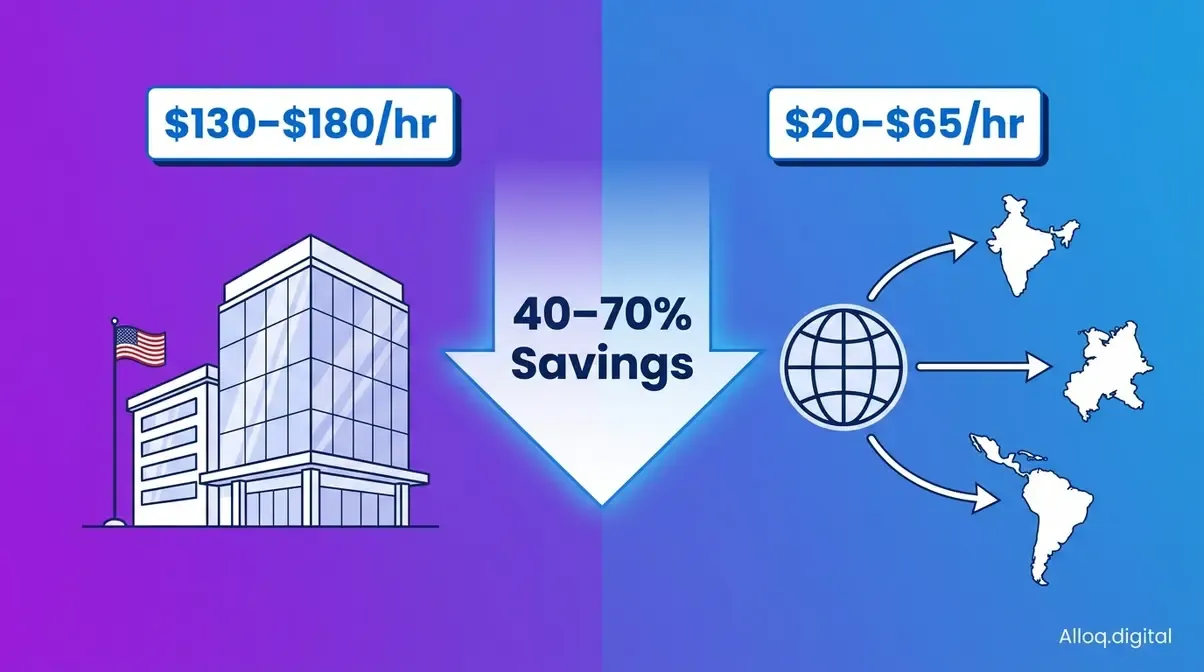 Offshore development delivers 40–70% cost savings compared to US or Western European teams - but hidden costs require explicit budgeting to protect the margin.
The honest answer is that offshore development costs vary by a factor of ten depending on region, seniority, engagement model, and vendor quality. Citing a single number is misleading. What matters is understanding the cost structure so you can build a realistic project budget - and identify where the hidden costs live before they surprise you.
How much do offshore developers cost?
Based on verified current market data from multiple sourcing platforms, here are current offshore development rates:
| Region | Junior Developer | Mid-Level Developer | Senior Developer | Notes |
|---|---|---|---|---|
| India | $15–$25/hr | $25–$45/hr | $45–$65/hr | Largest talent pool; highest rate variance |
| Eastern Europe (Poland, Romania) | $25–$40/hr | $35–$55/hr | $55–$80/hr | EU timezone proximity, GDPR-compliant |
| Ukraine | $20–$35/hr | $30–$50/hr | $50–$70/hr | High talent density; geopolitical risk factor |
| Latin America (Colombia, Mexico) | $20–$30/hr | $30–$45/hr | $45–$60/hr | US timezone alignment; USMCA IP protection |
| Vietnam | $15–$25/hr | $20–$35/hr | $35–$55/hr | Fastest-growing destination; strong quality |
| Philippines | $15–$25/hr | $20–$35/hr | $30–$50/hr | Strong English; customer-facing roles |
Sources: The Scalers, TechVinta, Uvik.net, UVIK Cost Guide, SecondTalent.
For comparison: a US-based senior full-stack engineer costs $130–$180/hour fully loaded including benefits, taxes, and equipment. At $55–$65/hour for a comparable Eastern European senior developer, the first-year saving on a single hire is $130,000–$230,000.
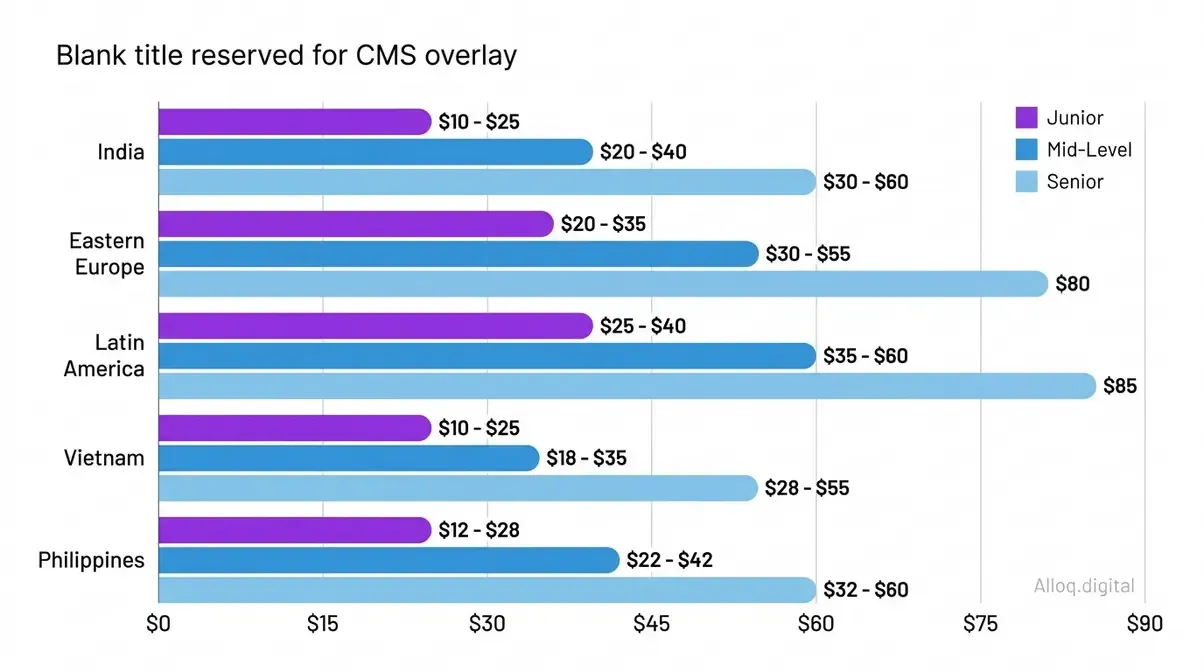 Current offshore developer rates by region - senior Eastern European developers command $55–$80/hour versus $130–$180/hour for US equivalents.
Hidden Costs That Erode Savings
The 40–70% saving figure is gross, not net. According to verified market analysis (NewWaveSolution), overhead typically adds 15–25% to effective project cost and must be resourced explicitly. Four cost categories routinely catch first-time offshore clients off guard:
Onboarding and knowledge transfer - the first four to six weeks of any new offshore engagement are partially non-productive. Engineers need codebase orientation, tooling access, documentation review, and security provisioning. Assume 30–50% productivity in week one to two, ramping to full velocity by week five.
Management bandwidth - offshore teams do not manage themselves. Your internal product owner or technical lead will spend four to eight hours per week on async communication, code review, sprint planning, and escalation handling. This is genuine work that displaces other priorities.
Quality assurance infrastructure - automated testing pipelines, code review tooling, and QA environments need to be stood up and maintained. If your existing CI/CD setup is minimal, expect a one-time investment of $5,000–$15,000 to build the infrastructure that makes offshore delivery reliable.
Communication tooling and licensing - Slack, Jira, Confluence, Figma, Zoom. For a ten-person offshore team, monthly tooling costs of $800–$2,000 are routine.
Reviewing Baseline Costs and Pricing
Understanding your effective all-in cost per sprint or per feature is more meaningful than hourly rates alone. Project-based pricing (fixed scope, fixed budget) shifts delivery risk to the vendor but requires airtight requirements documentation. Time-and-materials pricing gives flexibility but requires strong internal project management. Staff augmentation (dedicated team at a monthly rate) typically works out to 30–40% less than equivalent contractor billing and suits ongoing product development with evolving scope.
Best Countries for Offshore Development
No single country is universally best. The right destination depends on your team’s time zone, the technical specialisation you need, your compliance requirements, and your tolerance for geopolitical risk. What follows is a clear-eyed assessment of the four dominant regions - based on current market data, not marketing copy.
India: Volume, Versatility, and Scale
India remains the world’s largest offshore development market by volume. It produces over 1.5 million IT graduates annually, operates more than 40,000 IT services firms, and hosts engineering offices for virtually every major technology company. Rates run $20–$65/hour depending on seniority.
The trade-off is quality variance. India’s scale means the distance between a top-tier vendor (Infosys, Wipro’s premium units, or a high-quality boutique) and a bottom-tier vendor is enormous. Rigorous vendor evaluation - specifically, named-engineer interviews and a paid two-week trial sprint - is non-negotiable here. Senior engineer retention averages 12–18 months at mid-tier Indian vendors, shorter than Eastern Europe. Prioritise vendors who can demonstrate tenure.
Best for: Large-scale enterprise projects, data engineering, AI/ML, business intelligence, and teams who want access to deep specialist skills at volume.
Eastern Europe: Quality and Proximity
Poland, Romania, Ukraine, Czech Republic, and Hungary collectively represent Europe’s strongest offshore engineering market. Poland alone has more than 300,000 software developers; Romania has 202,000 (N-iX). Senior retention at established Polish and Romanian vendors runs 3–3.5 years - roughly double the Indian average.
Eastern European developers score highest on Western cultural alignment, English fluency (typically 85%+ of senior staff), and GDPR compliance by default. For UK and EU companies, Eastern Europe offers nearshore economics with offshore-grade cost savings relative to domestic rates.
Best for: Fintech, healthcare tech, enterprise SaaS, companies with EU data residency requirements, and teams that prioritise code quality over volume throughput.
Latin America: Time-Zone Alignment
For US and Canadian companies, Latin America offers a compelling combination: rates of $25–$55/hour, full time-zone overlap (Colombia is UTC-5, same as US Eastern in winter), and USMCA intellectual property protections for Mexican-based vendors. Mexico has over 700,000 IT professionals (N-iX). Colombia, Argentina, and Brazil are growing rapidly.
The productivity benefit of full time-zone alignment is frequently underestimated. A Colombian or Mexican engineer can participate in all-hands meetings, respond to Slack messages in real time, and pair-programme synchronously with US teammates - eliminating the coordination cost entirely. This makes Latin America the default recommendation for Agile-heavy product teams at US companies.
Best for: US and Canadian product companies running Agile sprints, customer-facing development requiring real-time collaboration, and teams scaling quickly without wanting to manage async workflows.
Southeast Asia: Vietnam & Philippines
Vietnam has become one of the most recommended offshore destinations, ranking number one for US companies in multiple industry analyses (SmartDev). It offers 500,000+ developers, $15–$55/hour rates, and a measurably improving English fluency rate among its younger engineering workforce. Vietnam’s government actively incentivises IT sector growth.
The Philippines historically led on English communication but has slightly lower technical depth than Vietnam for complex backend development. It remains an excellent choice for customer-facing applications, mobile development, and any work where communication quality is the primary criterion.
Best for: Cost-optimised development at quality above India’s average; UK and Australian companies benefit most from Vietnam’s and Philippines’ time zone positioning.
What Can You Build Offshore?
A persistent misconception frames offshore development as suitable only for commodity coding work - data entry portals, simple CRUD applications, basic mobile apps. Today, this is demonstrably wrong. The same conditions that expanded the global talent pool (remote-first culture, mature tooling, cross-border engineering education) have made offshore teams capable of sophisticated product development across virtually every category.
That said, certain software types are inherently better suited to offshore delivery than others, and the distinction is worth understanding.
Custom Enterprise Software and SaaS
Custom SaaS development solutions are among the most commonly built offshore today - multi-tenant platforms, business intelligence dashboards, CRM and ERP customisations, and API-first integration layers. The key requirement is thorough requirements documentation and a technically literate product owner on the client side.
Enterprise software development offshore works best under a dedicated team model, where the offshore squad owns entire modules of the codebase rather than working as ad hoc ticket processors. According to the Saigon Technology guide, teams with clear module ownership and defined API boundaries between onshore and offshore squads consistently deliver higher-quality outcomes than those working from a shared undifferentiated backlog.
MVPs and Startup Product Development
Minimum Viable Products are among the highest-ROI applications of offshore development. A typical MVP - a market-testable first version of a web or mobile application - can be built by a four-to-six-person offshore team at $20,000–$80,000 in materials costs, compared to $150,000–$350,000 for an equivalent onshore build in London or New York. Understanding hiring and scaling developers for early-stage products determines how quickly that MVP can iterate into a fundable, scalable product.
The risk specific to MVP development offshore is scope creep under fixed-price contracts. Startups typically iterate requirements rapidly based on user feedback, which conflicts with fixed-scope pricing. The solution is a hybrid model: fixed-scope for the initial MVP version, then transitioning to time-and-materials for iteration post-launch.
Mobile Apps and Front-End Development
Mobile application development - iOS, Android, and cross-platform via React Native or Flutter - is well-served by offshore teams, particularly in Vietnam, India, and Eastern Europe. The deliverables are cleanly testable (App Store/Play Store acceptance, UI behaviour, performance benchmarks), which makes quality assurance straightforward relative to complex backend systems.
Front-end web development, similarly, produces visually and functionally verifiable outputs that simplify offshore quality management. Many companies run a hybrid where core backend logic and architecture remain onshore or nearshore while front-end implementation is fully offshore.
The Offshore Governance Stack
This is where most offshore engagements succeed or fail. The cost and talent decisions are reversible - you can switch vendors, renegotiate rates, change destinations. Governance failures are not easily reversible: leaked IP, accumulated technical debt, delivery failures at launch, and security breaches leave lasting damage.
The Offshore Governance Stack is a three-layer framework - Legal, Technical, and Operational - that experienced CTOs apply as a coherent system rather than a piecemeal checklist. Each layer addresses a distinct category of risk, and skipping any layer creates a gap that the other two cannot compensate for.
Layer 1: Legal Safeguards and IP
Legal governance is the foundation. Before a single line of code is written, three documents must be signed and reviewed by legal counsel with international commercial law experience:
Non-Disclosure Agreement (NDA): Covers trade secrets, proprietary algorithms, customer data, and business logic. Standard mutual NDAs from LegalZoom are insufficient for international commercial software development - you need jurisdiction-specific NDAs that specify governing law (typically the client’s jurisdiction for US and UK companies), and that explicitly cover contractors and subcontractors used by the offshore vendor.
IP Assignment Agreement: Establishes that all code, documentation, and derivative works created during the engagement are the exclusive property of the client company. Without explicit IP assignment, offshore developers in many jurisdictions may retain moral rights or creator rights under local law. This agreement should cover both current employees of the vendor and any future assignees.
Service Level Agreement (SLA): Defines response times, uptime commitments (for managed services), defect resolution timelines, sprint velocity minimums, code review turnaround windows, and the consequences of persistent underperformance. An SLA without financial penalties for breaches is a wish list. Specify liquidated damages for critical milestone failures.
Layer 2: Technical Standards
Technical governance controls how the offshore team accesses your systems and codebase. The current baseline for any production-touching offshore engagement:
Zero Trust network architecture means offshore team members access only the specific repositories, environments, and data stores required for their current sprint tasks - not the entire codebase. Role-based access control (RBAC) enforced at the Git repository level, CI/CD pipeline level, and cloud environment level. Access is provisioned sprint-by-sprint and revoked on rotation.
ISO 27001 certification from the offshore vendor indicates a documented, auditable information security management system. Request the certification letter, not just the badge from their website. SOC 2 Type II (for US-regulated work) provides additional assurance that controls are operating effectively over time, not just documented on paper. For healthcare software, verify HIPAA Business Associate Agreements. For EU data, verify GDPR Data Processing Agreements.
Quarterly code audits by an independent third-party reviewer (not the offshore vendor, not your internal team) catch security vulnerabilities, architectural drift, and technical debt before they compound. Many companies skip this - the first audit typically reveals findings that would have cost ten times as much to remediate at launch.
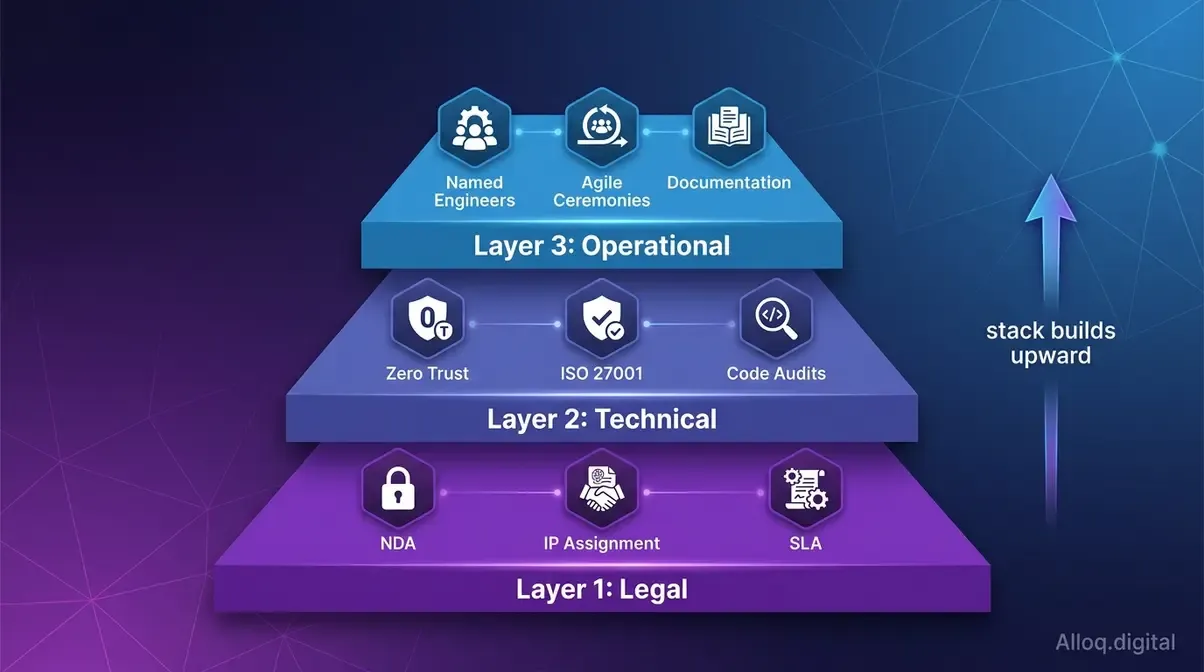 The Offshore Governance Stack - three interdependent layers of control that separate repeatable offshore delivery from costly one-off failures.
Layer 3: Operational Protocols
Operational governance is the day-to-day layer that most guides neglect because it is less dramatic than IP lawsuits or security breaches. It is, however, the layer that most directly determines sprint velocity and code quality.
Named-engineer contracts specify that your engagement is staffed by named, individually identified engineers - not interchangeable “resources” to be swapped by the vendor. This matters because offshore vendors under commercial pressure frequently rotate junior engineers onto your project while billing for senior rates, or reassign their strongest engineers to higher-margin new clients. A named-engineer clause, with a 30-day advance notice requirement and client approval for any personnel change, prevents this.
Agile ceremonies on client terms: Sprint planning, daily standups, retrospectives, and backlog refinement should happen at times that maximise the client’s participation, not the vendor’s convenience. For most engagements, this means offshore teams adjust their work schedule by two to three hours to create morning overlap with the client’s time zone.
Documentation standards should be enforced from day one: README files, API documentation, architectural decision records, deployment runbooks. Documentation debt compounds as fast as code debt. Require a documentation review as part of every sprint acceptance.
The AI-Augmented Offshore Team
Artificial intelligence is reshaping offshore development in ways that are not yet fully reflected in public guidance. According to McKinsey on AI-enabled software development, AI-enabled development lifecycles are reshaping how software gets built - with implications for offshore team productivity and quality benchmarks.
In practice, this plays out in two ways. First, AI-assisted coding tools (GitHub Copilot, Cursor, Tabnine) raise the productivity floor for offshore teams - junior developers with strong prompt engineering skills now produce code quality closer to what mid-level engineers delivered two years ago, which is a genuine benefit to cost-conscious clients. Second, AI-augmented code review (automated SAST tools, LLM-assisted pull request review) provides an additional quality control layer that catches common errors before human review - important when reviewer bandwidth is limited across time zones.
The operational implication: specify in your vendor evaluation that you expect AI tooling to be integrated into their development workflow, and that its use must be disclosed and audited, not hidden. For security-sensitive projects, define which AI tools are approved and which are prohibited (tools that send code to external training sets are typically prohibited for proprietary codebase work).
Evaluating Offshore Vendors
The offshore development vendor market currently comprises tens of thousands of firms - from 5-person boutiques to 50,000-person multinationals. Navigating it without a structured evaluation framework leads to two failure modes: over-relying on review aggregators (G2, Clutch), which are gamed; or selecting the cheapest bidder from an RFP, which consistently produces the worst outcomes.
The five criteria below, drawn from current vendor evaluation frameworks, provide a structured basis for selection. Apply them as a scoring model: rate each vendor 1–5 on each criterion, triple-weight senior retention, and set a threshold score before extending an offer.
Five Criteria for Vendor Evaluation
1. Verifiable security certifications: Require current ISO 27001 and SOC 2 Type II certificates - the actual audit letters, not website badges. For healthcare, require HIPAA BAA capability. For EU data, require GDPR DPAs (Saigon Technology). Vendors who cannot produce these within 48 hours of request have not genuinely implemented the underlying controls.
2. Named engineer profiles and technical interviews: Demand CVs and LinkedIn profiles for the specific engineers who will work on your project. Conduct live technical interviews with those engineers - not with a sales engineer or account manager. Vendors who refuse named-engineer interviews are signalling that they do not intend to staff the project as pitched (Hauer Power).
3. Senior engineer tenure: Ask for the average tenure of senior engineers over the past 24 months. The benchmark is 2+ years minimum; Polish and Romanian vendors typically achieve 3–3.5 years. Indian mid-tier vendors average 12–18 months. High churn among senior engineers is a leading indicator of code quality problems - they take architecture knowledge with them (Hauer Power).
4. Domain-specific case studies: Request three case studies from your exact industry - not “similar” industries. Healthcare software vendors must demonstrate FHIR R4 and HL7 experience. Fintech vendors must show PCI-DSS or open banking compliance experience. Generic “enterprise SaaS” case studies are insufficient for compliance-critical domains (Accelerance).
5. A paid trial sprint: Conduct a two-week paid trial sprint with the named engineers before signing a long-term contract. This is the single most diagnostic vendor evaluation tool available. It reveals actual communication quality, actual code quality, actual sprint velocity, and actual tooling compatibility - all of which look very different from proposal documents. Vendors who refuse paid trials are removing your most reliable vetting tool. That refusal is itself diagnostic.
Offshore Vendor vs. UK/US Agency
A mid-tier offshore development team of five engineers - one tech lead plus four mid-to-senior developers - running through a London-based digital agency would cost approximately £25,000–£45,000 per month. The equivalent team at a top-tier Eastern European vendor runs $15,000–$25,000 per month. The equivalent in India runs $8,000–$15,000 per month. Over a 12-month engagement, the differential between London agency and Eastern European offshore runs to £120,000–£240,000.
Partnering with an expert web development agency that operates distributed engineering teams with established governance structures captures this cost benefit without requiring you to manage vendor relationships, legal frameworks, and operational protocols from scratch.
Limitations of Offshore Development
Offshore development is not universally superior. Understanding when it creates more problems than it solves is as important as understanding when it delivers value - and this is where honest assessment is worth more than marketing positioning.
Common Pitfalls
Underspecified requirements: The number-one cause of offshore project failure is not communication barriers or time zones - it is requirements documents that would fail a first-year BA course. “Build me a platform like Airbnb” is not a specification. Offshore engineers are highly skilled at executing against defined requirements and poorly positioned to substitute for product thinking. If your product vision is still evolving, resolve it before offshoring.
Treating offshore teams as ticket queues: Companies that route individual tickets to offshore developers rather than handing ownership of features or modules consistently experience quality problems, architectural drift, and high rework rates. Offshore teams perform best with genuine ownership, not piecemeal task assignment.
Skipping the governance investment: Some teams attempt to manage offshore development informally - Slack messages, no documented SLAs, no access controls, no code audits. This works until it catastrophically does not. The governance investment of three to five percent of project budget prevents losses that routinely run to 30–50% of project cost in rework, security incidents, and litigation.
When to Choose Alternatives
When real-time creative collaboration is the core deliverable: Design sprints, UX research, rapid customer-facing iteration, and discovery workshops require the kind of real-time, whiteboard-level collaboration that time-zone gaps structurally undermine. Nearshore or onshore teams are better suited to these phases - many companies use offshore only from the execution phase onwards, after discovery has been completed.
When your compliance requirements mandate onshore data processing: Certain regulated industries - defence contracting with ITAR obligations, NHS-tier UK healthcare, specific financial services licences - require that software development and data processing occur within specific national boundaries. Verify your compliance position before offshoring anything touching regulated data.
When your internal product ownership is too thin: Offshore development amplifies whatever product management capacity you have. One strong product owner can direct a ten-person offshore team effectively. Zero product owners cannot. If your team has no one available to run the client-side of an offshore engagement, hire that person before procuring the offshore team.
When to Seek Expert Help
For organisations navigating offshore development for the first time, or for those recovering from a failed offshore engagement, independent advisory support during vendor selection and contract negotiation recovers more value than its cost in virtually every case. Legal review of offshore contracts by a solicitor or attorney with international IT law experience is essential - not optional - for any engagement over $50,000.
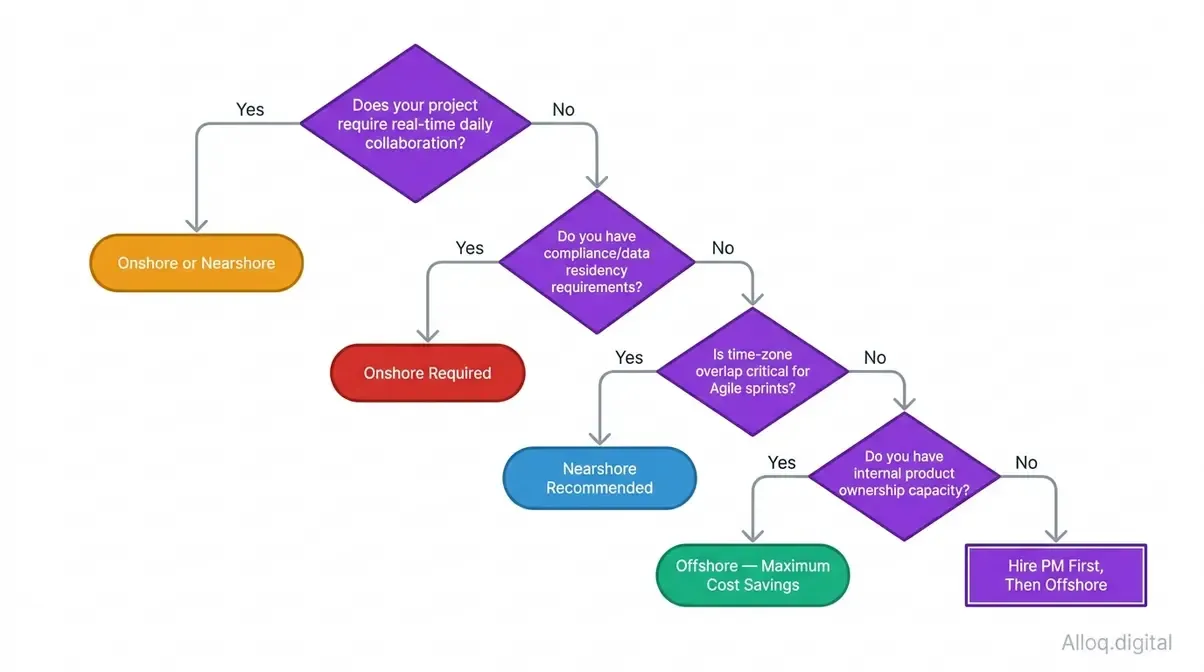 Use this decision flowchart to map your project’s collaboration needs, compliance requirements, and team capacity to the right delivery model.
Frequently Asked Questions
Is offshore development secure?
Yes, offshore development is highly secure when managed through strict governance protocols. Implementing Zero Trust architecture and requiring verified ISO 27001 certifications protects your intellectual property from unauthorized access. Companies must also enforce jurisdiction-specific legal frameworks, including robust IP assignment agreements, to guarantee absolute codebase ownership at all times.
Why outsource software development?
Companies outsource to achieve significant cost reductions while rapidly scaling their engineering capacity. According to Statista developer salary data, this approach can reduce labor expenses by 40 to 70 percent compared to hiring locally. Additionally, leveraging an international workforce provides immediate access to specialized talent pools that are often scarce or prohibitively expensive in domestic markets.
How are time zones handled?
Successful engagements manage time zones by establishing a mandatory three-hour daily overlap window for synchronous collaboration. During this dedicated period, distributed teams conduct critical Agile ceremonies such as daily standups, sprint planning, and code reviews. For the remainder of the workday, developers utilize asynchronous communication tools like Jira and Loom to maintain steady project velocity without causing burnout.
How to hire an offshore team?
Hiring an offshore team requires a systematic evaluation process that prioritizes verifiable technical capability over generic marketing claims. Begin by demanding named-engineer profiles and conducting live technical interviews to assess both coding proficiency and cultural alignment. Carefully check senior developer tenure rates, as high retention strongly correlates with reliable code quality. Finally, always execute a paid two-week trial sprint to validate the vendor’s actual communication standards and delivery speed before signing a long-term contract.
Conclusion
Offshore software development has evolved far beyond its early reputation, becoming a fundamental pillar for technology companies seeking to rapidly scale their engineering output while maintaining lean operational budgets. By rigorously enforcing the three-layer Offshore Governance Stack - prioritizing robust legal IP safeguards, strict technical Zero Trust environments, and deeply integrated operational workflows - CTOs can successfully capture 40 to 70 percent cost reductions without compromising code quality. Implementing these proven frameworks bridges the gap between global talent accessibility and secure, repeatable product delivery.
Book a no-obligation discovery call with alloq.digital to assess whether offshore development is right for your next project.