MVP Development Services: $10k–$125k Cost Breakdown

Building a startup often comes with a harsh reality check. Too many products spend months in development only to discover the team solved the wrong problem. As a founder, you face strict budgeting constraints and tight timelines that demand early market traction over bloated feature sets. You need a fast, reliable method to test your core assumptions with actual paying customers.
Securing reliable mvp development services helps you navigate this critical phase efficiently. This approach prioritizes core functionality and user validation over complex, unproven architecture. A systematic development process keeps your initial financial exposure low while generating tangible data on user behavior.
This guide provides radical transparency on exact 2026 cost estimates across various industries. We map out the step-by-step technical process required to build a functional foundation. You will also learn how to use this initial product to secure pre-seed funding and transition toward sustainable profitability.
Key Takeaway
Professional mvp development services are strategic technical partnerships that help founders launch functional core products rapidly, typically costing between $10,000 and $125,000, to gather crucial user feedback, validate actual market demand, and successfully build a reliable foundation for securing early pre-seed investment.
- Focus strictly on core value delivery for early adopters
- Help conserve budget by avoiding unvalidated features
- Accelerate the timeline from concept to testable application
- Create tangible performance metrics to demonstrate traction
Author Credentials
📝 Written by: Content Team & Simon (Head of Product Strategy) ✅ Reviewed by: Simon – Full-stack expert in custom SaaS applications and AI automations. 📅 Last updated: 21 February 2026
Transparency Notice
ℹ️ Transparency Statement
This comprehensive guide explores technical architecture and budgeting based on current 2026 market research and alloq.digital’s proprietary project data. All cost estimates and strategic advice are verified by our technical leadership. Our primary goal is to provide accurate, helpful information to empower founders to make data-driven development decisions.
Startup MVP Strategy & Fundamentals
Effective mvp development services for startups prioritize lean methodologies and clear value propositions to manage development risks. Defining your core offering early accelerates idea validation and conserves your initial startup runway.
What Is an MVP in Web Development?
Understanding what is mvp in web development forms the baseline of your entire product strategy. A Minimum Viable Product represents a core software build designed specifically to test business hypotheses. According to a 2026 industry overview, it acts as a functional foundation for user feedback, not a half-finished or broken application. It includes only the essential features needed to solve a specific problem for your early adopters.
Deploying a functional core allows you to gather data on actual user behavior rather than relying on hypothetical interest. This strategy helps manage scope creep and keeps your engineering team focused on immediate value delivery. Founders often discover that users utilize the product in completely unexpected ways. Gathering this behavioral data early informs your subsequent development phases and prevents costly architectural rewrites.
MVP vs. Prototype: Solving the Right Problem First
Many teams confuse interactive prototypes with market-ready software builds. A prototype serves internal validation, helping teams visualize concepts and test technical feasibility before writing any production code. An MVP faces the actual market to validate commercial viability, user demand, and willingness to pay. As shown in the infographic below, there are distinct feature differences between an MVP and a full-scale product.
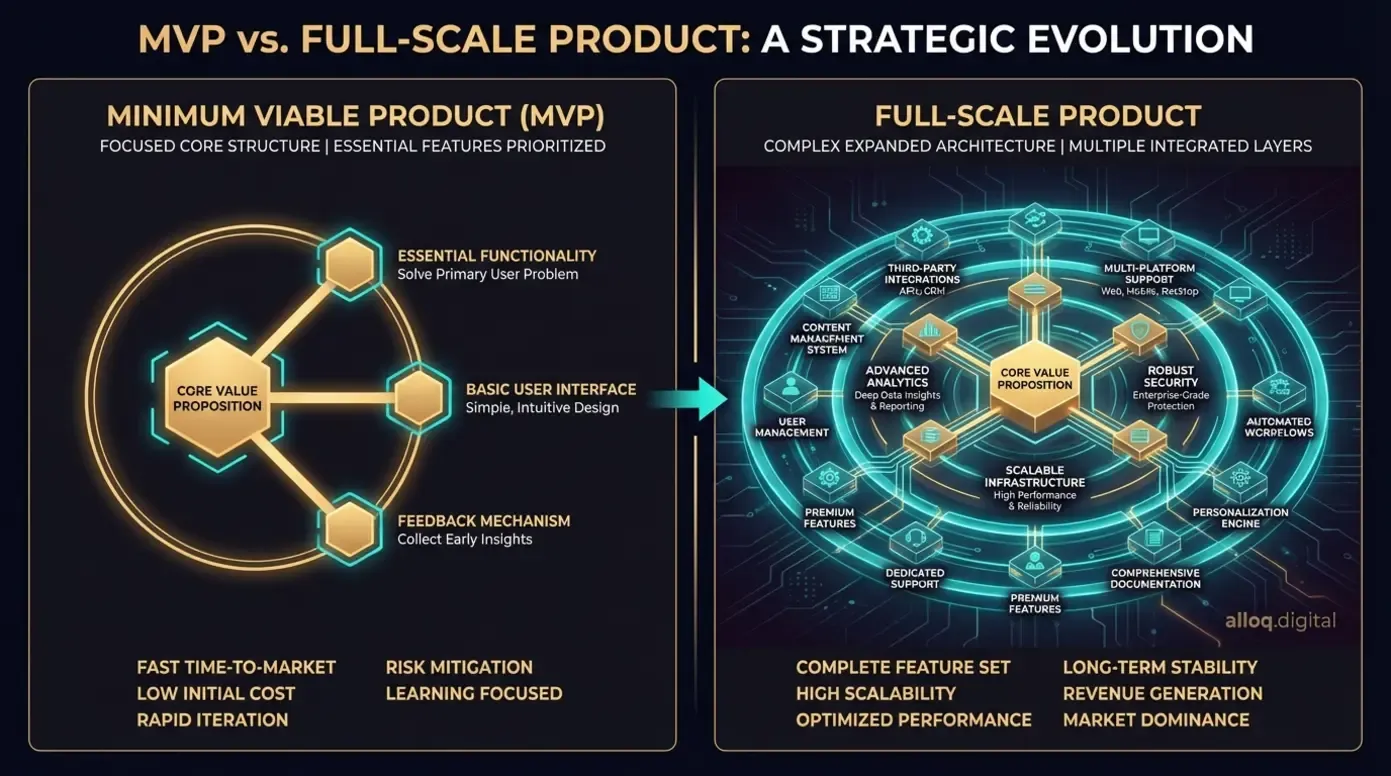 An MVP focuses strictly on core value, preventing expensive feature bloat.
Building a full-scale application prematurely often means you spend months coding only to realize you solved the wrong problem. Launching a lean version significantly reduces this risk. For alternative approaches to testing concepts before writing custom code, you can explore methods for validating startup ideas using no-code tools.
Idea Validation & The Build-Measure-Learn Cycle
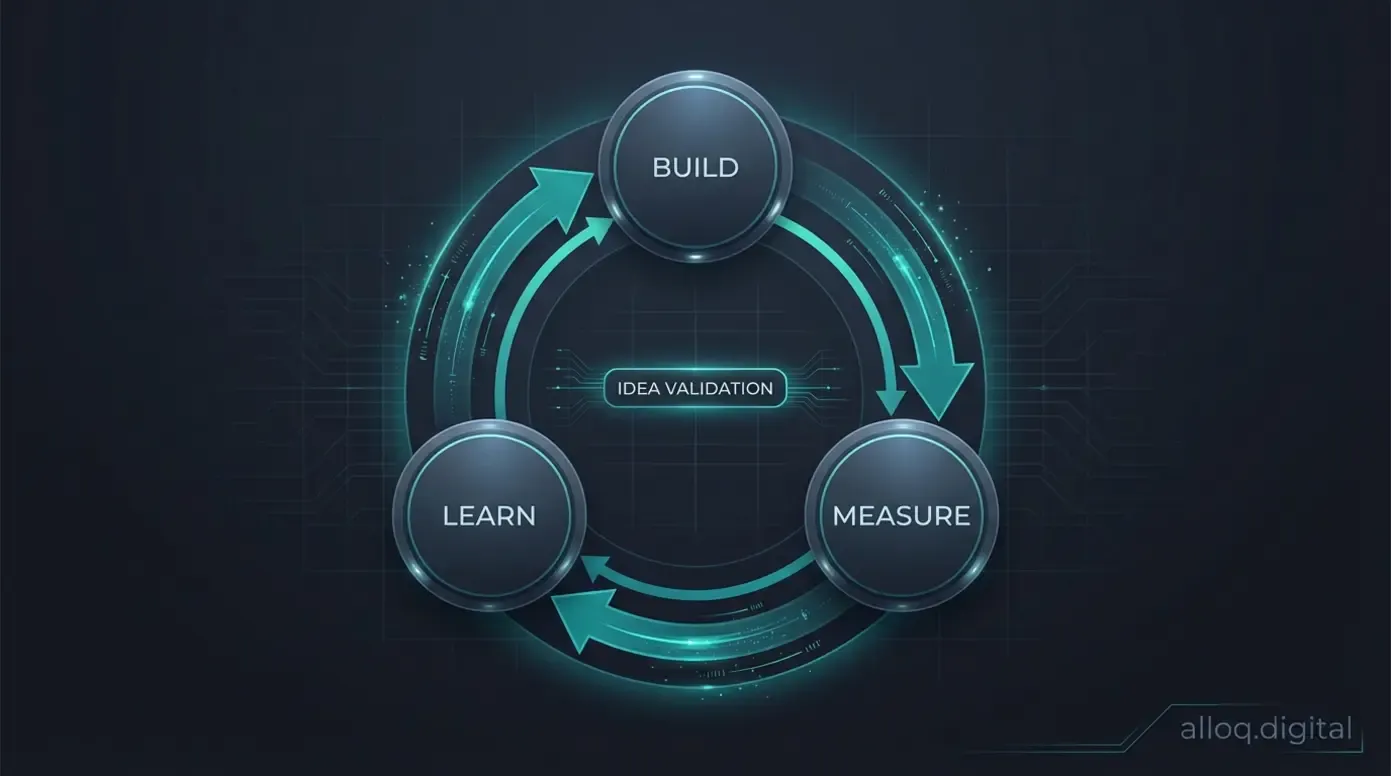 The Build-Measure-Learn loop dictates the pacing of modern startup execution.
The Build-Measure-Learn cycle remains the standard operational framework for agile product teams. This methodology centers on the core definition by Eric Ries of quickly turning ideas into products, measuring customer reactions, and learning whether to pivot or persevere. You can often test your core value proposition through a simplified setup before investing in extensive backend architecture.
Community Perspective: “We spent four months over-engineering our backend before talking to a single user. Our next project was validated in two weeks using a simple low-code form.” “The goal isn’t to build a small product, but to learn the most about your customer with the least amount of technical debt.”
Testing assumptions early provides concrete data points to guide your next engineering sprint. This iterative process routinely highlights which features users actually value compared to your initial product roadmap. Your engineering budget then targets proven demand rather than internal assumptions.
MVP Cost & Budgeting
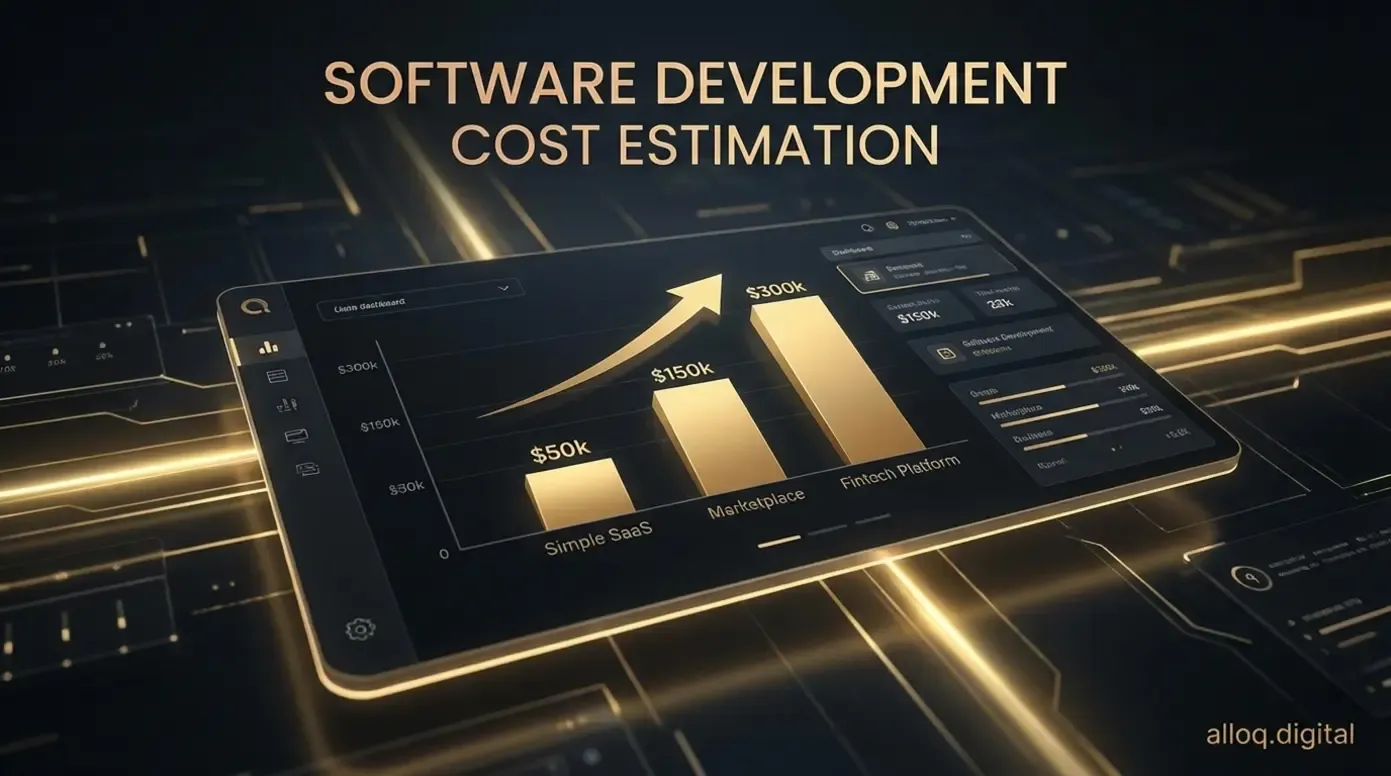 Development costs scale proportionally with feature complexity and industry compliance requirements.
Navigating technical budgets requires an understanding of how feature complexity, platform choice, and resource allocation drive your overall development expenses.
How Much Does MVP Development Cost in 2026?
Anticipating exact mvp development cost figures allows you to plan your startup runway effectively. In 2026, the average financial commitment for a robust initial build ranges from $10,000 to $125,000. This massive variance depends heavily on compliance requirements, database complexity, and the geographic location of your chosen technical partner. Pragmatic budget management requires defining your scope strictly and pushing back on feature bloat.
Research indicates that startups often fail due to lacking market need, making massive upfront technical investments highly risky. Keeping your initial budget lean helps you retain capital for marketing campaigns and iterating on user feedback. A conservative financial approach during phase one provides the flexibility needed to pivot when early user data contradicts your initial assumptions.
Transparent Pricing & Industry Cost Estimates
Different industry verticals require varying levels of technical sophistication, regulatory compliance, and user experience polish. A highly regulated fintech application demands a substantially different baseline budget than a straightforward consumer marketplace. Understanding these benchmarks helps you assess technical proposals accurately.
| Industry Vertical | Baseline Feature Complexity | Estimated 2026 Cost Range | Typical Timeline |
|---|---|---|---|
| Simple B2B SaaS | Dashboard, user roles, core tool | $15,000 – $35,000 | 6–8 Weeks |
| E-Commerce Marketplace | Payments, vendor profiles, search | $30,000 – $60,000 | 8–12 Weeks |
| Healthcare (HIPAA) | Data encryption, secure portals | $50,000 – $90,000 | 12–16 Weeks |
| Fintech Platform | Ledger systems, KYC compliance | $70,000 – $125,000 | 14–20 Weeks |
These baseline estimates assume a highly focused feature set designed purely for immediate market testing. For deeper insights into resource allocation and technical scoping, review this detailed breakdown of MVP development costs.
Where Your Budget Actually Goes (And How to Save)
A transparent technical partner breaks down your investment across system design, engineering hours, and quality assurance. Typically, backend architecture and database structuring consume the largest portion of your financial resources. UI/UX design focuses on creating intuitive user flows, while QA testing ensures the product functions reliably under realistic user load. The following diagram illustrates where your MVP budget actually goes in 2026.
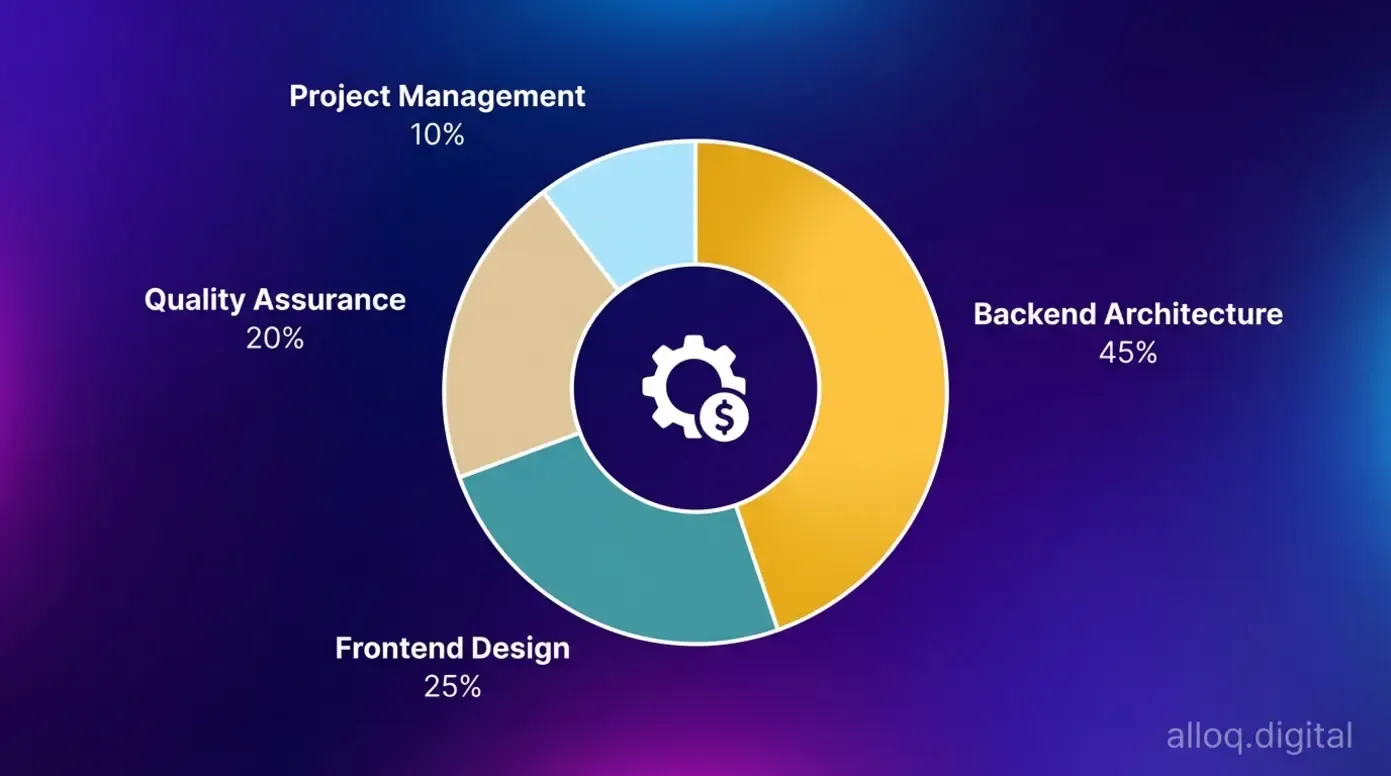 Backend architecture and database structuring typically consume the largest portion of early funding.
Understanding the factors driving your total mvp app development cost enables you to make strategic architectural compromises. You can save substantial capital by connecting third-party APIs instead of building custom features for generic functions like payment processing or email authentication. Focus your engineering hours strictly on the proprietary elements that deliver your core business value.
MVP Development Agencies & Services
Engaging professional mvp development services helps ensure rapid, cost-effective engineering focused purely on essential features for early market entry.
Finding the Right MVP Product Development Agency
Selecting an mvp product development agency requires evaluating both their technical capabilities and their communication standards. A reliable partner communicates like a competent colleague, challenging unnecessary features and prioritizing speed to market. Look for transparent cost structures and a demonstrated understanding of your specific business objectives.
Technical competency in scalable modern stacks influences your future product growth. Agencies proficient in frameworks like React Native or workflow automation tools like N8N often reduce initial development timelines significantly. Verify their approach to data security, especially concerning GDPR compliance and database architecture. Partnering with a team that delivers structured custom SaaS MVP development services helps ensure your codebase remains viable as your user base expands.
The MVP Development Process: From Discovery to Launch
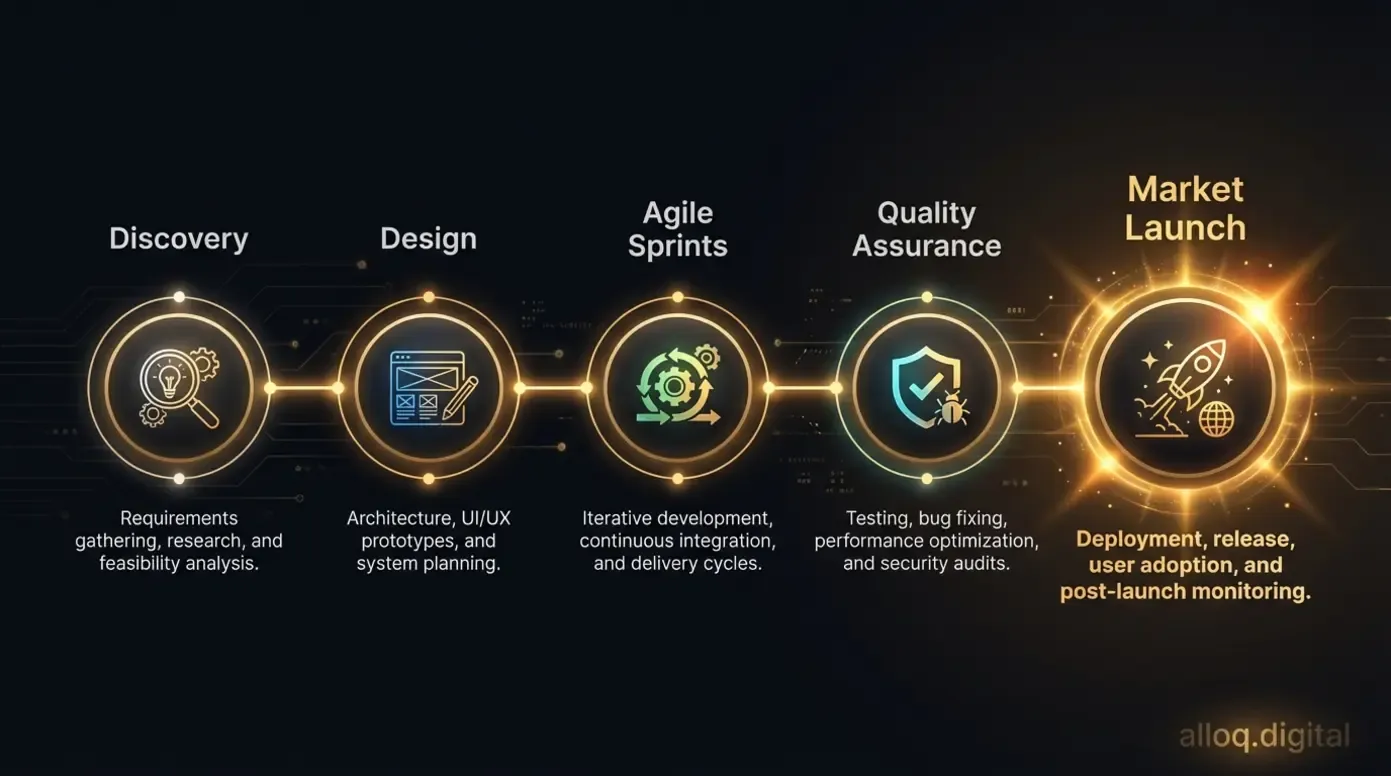 A structured technical roadmap prevents expensive mid-project scope changes.
An experienced mvp development company follows a structured roadmap to transform your concept into a testable application. This process generally spans 5 weeks to 6 months, depending on the agreed-upon scope and specific platform requirements. A rigid operational process minimizes unexpected delays.
- Discovery and Scoping: Defining the exact problem, target audience, and absolute minimum feature requirements.
- UI/UX Design: Creating wireframes and user flows to map the customer journey visually.
- Agile Development: Writing the frontend and backend code in structured, iterative sprints.
- Quality Assurance: Testing the application across relevant devices to resolve critical functional bugs.
- Deployment: Launching the functional product to early adopters to gather immediate market feedback.
Following this strict sequence helps prevent mid-project scope changes that routinely exhaust startup budgets.
Post-Launch: Attracting Pre-Seed Investors
A launched product serves as a powerful tool for securing early venture capital. Investors rarely fund unvalidated ideas; they look for strong execution and demonstrated market demand. Tracking active usage, user retention rates, and customer acquisition costs helps you build a compelling, data-driven case for financial backing.
With market reports showing global venture funding rebounding significantly in 2026, demonstrating early traction positions your startup favorably among pre-seed investors. You can use this initial performance data to raise capital, which funds the transition from a minimal product to a Minimum Marketable Product (MMP). This subsequent phase focuses on scaling cloud infrastructure, expanding feature sets, and driving sustainable revenue.
Limitations, Alternatives, and Professional Guidance
While launching a lean product accelerates market entry, this approach carries specific constraints that require careful technical planning and risk assessment.
This strategic framework works well for most digital startups, but highly regulated industries face distinct technical challenges. The $10,000 to $125,000 cost estimate represents a baseline for standard web and mobile applications. Applications requiring complex compliance frameworks—such as HIPAA in healthcare or PCI-DSS in fintech—often demand elevated budgets and extended timelines for security auditing. Building a minimal product in these sectors sometimes means prioritizing security infrastructure over frontend user features.
If your core product involves the following conditions, consult a certified professional before beginning development:
- Financial transactions or banking integrations: Systems security architect
- Patient health information (PHI): HIPAA compliance specialist
- Large-scale enterprise data processing: Cloud infrastructure architect
For rapid initial validation without extensive coding, low-code platforms offer viable alternative approaches. These tools allow founders to test basic assumptions quickly and cheaply, though they typically present scalability limitations as your active user base grows into the tens of thousands. Assessing these trade-offs early helps you choose the right path for your current funding stage.
Frequently Asked Questions (FAQs)
What is MVP development Services?
MVP development services are specialized technical offerings that help startups build and launch a functional version of their product with core features. This approach enables founders to validate business ideas, gather early user feedback, and attract investors while minimizing initial engineering costs. The process focuses strictly on speed-to-market, core value delivery, and creating a scalable technical foundation for future growth.
How much does MVP development cost?
The average cost of a minimum viable product typically ranges from $10,000 to $125,000 in 2026. This financial variance depends heavily on product complexity, platform requirements, industry compliance standards, and the geographic location of your development team. Simple business dashboards sit at the lower end, while highly secure healthcare or fintech applications require substantially larger baseline budgets.
How long does it take to develop an MVP?
Development teams typically build and deliver a working, testable product in 5 weeks to 6 months. Specialized technical agencies utilize agile methodologies and iterative coding sprints to maintain this rapid pace. Complex marketplace integrations, native mobile applications, or stringent data security requirements naturally push the delivery timeline toward the longer end of this spectrum.
Conclusion
Securing reliable mvp development services represents a highly effective way to validate your startup concept without burning through your initial funding runway. A well-executed lean product focuses entirely on delivering core value to early adopters, providing the concrete behavioral data you need to iterate confidently.
Partnering with an agency that provides radical transparency regarding costs and development timelines often makes the difference between gaining early traction and failing prematurely. Rather than guessing your technical requirements or over-engineering your backend, you need a clear, data-driven roadmap to guide your engineering efforts from day one.
Review our technical consulting options at alloq.digital or use our interactive cost assessment tools to scope your specific 2026 project requirements accurately.