
You have a product idea, maybe even a paying customer or two. But somewhere between “recurring billing” and “multi-tenant architecture,” the gap between a working prototype and a scalable SaaS business starts to feel enormous. Finding SaaS developers who understand business logic-not just syntax-is the single biggest bottleneck most founders face in 2026.
The cost of getting this wrong is steep. A misaligned hire burns through $50k+ in development budget and six months of runway. A poorly architected MVP crumbles the moment your tenth enterprise customer signs up. And without a clear growth framework, even a well-built product can stall before it reaches profitability.
This guide is your 2026 blueprint. It covers the technical fundamentals every SaaS product demands, the growth metrics (like the 3-3-2-2-2 rule and Rule of 40) that separate surviving startups from thriving ones, and a practical framework for sourcing the right talent-whether you hire, bootstrap, or build it yourself.
Key Takeaway
SaaS developers are specialized engineers who build cloud applications around multi-tenancy, recurring billing, and scalable infrastructure.
- SaaS architecture differs fundamentally from standard web app development
- Growth benchmarks like the 3-3-2-2-2 rule and Rule of 40 are as critical as the code itself
- Hiring options range from freelance platforms (Upwork) to premium networks (Toptal) and agencies
- Solopreneurs can validate with no-code tools, but scaling requires custom development
- Security and compliance (OWASP, GDPR) are non-negotiable from day one
Author Credentials
📝 Written by: Simon (alloq.digital Founder) ✅ Reviewed by: Simon, SaaS Architect & Automation Expert 📅 Last updated: 14 February 2026
Transparency
ℹ️ Transparency Notice
This article explores SaaS development based on professional architectural standards and industry benchmarks. Some links in this article may connect to our services. All information presented has been verified and reviewed by Simon. Our goal is to provide accurate, helpful information to our readers.
SaaS Technical Fundamentals & Architecture
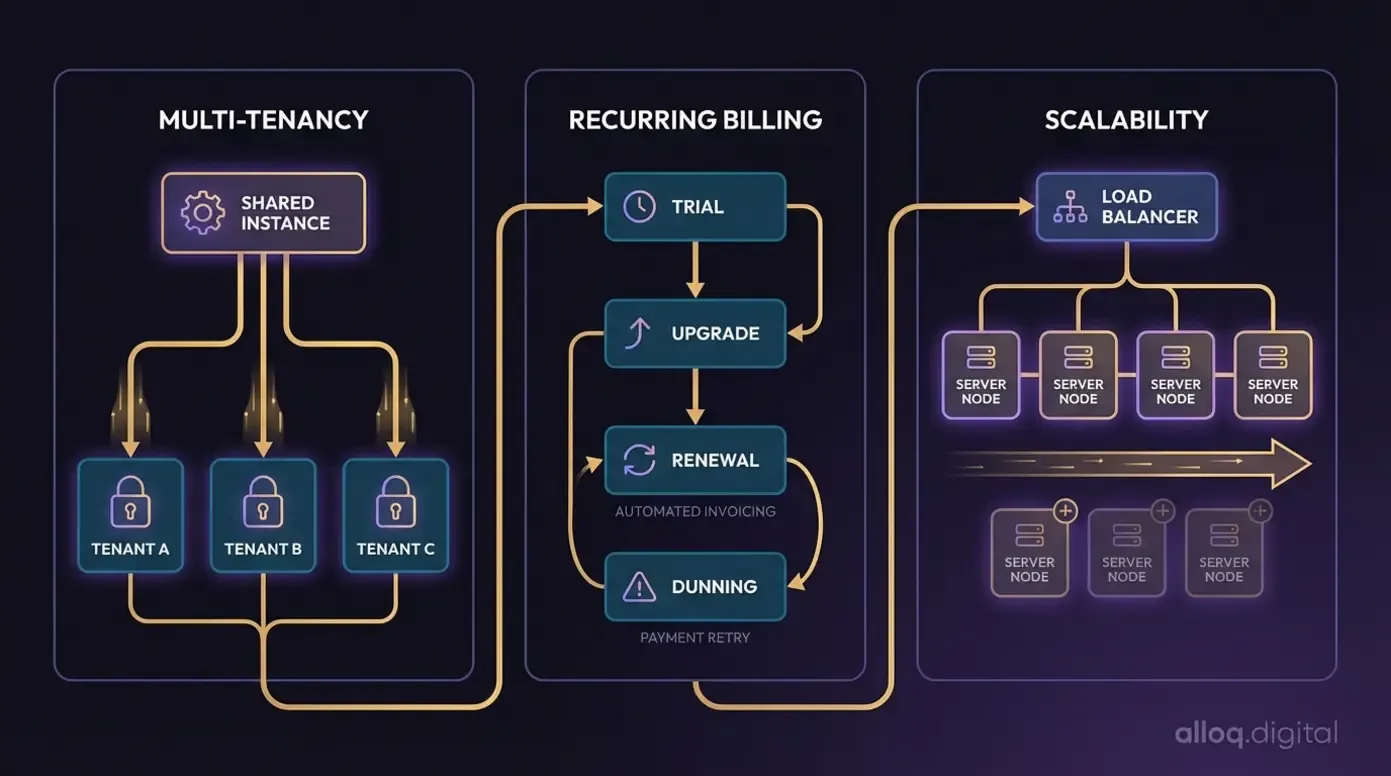 The three foundational pillars of SaaS architecture - multi-tenancy, recurring billing, and scalability - shape every technical decision from database schema to deployment.
SaaS developers work within a distinct architectural paradigm that separates cloud-delivered software from traditional web applications. Understanding these fundamentals determines whether your product can serve ten customers or ten thousand without a complete rebuild.
Three pillars define every SaaS system: multi-tenancy, subscription billing logic, and horizontal scalability. Multi-tenancy means a single application instance serves multiple customers while keeping their data strictly isolated. This is not a minor design choice. It shapes your database schema, your security model, and your deployment pipeline from the very first commit.
Recurring billing is the second pillar, and it goes far beyond plugging in a Stripe widget. Subscription lifecycles involve trials, upgrades, downgrades, cancellations, and failed payment recovery (known as dunning). Each of these states requires dedicated logic in your application layer. Treat billing as architecture, not an afterthought.
Scalability rounds out the foundation. A SaaS product that cannot handle traffic spikes or growing data volumes is a product with an expiration date. According to AWS’s multi-tenant architecture guide, multi-tenant SaaS systems require careful isolation of tenant data alongside elastic resource allocation (2026). This makes cloud-native design a requirement, not a preference.
Core SaaS Mechanics: Multi-Tenancy & Billing
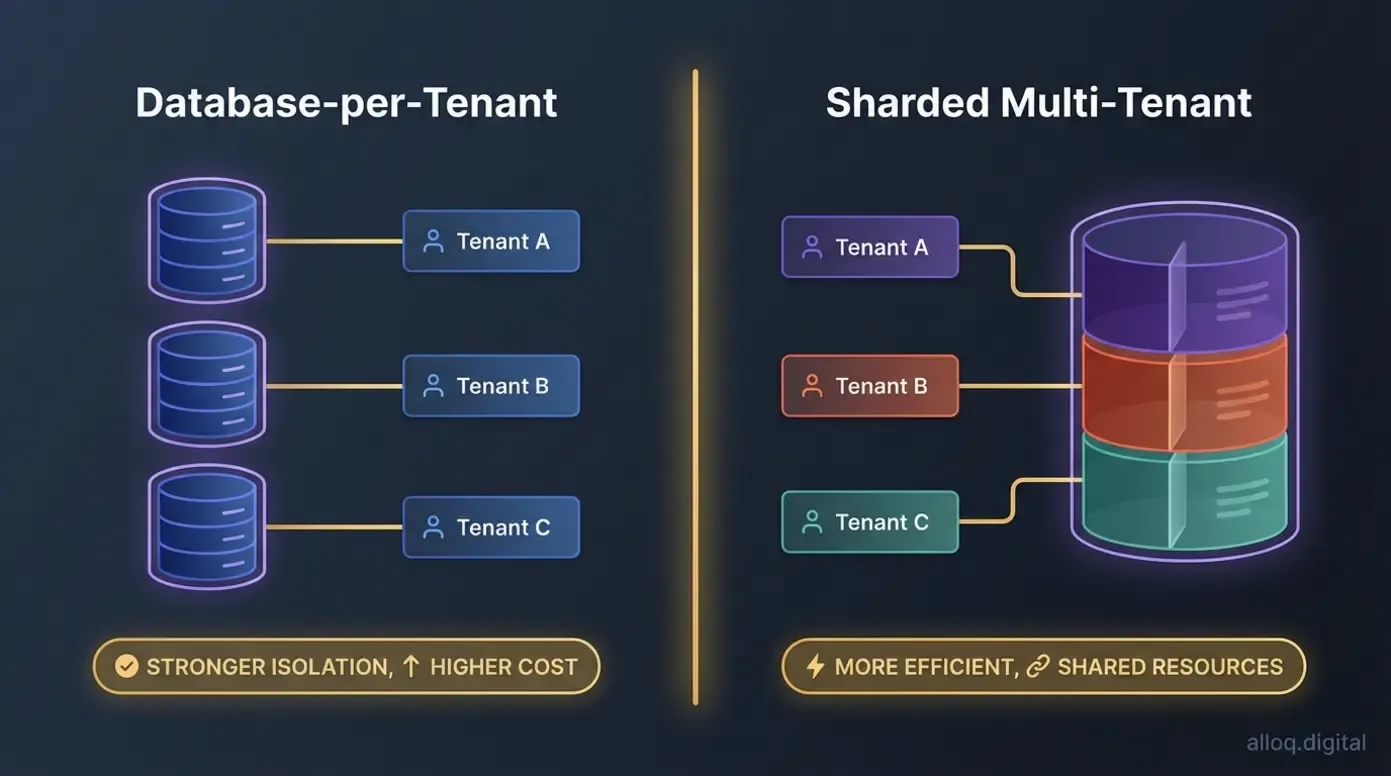 Two dominant multi-tenancy patterns - database-per-tenant offers stronger isolation while sharded multi-tenant maximizes resource efficiency at lower cost.
The architecture design choice between single-tenant and multi-tenant deployments shapes every downstream decision in your product.
| Factor | Single-Tenant | Multi-Tenant |
|---|---|---|
| Infrastructure Cost | Higher (dedicated resources per customer) | Lower (shared resources across customers) |
| Data Isolation | Complete by default | Requires deliberate architectural enforcement |
| Customization | Easier per-client changes | Harder; changes affect all tenants |
| Maintenance | Complex at scale (N deployments) | Simpler (one codebase, one deployment) |
| Scalability | Limited without significant investment | Built for horizontal growth |
Most SaaS products targeting growth adopt multi-tenant designs. The two dominant patterns are database-per-tenant (stronger isolation, higher cost) and sharded multi-tenant (shared database with tenant identifiers, more efficient). According to Microsoft’s tenancy design patterns documentation, the right choice depends on your compliance requirements and expected scale.
When multiple companies share one database instance, your schema must enforce row-level security. Every query needs a tenant identifier. Miss this, and one customer can see another customer’s data-a breach that can end your business overnight.
Subscription lifecycles add another layer of complexity. A user might start a free trial, upgrade mid-cycle, pause their account, then reactivate months later. Each state transition must be handled gracefully in your billing logic.
For teams building scalable SaaS architecture, these decisions need to be made before writing the first line of production code.
The “Build-to-Scale” Roadmap (Growth & Metrics)
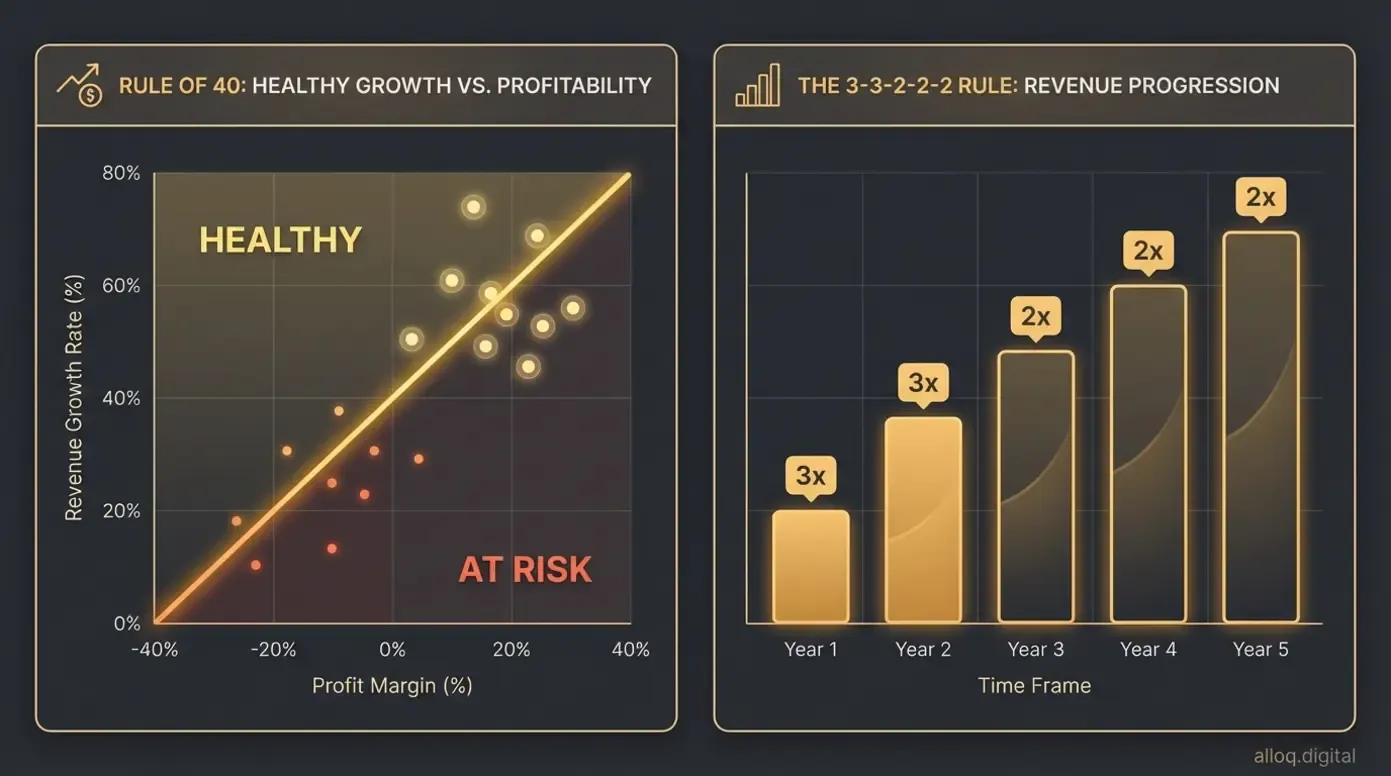 Two essential SaaS growth frameworks - the Rule of 40 balances growth against margins, while the 3-3-2-2-2 rule maps an aggressive five-year revenue trajectory.
Strong SaaS developers understand that code without a growth engine is just a side project. Two frameworks separate venture-scale products from stalled experiments: the 3-3-2-2-2 growth rule and the Rule of 40.
The 3-3-2-2-2 growth rule is a revenue trajectory benchmark used by venture capitalists to identify high-potential startups. It works like this: triple your annual recurring revenue (ARR) in Year 1, triple it again in Year 2, then double it in Years 3, 4, and 5. A company starting at $1M ARR following this path reaches $72M by Year 5. This is aggressive. Most companies never hit it. But it provides a concrete target to measure against. As shown in the SaaS Growth Trajectory Chart below, the revenue path demands exponential growth in the early years.
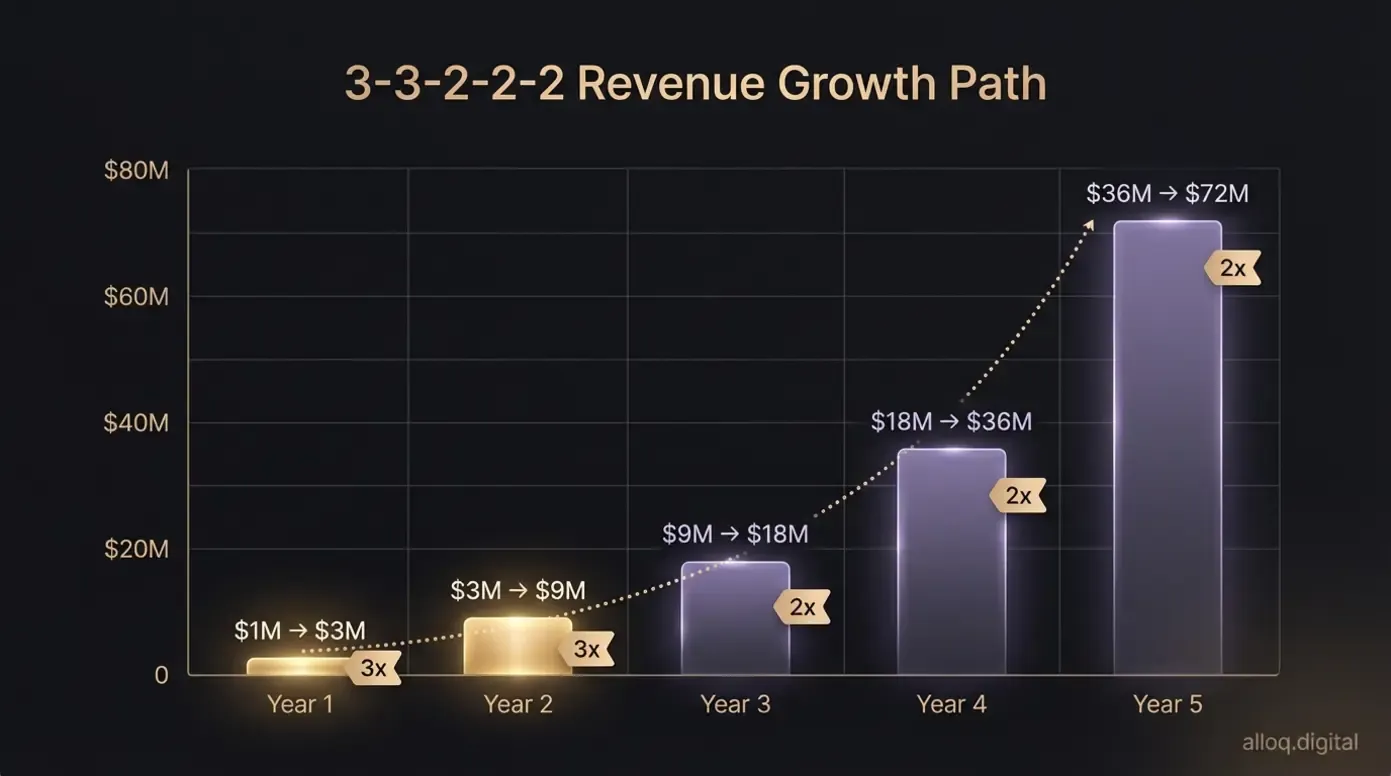 The 3-3-2-2-2 rule maps an aggressive revenue path - tripling ARR in Years 1-2, then doubling in Years 3-5 to reach $72M from a $1M starting point.
The Rule of 40 offers a more forgiving but equally important benchmark. According to Bain & Company’s analysis, the Rule of 40 states that a healthy SaaS company’s combined revenue growth rate and profit margin should exceed 40%. A company growing at 60% annually can afford a -20% profit margin. A company growing at 10% needs at least 30% margins. This metric forces developers and founders to think beyond features and into unit economics.
Equity matters too. For senior SaaS developer hires at early-stage startups, equity compensation typically ranges from 0.45% to 1.0%. Negotiating below this range may signal a company that undervalues technical talent. Negotiating above it requires demonstrating exceptional domain expertise or a proven track record.
For more on scaling strategies, explore B2B software growth strategies that complement these metrics with marketing fundamentals.
Essential SaaS Tech Stack & Skills
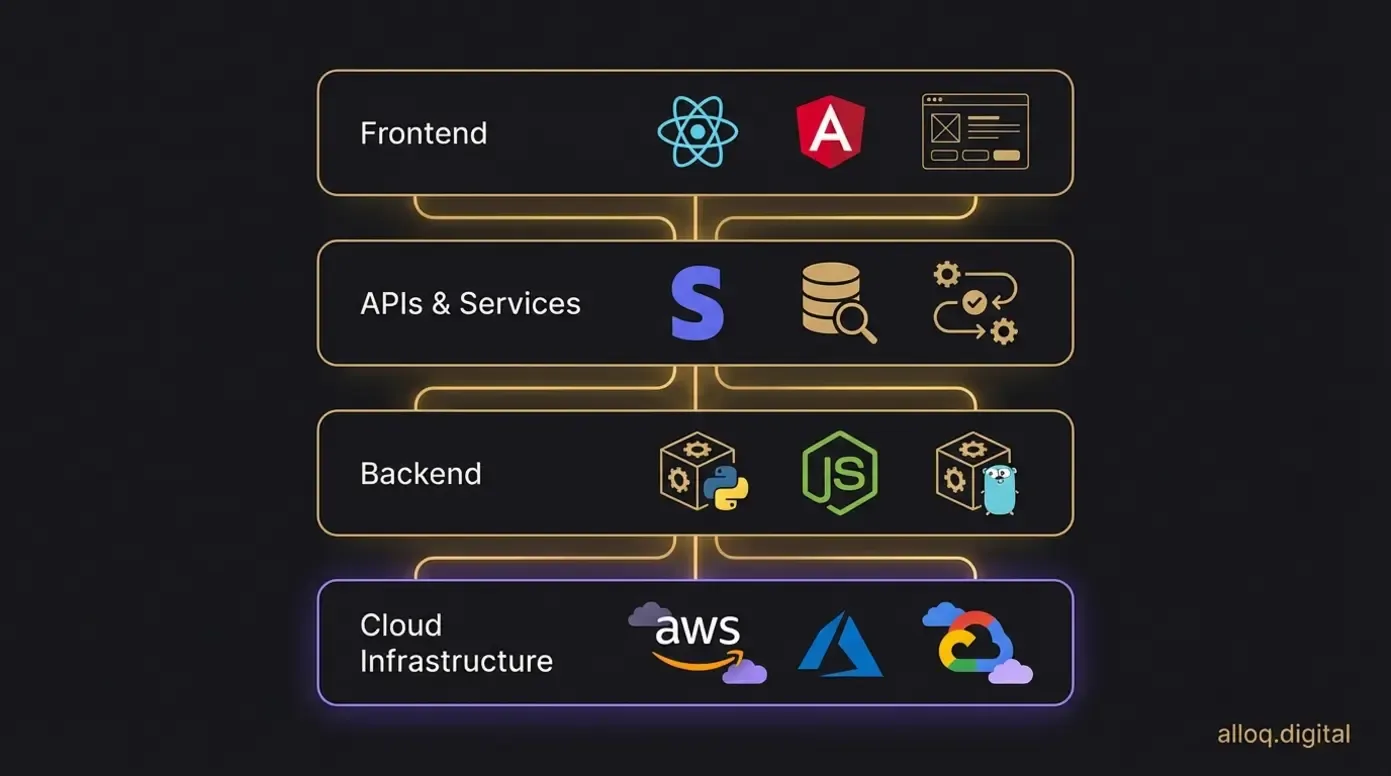 A production-ready SaaS tech stack in 2026 spans four layers - from cloud infrastructure through backend and API services to the frontend experience.
Choosing the right tech stack is not about chasing trends. It is about selecting tools with proven ecosystems, strong community support, and compatibility with cloud-native SaaS patterns.
Backend & Cloud Infrastructure (Python, Node, AWS)
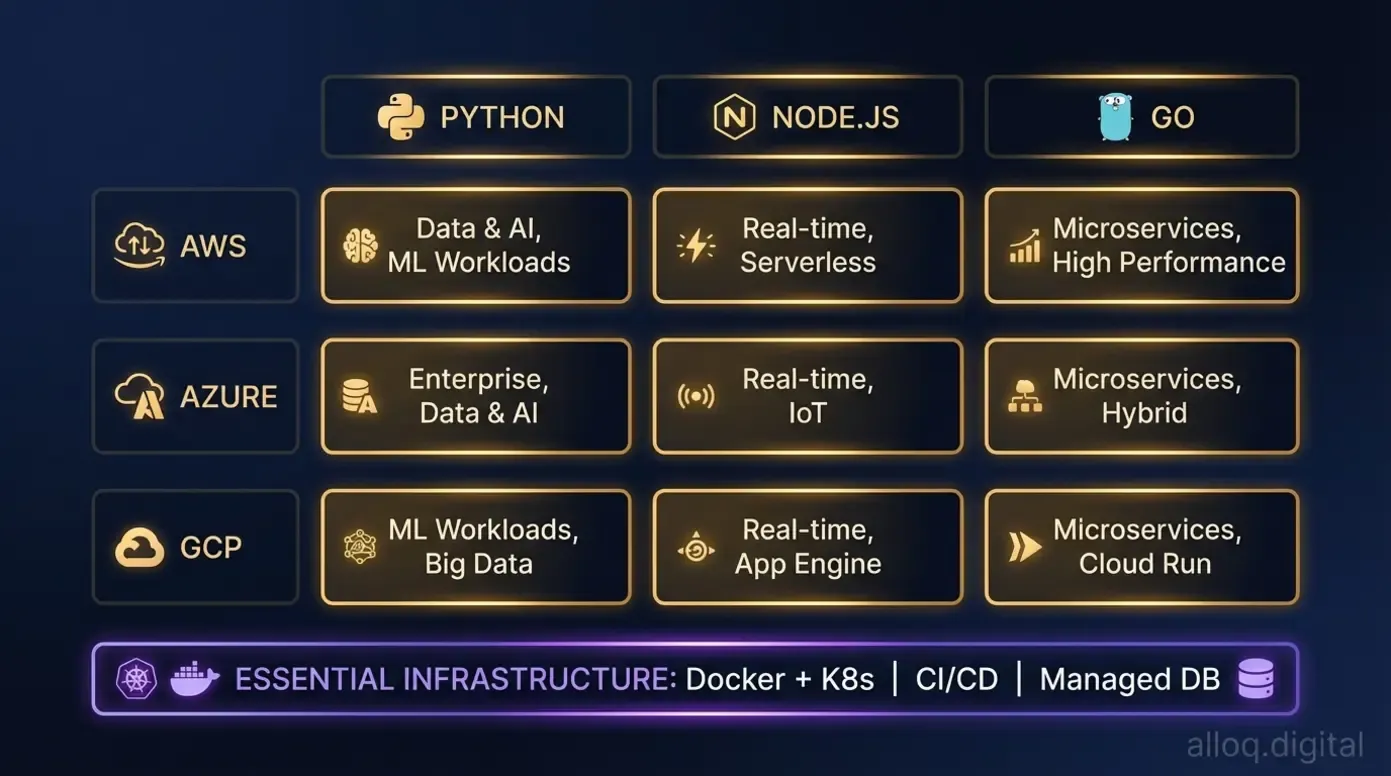 Backend language and cloud platform selection depends on your product’s requirements - from Python’s AI strengths to Go’s microservice performance and AWS’s multi-tenancy control.
Your backend and cloud infrastructure choices determine your product’s ceiling. Here is what a production-ready SaaS stack looks like in 2026:
Backend Languages:
- Python (Django/Flask): Strong for data-heavy applications, AI integrations, and rapid prototyping
- Node.js (Express/NestJS): Ideal for real-time features, event-driven architectures, and teams that want a unified JavaScript stack
- Go: Increasingly adopted for microservices requiring high concurrency and low latency
Cloud Platforms:
- AWS: Broadest service catalog. Best for teams needing granular control over multi-tenancy configurations
- Azure: Strong enterprise integration, particularly for B2B SaaS targeting Microsoft-centric organizations
- GCP: Competitive for machine learning workloads and BigQuery analytics
Essential Infrastructure:
- Container orchestration (Docker + Kubernetes) for consistent deployments
- CI/CD pipelines (GitHub Actions, GitLab CI) for automated testing and delivery
- Managed databases (PostgreSQL on RDS, or PlanetScale for MySQL) with tenant isolation
According to Paddle’s SaaS market report (2024), churn rate benchmarks vary significantly by sector, making backend reliability and uptime a direct revenue lever. As shown in the SaaS Tech Stack Ecosystem below, the architecture relies on seamless integration between these layers.
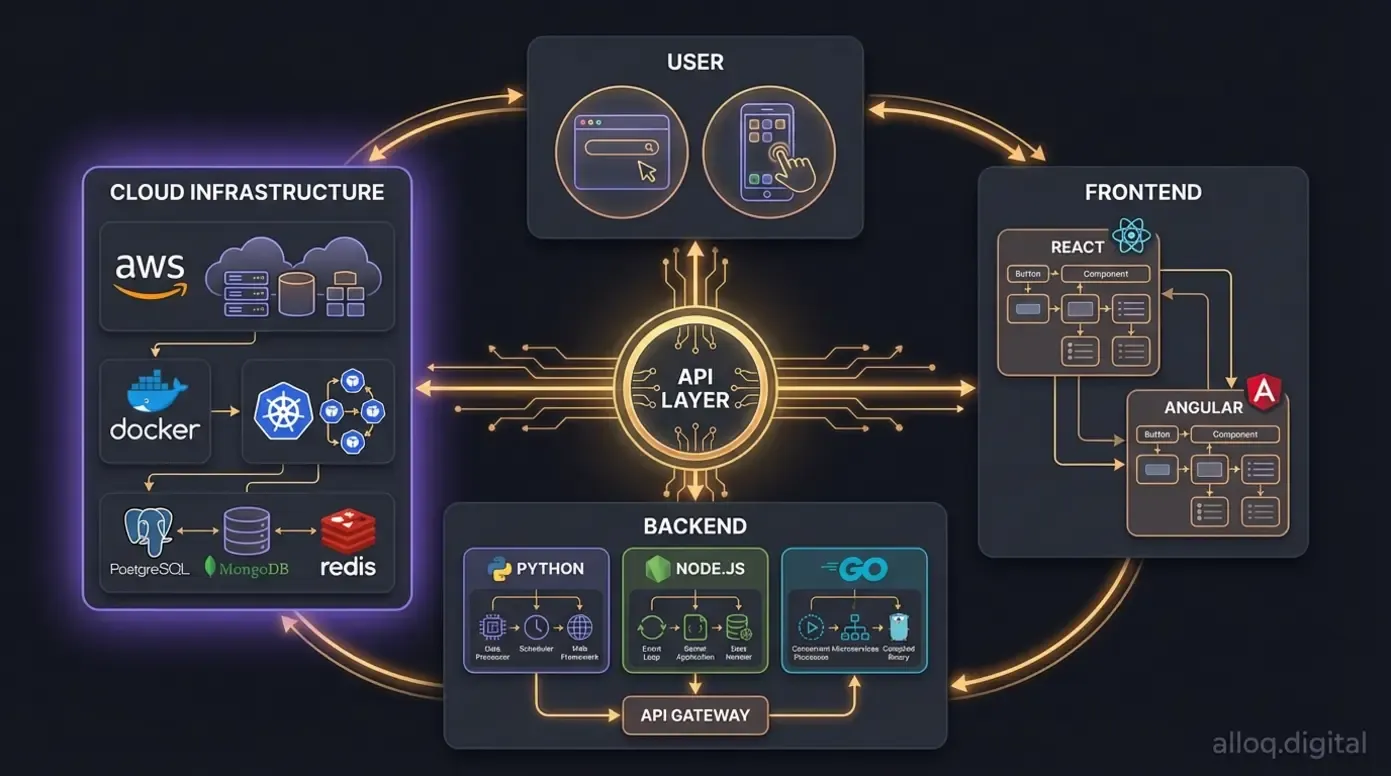
For guidance on selecting a modern web technology stack matched to your product requirements, start with your scalability targets and work backward.
Frontend Frameworks & API Integration
The frontend is where your users live. React and Angular remain the dominant frameworks for SaaS interfaces in 2026. React offers flexibility and a massive component ecosystem, making it well-suited for products with complex, interactive dashboards. Angular provides a more opinionated, batteries-included framework that larger teams often prefer for consistency.
Equally important is API-first design. Your frontend should communicate with the backend exclusively through well-documented APIs. This approach enables third-party integrations (Stripe for payments, Slack for notifications, Zapier for automation) without modifying core application logic. It also allows you to build mobile apps, partner integrations, or public developer APIs from the same backend.
Strong api development practices-versioning, rate limiting, and comprehensive documentation-distinguish professional SaaS products from hobbyist projects.
Sourcing & Hiring SaaS Talent
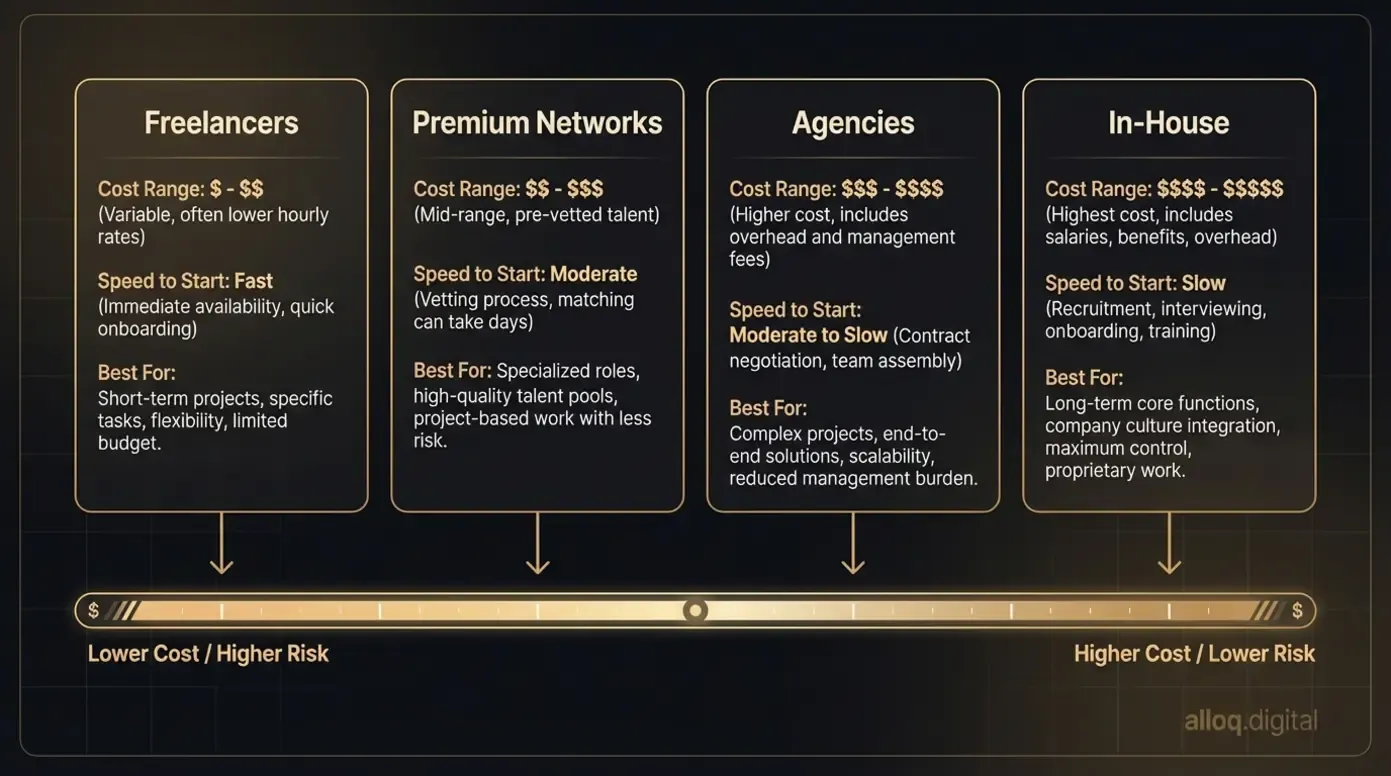 Each hiring model carries distinct trade-offs - freelancers offer speed and low cost, while in-house teams deliver reliability and long-term alignment at higher investment.
Knowing where and how to find the right saas developer for your project is often more challenging than the technical build itself. The three primary sourcing channels each carry distinct trade-offs.
Freelancers vs. Agencies vs. In-House
The right hiring model depends on your stage, budget, and timeline. Here is a direct comparison:
| Factor | Freelancers (Upwork, Fiverr) | Premium Networks (Toptal) | Agencies (Full Service) | In-House |
|---|---|---|---|---|
| Cost | $25–$80/hr | $80–$200/hr | $100–$250/hr | $120k–$200k/yr (salary) |
| Speed to Start | Days | 1–2 weeks | 2–4 weeks | 1–3 months |
| Reliability | Variable | Vetted, higher consistency | Contractually bound | Highest long-term |
| Best For | MVPs, small features | Complex builds, short engagements | End-to-end product development | Core product, long-term growth |
| Risk | Quality inconsistency | Higher cost | Less flexibility | Commitment, overhead |
As one founder noted in a professional community: “You can try with some freelancer developers on Upwork, Fiverr, etc. Or you can talk to software dev agencies if you have a big project.” This mirrors the general consensus-start lean, scale your team model as your product matures.
Equity considerations matter for in-house hires. According to Silicon Valley Bank’s startup equity data, early-stage SaaS companies typically offer senior developers between 0.45% and 1.0% equity. Offering below this range may make it harder to attract experienced talent. Offering above requires clear justification tied to the role’s strategic impact.
When vetting candidates, test for SaaS-specific knowledge: multi-tenancy patterns, subscription state management, and CI/CD fluency. A strong portfolio of web apps does not automatically translate into SaaS competence. Connect with an experienced SaaS developer who can demonstrate this domain expertise directly.
Micro-SaaS & Solopreneurship Strategies
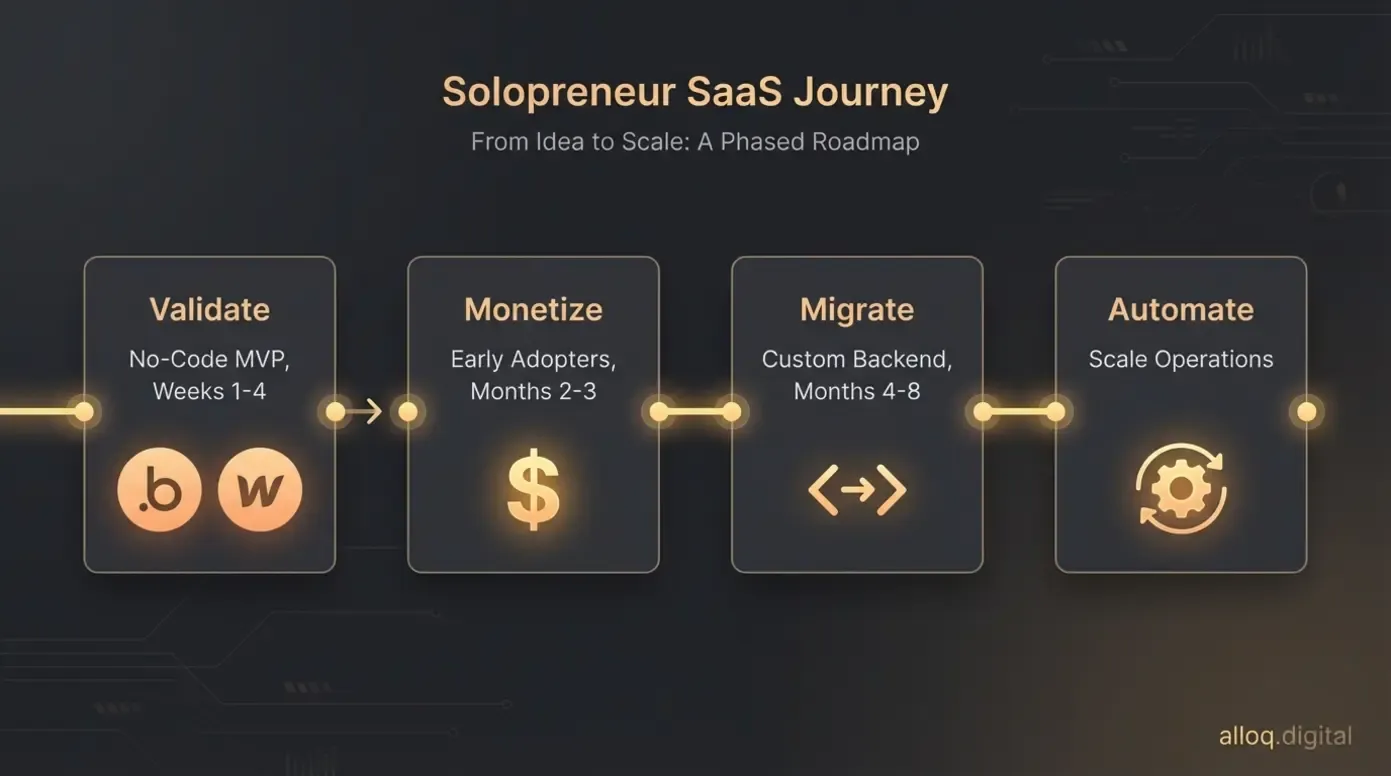 The practical solopreneur path - validate with no-code tools, monetize with early adopters, migrate to custom code, and automate to scale without hiring.
Not every SaaS product needs venture funding or a ten-person engineering team. The Micro-SaaS model-small, focused products built by one or two people-offers a realistic path to $5k–$10k in monthly recurring revenue.
Bootstrapping with No-Code & Low-Code
Can you start a SaaS business with no money? Practically, yes. Tools like Bubble, Webflow, and Glide allow solopreneurs to build functional MVPs without writing code. Free-tier cloud services (AWS Free Tier, Firebase Spark) handle hosting for early-stage products with minimal traffic.
The key advantage of no-code tools is speed. You can validate a product idea in weeks rather than months. Build a minimal version, get it in front of ten paying users, and learn whether the problem is real before committing significant capital.
But recognize the ceiling. No-code platforms introduce constraints around customization, performance, and data portability. Once your product reaches a certain complexity-typically 50+ active users or enterprise-grade compliance requirements-you may need to migrate to custom development. This transition is expensive if not planned for from the start.
A practical path looks like this:
- Validate with no-code (Weeks 1–4)
- Monetize with a minimal version and early adopters (Months 2–3)
- Migrate core logic to a custom backend as revenue supports it (Months 4–8)
- Automate repetitive workflows to reduce operational overhead
For solopreneurs looking to reduce manual work early, explore automating business workflows as a force multiplier before hiring additional team members.
These frameworks-the Rule of 40, the 3-3-2-2-2 trajectory, and equity benchmarks-are not academic exercises. They are the metrics that determine whether your product attracts investment, retains talent, and survives its first three years. A 2024 Bain & Company analysis of software companies found that those consistently meeting the Rule of 40 generated shareholder returns more than double their peers.
According to Simon, SaaS Architect at alloq.digital, the shift toward AI-driven development in 2026 makes these business fundamentals even more important. “AI tools can accelerate code output, but they cannot replace architectural decisions or growth strategy. The developers who thrive are the ones who understand both.”
This specific data helps you evaluate hiring candidates, assess your own product’s trajectory, and make informed build-vs-buy decisions rather than relying on generic advice.
Common Pitfalls & Risks in SaaS Development
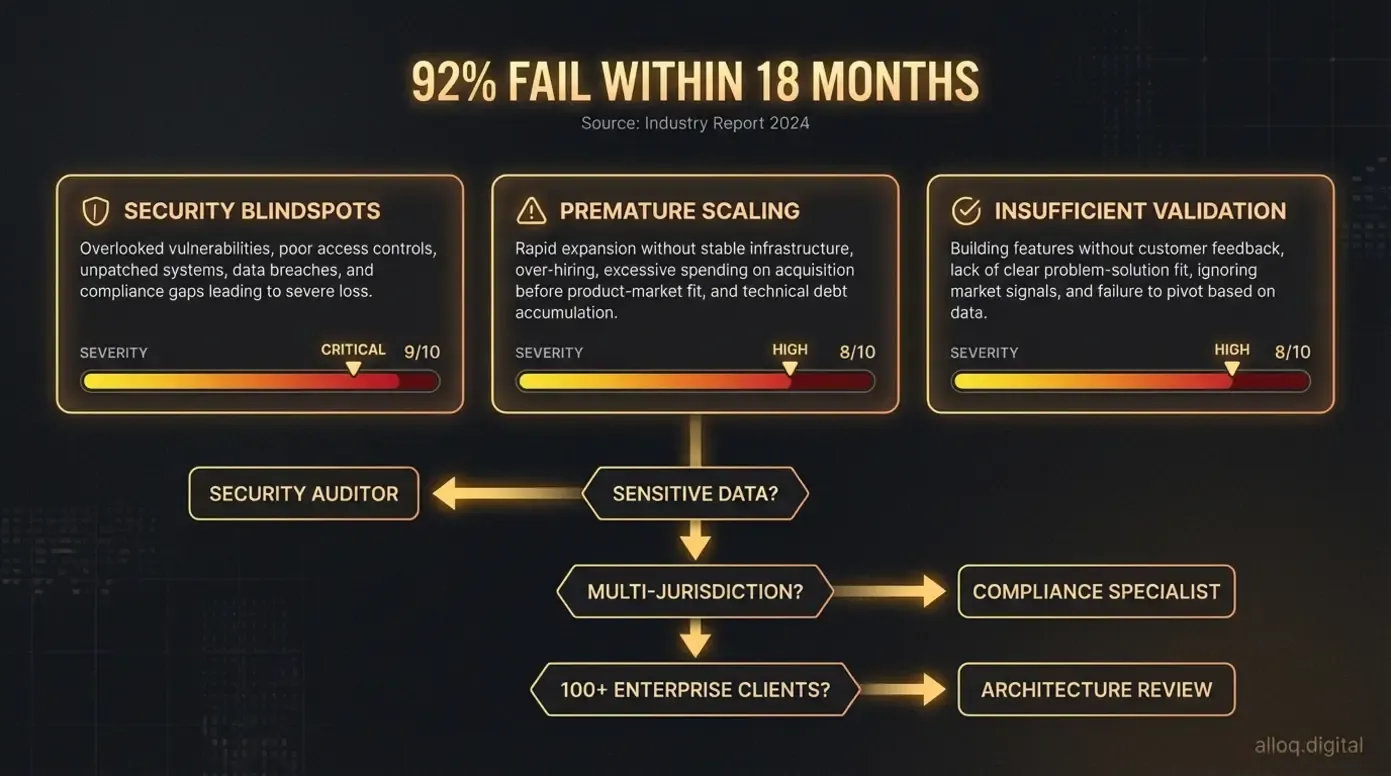 92% of Micro-SaaS products fail within 18 months - security blindspots, premature scaling, and insufficient market validation are the primary causes, not technical shortcomings.
Building a SaaS product carries specific risks that technical enthusiasm alone cannot solve. Acknowledging these early can save months of wasted effort and significant financial loss.
Security & Compliance Blindspots
Scalability and security failures are the most common reasons SaaS products lose enterprise customers. Multi-tenant applications face a unique threat surface: a vulnerability in shared infrastructure can expose every customer’s data simultaneously.
The OWASP Top 10 (2025) identifies broken access control as the number one web application security risk. In a multi-tenant SaaS context, this means a single misconfigured API endpoint can allow one tenant to access another tenant’s data. This is not a theoretical risk. It happens regularly in production environments.
Common pain points reported by developers include underestimating the compliance burden. If your SaaS handles personal data in Europe (GDPR) or health data in the US (HIPAA), you need dedicated compliance expertise. Attempting to handle this without professional guidance is a liability.
Industry data suggests that approximately 92% of Micro-SaaS products fail within 18 months. The primary causes are not technical-they are premature scaling, insufficient market validation, and underinvestment in security.
If any of the following apply, consult a qualified professional:
- Handling sensitive data: Engage a security auditor before launch
- Operating across jurisdictions: Work with a compliance specialist for GDPR/HIPAA
- Scaling beyond 100 enterprise clients: Commission a formal architecture review
When to Hire a Pro vs DIY
No-code and low-code tools are effective for validating an idea and acquiring your first paying customers. They are not designed for production-scale SaaS products serving enterprise clients.
The transition point typically arrives when you encounter one of these situations: your application needs complex role-based access control, your database requires tenant-level isolation for compliance, or your user base exceeds what your no-code platform can handle without performance degradation. At that stage, custom development is not optional-it is the cost of continued growth.
Frequently Asked Questions
What is a SaaS developer?
A SaaS developer is a specialized software engineer who builds, deploys, and maintains cloud-based applications delivered via a subscription model. They focus on multi-tenancy architecture, recurring billing integrations, and high scalability on platforms like AWS or Azure. Unlike standard web developers, they architect systems where a single codebase serves multiple distinct customers securely.
Is SaaS a coding language?
No, SaaS (Software as a Service) is a software delivery model, not a coding language. SaaS applications are built using standard programming languages like Python, Node.js, and PHP, combined with frontend frameworks like React or Angular. The term refers to how software is licensed and accessed by end users, not how it is written.
Can I start a SaaS business with no money?
Yes, it is possible to build a Micro-SaaS with minimal capital using no-code tools and free-tier cloud services. Solopreneurs often validate ideas with a minimal viable product before investing significant funds. However, scaling to a commercial level typically requires investment in hosting, marketing, and custom development features over time.
How much money do I need to start a SaaS?
The cost to build a professional SaaS platform typically ranges from $50,000 to $150,000, depending on complexity and team structure. Factors include the choice between freelancers and agencies, the tech stack, and feature scope. A solopreneur handling development personally can launch for significantly less, primarily covering server and marketing costs.
What is the 3-3-2-2-2 rule of SaaS?
The 3-3-2-2-2 rule is a revenue growth benchmark for high-performing SaaS startups. It suggests tripling revenue for two consecutive years, then doubling it for three consecutive years. Venture capitalists use this trajectory to identify companies with strong scalability and product-market fit, though it is an aggressive target that few companies fully achieve.
Your SaaS Blueprint Starts With Architecture, Not Code
The difference between a SaaS product that scales and one that stalls comes down to preparation. Technical fundamentals-multi-tenancy, billing logic, cloud-native infrastructure-form the foundation. Growth frameworks like the Rule of 40 and the 3-3-2-2-2 rule provide the benchmarks. And the right hiring strategy ensures you have the saas developers who can execute on both.
Whether you choose to bootstrap with no-code tools, hire a freelance developer from Upwork, or partner with a specialized agency, the approach matters less than the blueprint behind it. A scalable SaaS product is an asset. Code without architecture and metrics is just a project.
Start by auditing your current stack against the fundamentals outlined here. Map your growth trajectory against the 3-3-2-2-2 benchmarks. And if the gap between where you are and where you need to be feels too wide to bridge alone, reach out to qualified experts who have built and shipped production SaaS products. The blueprint is clear. The next step is yours.