
Agentic AI vs. AI Agents: Why the Confusion Costs You
“Agent” has become the default label for almost anything with a language model inside. Vendors call their chatbots agents, their copilots agents, their workflow scripts agents. Somewhere under that marketing fog sits a real architectural distinction. One that determines how you scope projects, allocate budget, and decide what to build first.
Here is the one-sentence rule: an AI agent is a building block that executes a well-defined task; agentic AI is the coordinated system that plans and manages multi-step workflows built from those blocks.
Commercially, this matters, not just semantically. Teams that conflate the two either over-engineer a multi-agent platform for a problem one reliable agent would solve, or they deploy a dozen disconnected point agents and wonder why the workflow still fragments. Both paths stall ROI. Gartner has publicly predicted that companies will scrap a large share of their agentic AI projects within the next few years - and unclear scope ranks as a predictable contributor.
This article gives you sharp definitions of both terms, a comparison table, an autonomy spectrum from chatbot to multi-agent system, direct answers to common questions like whether ChatGPT counts as agentic, and a practical framework for your build decision.
What Is Agentic AI?
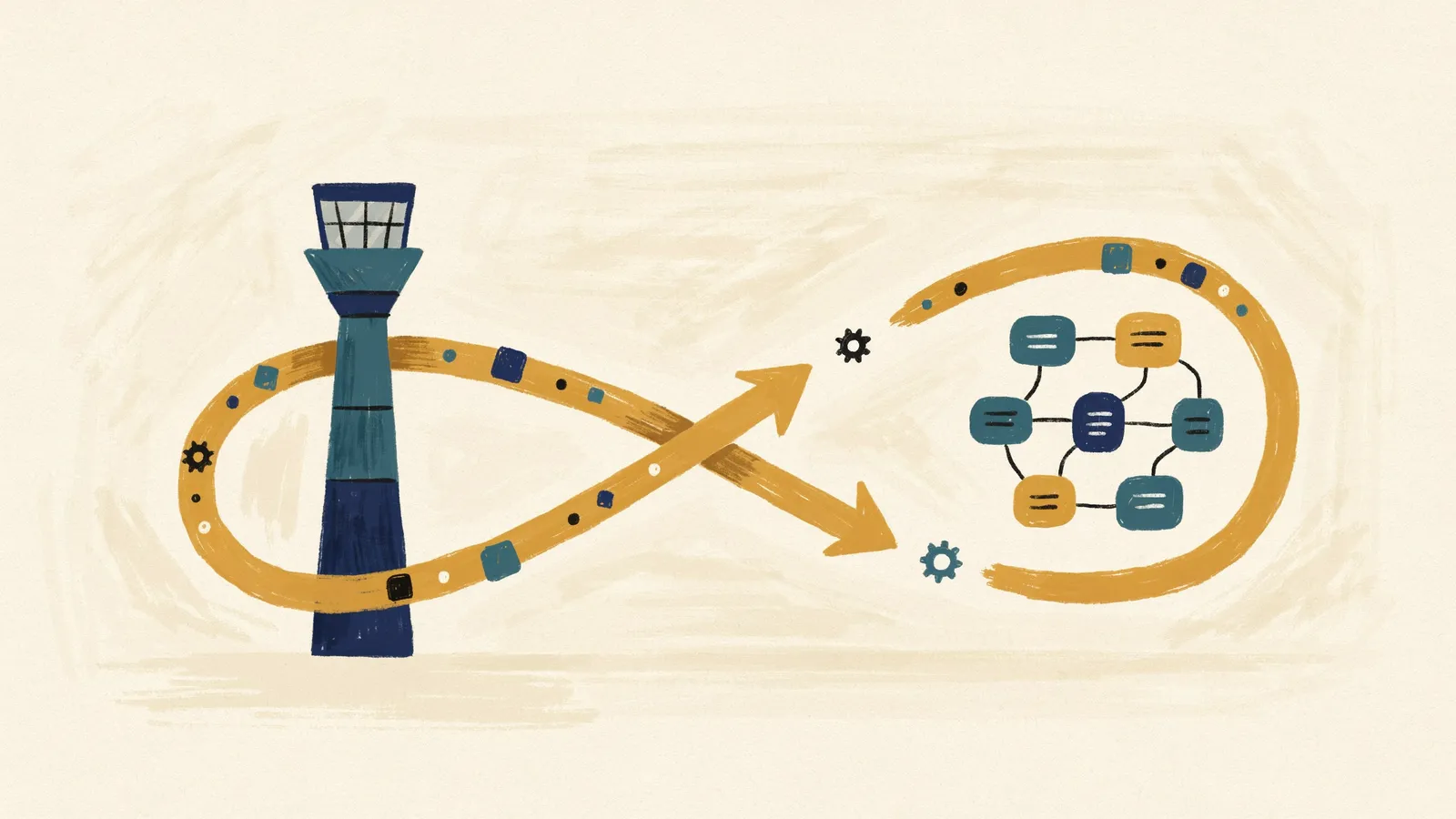
Agentic AI is a system that pursues a goal by coordinating multiple AI agents, tools, and data sources. It reasons about the objective, plans a sequence of steps, selects the right agents for each step, and adapts the plan as conditions change - all with limited human oversight rather than step-by-step instructions.
The key phrase is “pursues a goal.” Agentic AI operates at the workflow and outcome level, not the single-task level. Give an agentic system a specific goal, and it formulates a plan, then iteratively executes tasks - using the outcomes of previous steps to refine subsequent ones. A loop of perception, reasoning, planning, action.
A conceptual taxonomy on arXiv describes this as a paradigm shift: the taxonomy identifies multi-agent collaboration, dynamic task decomposition, persistent memory, and coordinated autonomy as defining traits, in contrast to AI agents as modular, task-specific systems.
Concretely: an agentic procurement system does not just extract data from one invoice. It receives a purchase request, checks budget against the ERP, retrieves supplier terms, drafts the order, routes exceptions to a human, and confirms delivery status - across several systems, without a person driving each step. The same pattern shows up in incident resolution, research automation, and agentic AI in customer service, where orchestration across ticketing, knowledge base, and CRM is the whole point.
The defining capability is orchestration: shared context between agents, planning across systems, and goal-directed reasoning that decides what happens next.
What Is an AI Agent?

An AI agent is a software system that perceives information, reasons over it, and takes action to achieve a defined goal - usually a single, well-scoped task such as retrieving a record, validating data, classifying a document, or routing a request inside the domain and permissions its builders define.
That perceive-reason-act loop distinguishes an agent from a plain script or a chatbot. In practice, a modern agent is a model wrapped in a harness of tools, memory, and execution logic that carries out a specific task - a framing JetBrains uses in its comparison of the two terms. The agent decides how to complete its task, but only inside the domain, permissions, and triggers its builders define.
The idea itself is not new. Long before language models, classic AI research framed an agent as anything that perceives its environment and acts on it, and textbooks catalogued a hierarchy of agent types decades ago. What changed is the engine: today’s models supply the reasoning that early rule-based and search-based agents lacked, but the underlying vocabulary carried straight over. That lineage explains why the categories still map cleanly to today’s systems:
- Reactive agents respond directly to inputs with predefined behaviors.
- Model-based agents maintain an internal state of their environment.
- Utility-based agents weigh options against a scoring function.
- Learning agents improve their behavior from feedback over time.
The important architectural point: an individual agent is a building block. It can run standalone - an invoice-extraction agent, a lead-qualification agent - or serve as one component inside a larger agentic system. For a deeper breakdown of what AI agents are and how they work, including how they differ from chatbots and RPA, see our dedicated explainer.
Agentic AI vs. AI Agents: The Key Differences (Comparison Table)
Agents execute tasks. Agentic AI manages outcomes. That’s the core distinction in one line. The table breaks it down along the dimensions that actually matter for architecture decisions.
| Dimension | AI Agent | Agentic AI |
|---|---|---|
| Scope | Single, well-defined task | Broad goal spanning a multi-step workflow |
| Autonomy | Bounded - acts within preset parameters and triggers | Adaptive - re-plans as conditions change |
| Number of agents | One | Multiple, often specialized |
| Coordination | None - operates in isolation | Orchestration layer with shared context |
| Planning | Fixed or limited to the task at hand | Dynamic, multi-step, revised mid-execution |
| Memory | Task-scoped, often short-lived | Persistent across steps and agents |
| Example | Agent that extracts data from an invoice | System that runs procurement end to end: request, budget check, supplier selection, order, exception handling |
The pattern holds across serious sources: an AI agent is a doer that executes predefined tasks with narrow focus, while agentic AI is a planner that sets goals, makes decisions, adapts, and orchestrates multiple agents to achieve outcomes.
One nuance worth naming: JetBrains argues that “agentic” describes a behavioral quality - the capacity to pursue a goal across steps and make bounded decisions - while an agent is the software system that exhibits it. That reading fits the table above. Industry usage, though, has settled on the system-level meaning: coordinated, multi-agent, goal-directed architecture.
The Autonomy Spectrum: From Chatbot to Multi-Agent System
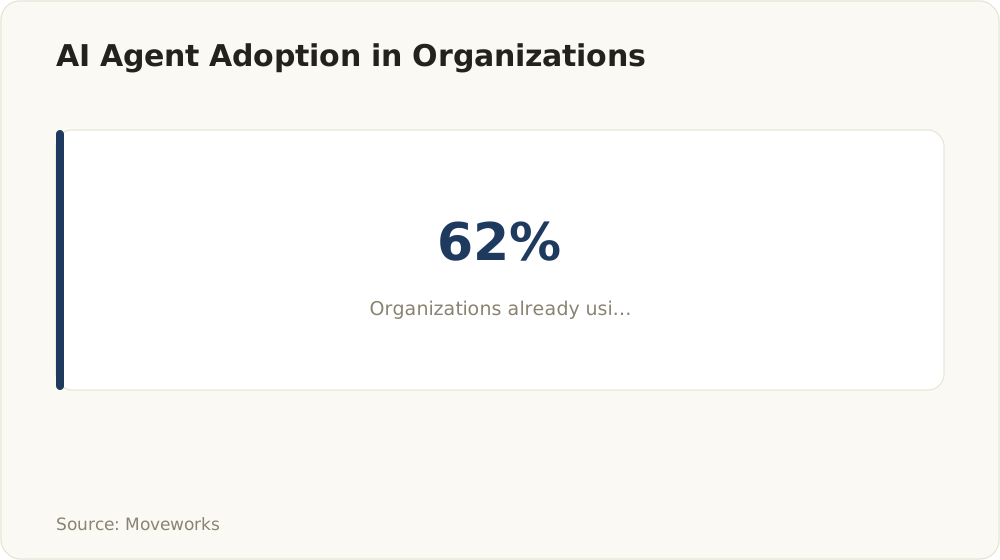
Adoption share reported for AI agents, with most deployments at task-specific levels rather than full multi-agent orchestration.
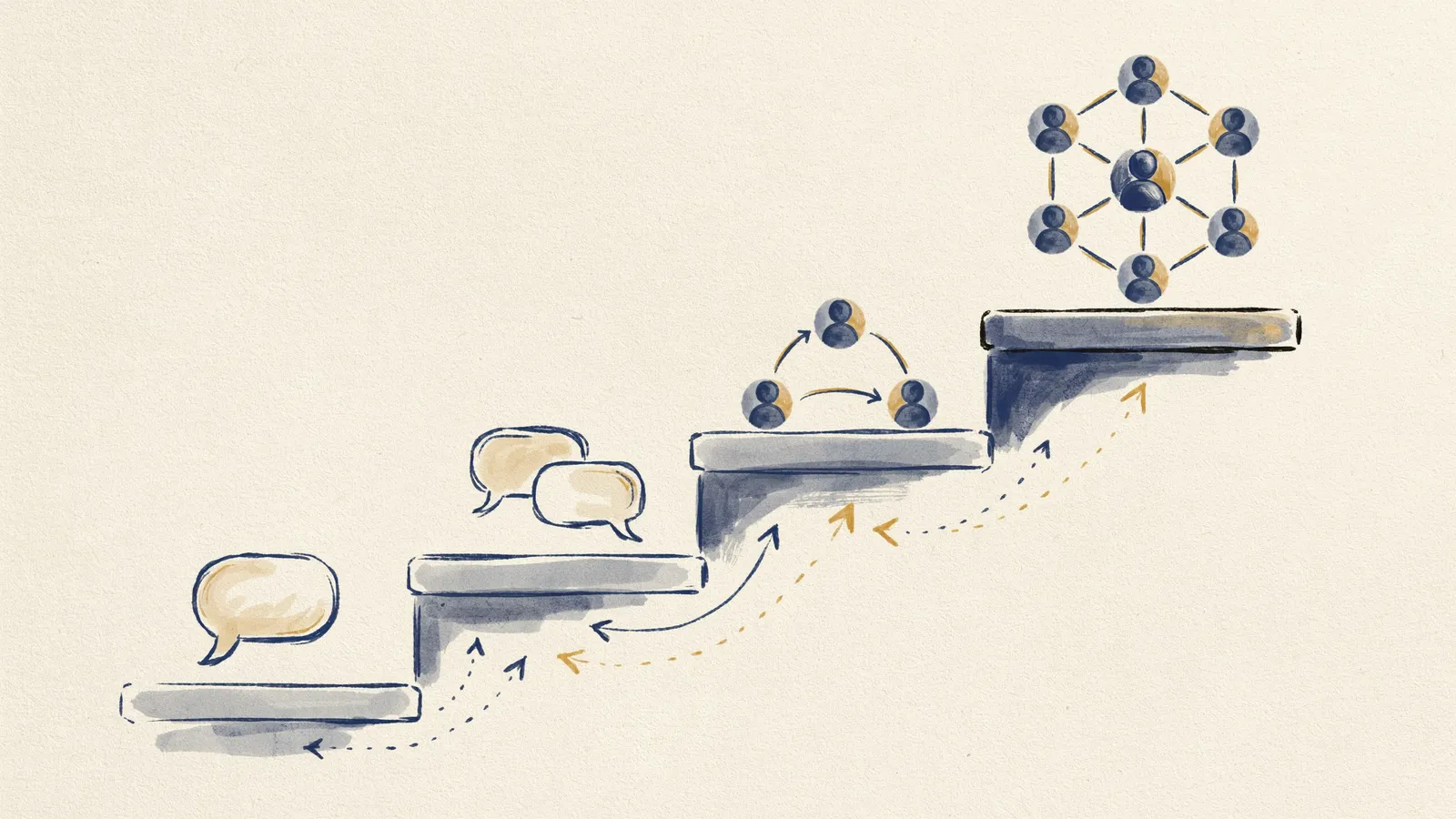
“Is it agentic or not?” The binary framing misleads more than it clarifies. Autonomy is a progression, and each step adds a specific capability:
- Chatbot. Responds to prompts. No tools, no goals, no memory beyond the conversation. Generative, not agentic.
- Tool-using agent. Acts on a single task: calls APIs, queries databases, executes a bounded workflow. Adds tool use and task-level reasoning.
- Agent with memory and planning. Decomposes its task into steps, retains context across them, retries on failure. Agent-like behavior, still single-agent.
- Multi-agent orchestration. A coordinating layer distributes work across specialized agents, maintains shared context, and adapts the overall plan. This is agentic AI.
First tools, then planning and memory, then coordination - each level adds exactly one thing. We cover this progression in depth in our guide on why autonomy sits on a scale, not a binary, including the guardrails each level requires.
Where do most deployments actually sit? Lower than the hype suggests. A vendor analysis from Moveworks reports that 62% of organizations already use AI agents, but the bulk of those sit at levels 2-3: task-specific agents embedded in existing applications, not autonomous multi-agent systems. Full level-4 orchestration remains the exception in production. Reliability drives that gap - agents that solve a task once often fail to complete the same task consistently across many repeated runs.
Is ChatGPT an Agentic AI?
ChatGPT on its own is a generative AI chatbot, not agentic AI. It becomes agent-like when it plans, uses tools, and takes actions - for example through its agent modes or custom GPTs with API access - but a single tool-using assistant is still not a coordinated multi-agent agentic system.
The distinction runs between the base model and what teams configure on top of it. Base ChatGPT sits at level 1 of the spectrum: it generates responses. Enable browsing, code execution, or agent mode, and it climbs to level 2-3: it acts toward a goal with tools and some planning. That is agent behavior.
The threshold to agentic AI is orchestration. When a system coordinates multiple specialized components - a research agent, a drafting agent, a validation agent - with shared context and a plan that adapts, it crosses into agentic territory. A ChatGPT-based assistant can serve as one agent inside such a system; it is not the system itself. Same logic for Claude, Gemini, and every other foundation model with tool access.
Who Are the Big Players in AI Agents Today?
The AI agent landscape has no official “big four,” despite what search suggestions imply. The influential names generally fall into three categories: foundation-model providers whose models power agents, frameworks developers use to build and connect agents, and enterprise platforms that embed agentic orchestration. Which category matters depends on what you need.
The categorization helps more than any ranking:
- Models with agent capabilities: ChatGPT, Claude, and Gemini are foundation models that exhibit agent behavior when given tools and goals. They are the reasoning engine, not the architecture.
- Agent frameworks: LangChain, CrewAI, and AutoGPT are toolkits developers use to build agents and wire them together. These framework-layer tools are where developers assemble agentic systems.
- Agentic platforms: Productized systems that ship orchestration, governance, and integrations out of the box. This is where vendor marketing runs loudest and definitions run loosest. One category with visible production traction is agentic AI coding tools, where multi-step planning and tool use already deliver measurable output.
A practical warning: evaluate the architecture, not the label. Vendors rebrand rule-based automation as “agentic” because the term sells. Ask how the system plans, what context agents share, where humans intervene. And weigh lock-in before you commit a core workflow to any single platform’s orchestration layer.
When Does an AI Agent Become Agentic AI?
An AI agent becomes agentic AI when a coordinating layer adds shared context, planning, and goal-directed reasoning across multiple agents. Simply running several agents in parallel is not agentic - without orchestration, each agent executes independently, and the result is a set of isolated automations rather than a managed workflow.
This is the most misunderstood point in the entire debate. More agents does not equal agentic AI. Ten disconnected agents handling ten disconnected tasks are still ten point solutions - exactly the fragmented-automation trap many companies fall into. What makes a system agentic is coordination, planning, and goal-directed reasoning across those agents.
The practical test has three questions:
- Does the system plan across systems? The question is not whether agent A finishes its task, but whether something decides what happens next based on the overall goal.
- Does it adapt? If a step fails or conditions change, does the system revise its plan, or does the workflow just stop?
- Is context shared? Do downstream agents know what upstream agents did, or does each start blind?
Three yeses mean agentic. Anything less means agents - possibly excellent ones, but agents.
The same test separates agentic AI from its neighbors. RPA follows fixed, rule-based scripts: deterministic, brittle when inputs change, with no reasoning. A chatbot responds to prompts without pursuing goals. Agentic AI reasons about a goal, plans across systems, adapts - precisely why it is harder to govern, and why the arXiv taxonomy flags coordination failure and emergent behavior as challenges specific to the agentic paradigm.
What This Means for Your Build Decision
Your build decision comes down to sequencing: start with a single well-scoped agent for the task with the clearest ROI, then add orchestration only when a genuine cross-system workflow demands it. The definitional clarity between agents and agentic AI translates directly into this architecture strategy, with governance treated as a design requirement.
Start with well-scoped agents. Identify the single task with the clearest ROI - ticket triage, data extraction, lead enrichment - and build one reliable agent for it. A single agent that works beats a multi-agent system that demos well and fails in production.
Add orchestration only when the workflow demands it. The trigger is a genuine cross-system workflow: multiple steps, multiple tools, decisions between steps. If your process runs linear and single-system, an orchestration layer adds cost and failure modes without adding value. Not every problem needs agentic AI; many need one dependable agent.
Treat governance as a design requirement, not an afterthought. At the agentic level, systems make consequential decisions across your stack. Human-in-the-loop checkpoints for high-stakes actions, audit trails for every agent decision, explicit permission boundaries - these stay non-negotiable. Agents currently show significant consistency gaps between single-run and repeated execution, so review loops are not optional overhead. They make the system production-grade. Designing humans into the loop is a performance decision, not just a compliance one.
Own the architecture decision. The difference between a demo and a production system is rarely the model. It is senior technical ownership of scoping, error handling, and the choice of where autonomy ends. Build in-house or with a partner - either way, someone accountable answers three questions. Which tasks get agents? Where does the orchestration boundary sit? Who intervenes when the system hits a situation its design never anticipated?
The terminology debate resolves into a simple planning tool. Agents are your building blocks; agentic AI is the system you may eventually need. Companies that get this sequencing right ship automation that compounds. Companies that skip the distinction ship either an expensive orchestration layer with nothing worth orchestrating - or a pile of point agents that never becomes a system.
FAQ
What is the concept of agentic AI?
Agentic AI is the concept of AI systems that pursue goals autonomously by coordinating multiple agents, tools, and data sources. Such a system perceives its environment, reasons about the objective, plans a sequence of actions, executes them, and adapts to changing conditions - with limited human oversight instead of step-by-step instructions.
Can a single AI agent be agentic AI?
A single tool-using agent exhibits agent-like autonomy - planning, acting, adapting within its task - but most definitions reserve agentic AI for systems that orchestrate multiple agents with shared context. Some sources treat agentic as a behavioral quality any sufficiently autonomous agent can show; the dominant industry usage means the coordinated multi-agent system.
What is the difference between agentic AI and generative AI?
Generative AI creates content - text, images, code - in response to prompts and stops there. Agentic AI takes goal-directed action: it plans, executes tasks across systems, and adapts. The two connect closely: generative models typically provide the reasoning engine inside agentic systems, serving as the foundation the agentic architecture builds on.
Which tools are AI agents and which are agentic AI systems?
ChatGPT, Claude, and Gemini are foundation models that behave like agents when configured with tools and goals. LangChain, CrewAI, and AutoGPT are frameworks for building agents and connecting them. Agentic AI systems are the orchestrated multi-agent architectures teams assemble from these parts - a property of the architecture, not any single product.