
SEO for Software Companies: B2B Framework That Builds Pipeline

You have a powerful product. Your engineers spent months building features that solve real problems. Yet when a CTO searches for the exact solution you offer, your competitor’s mediocre blog post appears first. That gap between product quality and search visibility is where most B2B software companies lose deals before a conversation ever starts.
The cost of that gap compounds. A six-month enterprise sales cycle means every lost organic touchpoint delays pipeline by quarters, not days. When your documentation doesn’t rank, when your comparison pages don’t exist, and when your content targets the wrong stage of the buyer journey, you hand qualified leads to competitors who simply showed up earlier in the research process.
This guide introduces the Developer-First & Pipeline-Proven Framework—a strategy built specifically for SEO for software companies operating in complex B2B markets. You will learn how to map keywords to each stage of the SaaS buyer journey, turn API documentation into a ranking asset, build measurable authority through technical case studies, and prove exact ROI with multi-touch attribution. Every section includes actionable steps you can implement this week.
Key Takeaway
Effective SEO for software companies requires aligning technical documentation with the B2B buyer journey to capture high-intent leads at every stage of a long sales cycle.
- Focus on Developer-First technical SEO, including API and documentation indexing
- Map keywords to Awareness, Consideration, and Decision stages for targeted content
- Implement Multi-Touch Attribution to prove ROI on enterprise deals
- Build E-E-A-T with verifiable case studies, structured data, and expert-led content
- Audit technical assets regularly to avoid schema debt and zero-click risks
Specialized SEO Strategy for Software & IT
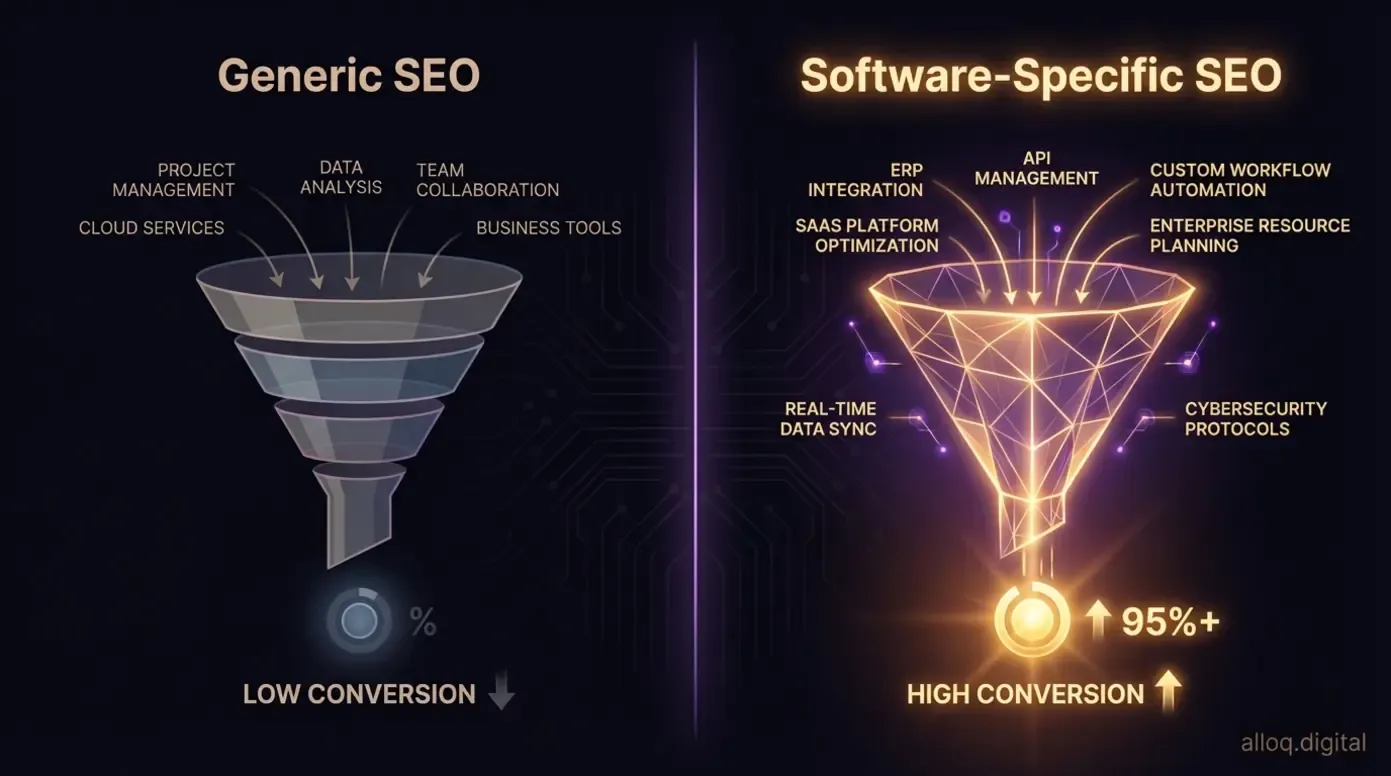 Generic SEO tactics optimize for volume, while software-specific SEO targets the technical intent and buyer journey stages that drive actual pipeline.
SEO for software companies fails when it borrows playbooks designed for e-commerce or local businesses. A B2B software buyer doesn’t impulse-purchase a $50,000 annual contract after reading one blog post. Research suggests that these buyers engage multiple stakeholders, evaluate competing solutions over months, and consume dozens of content pieces before requesting a demo. Your SEO strategy must account for every one of those touchpoints.
General SEO tactics often miss the mark because they optimize for volume rather than intent. Ranking for a high-volume keyword like “project management” may drive traffic, but that traffic rarely converts when your product is an enterprise resource planning platform for manufacturing. The real opportunity lies in targeting the specific technical language your buyers already use—phrases like “ERP integration for discrete manufacturing” or “API-first project management for DevOps teams.” These queries carry commercial intent that generic terms never will.
The framework that follows addresses three interconnected challenges: mapping the right keywords to each stage of the buyer journey, overcoming the ranking difficulty inherent in complex B2B products, and proving that your organic content actually contributes to closed revenue. Without all three, you either attract the wrong audience, can’t compete, or can’t justify continued investment.
Mapping Keywords to the SaaS Buyer Journey
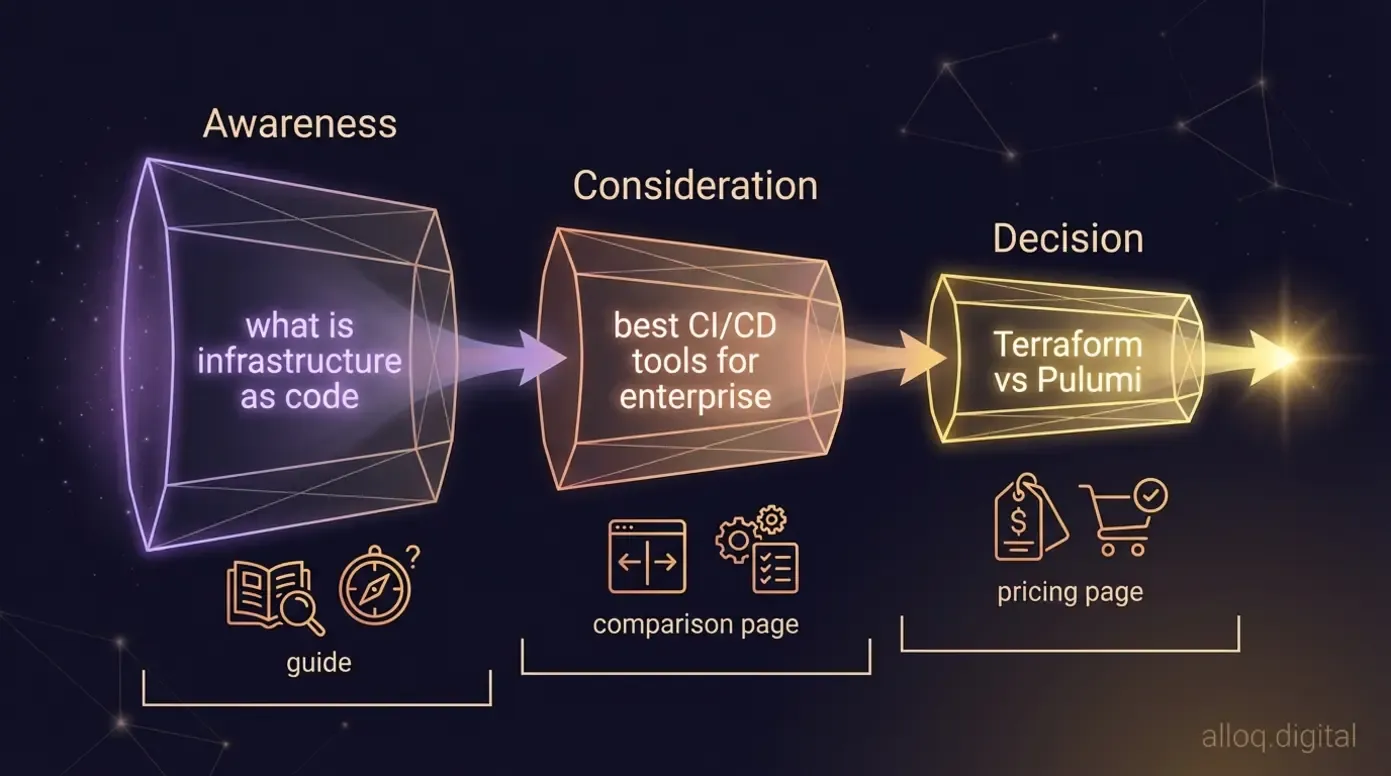 Mapping keywords to awareness, consideration, and decision stages ensures your content captures buyers at every point in the B2B evaluation cycle.
A strong digital marketing strategy for software companies starts with understanding that not every search query carries the same intent—or the same value.
Awareness-stage queries are informational. A prospect types “what is infrastructure as code” or “how to automate deployment pipelines.” They have a problem but haven’t started evaluating vendors. Content targeting these queries—guides, explainers, and educational posts—builds your topical authority and earns the first touchpoint.
Consideration-stage queries are categorical. The same prospect now searches “best CI/CD tools for enterprise” or “top infrastructure automation platforms.” They know a solution category exists and are building a shortlist. Category pages, feature comparisons, and pillar content serve this stage well.
Decision-stage queries are comparison-driven. The prospect is ready to evaluate specific options: “Terraform vs Pulumi for large teams” or “Product X pricing enterprise.” These high-intent phrases often have lower search volume but dramatically higher conversion rates. Prioritizing decision-stage keywords delivers quicker pipeline impact.
According to a 2025 Content Marketing Institute study, 71% of B2B marketers prioritize long-form articles for exactly this reason—longer content allows you to address each journey stage within a single asset or topic cluster.
The practical step: audit your existing content and tag each page by journey stage. Most software companies discover they have a surplus of awareness content and almost nothing targeting the decision stage. Fill that gap first.
For teams building their platform from the ground up, comprehensive SaaS platform development should account for SEO architecture from day one. As shown in the SaaS Buyer Journey Keyword Map below, aligning architecture with these stages creates a robust foundation.
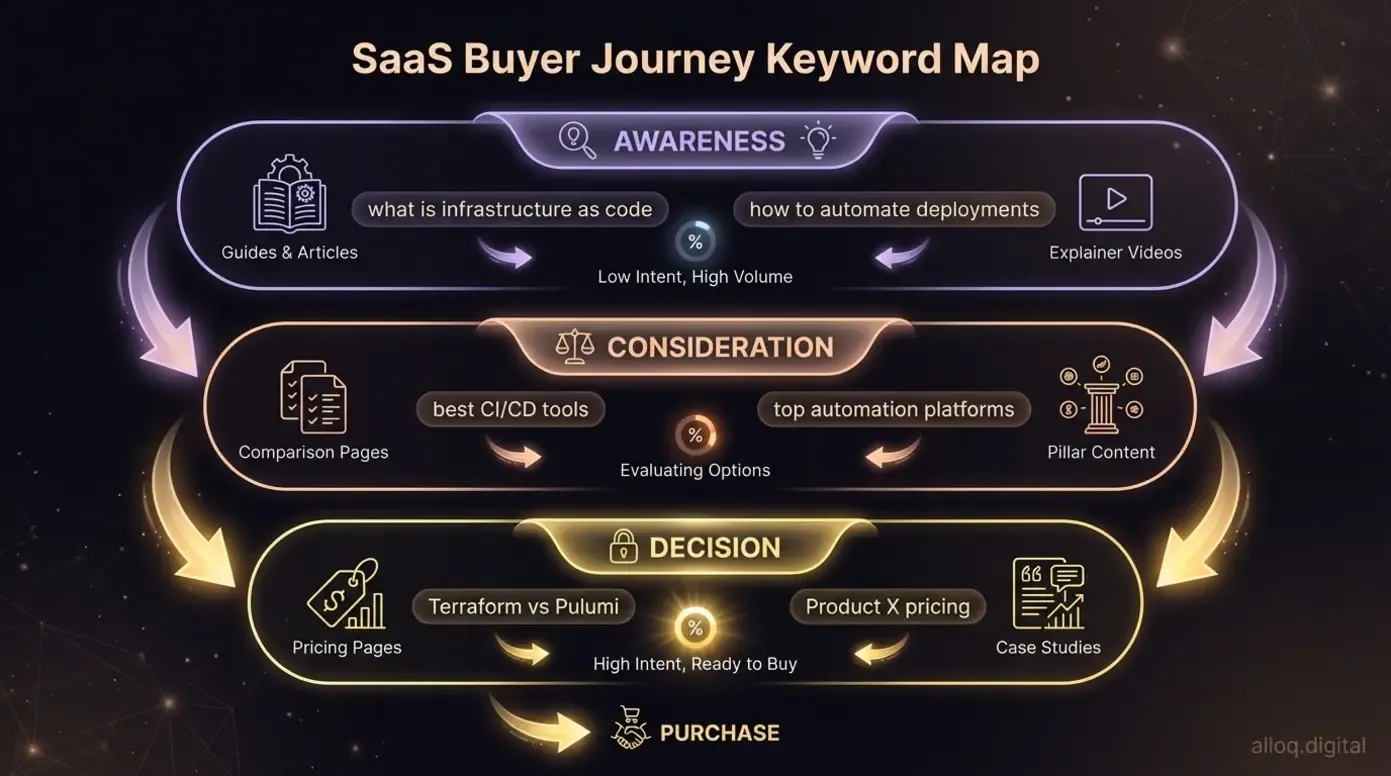 The SaaS Buyer Journey Keyword Map aligns specific keyword types and content formats to each stage of the B2B evaluation process.
Proving ROI with Multi-Touch Attribution
The biggest objection to SEO investment in software companies is that you can’t tie a blog post to a six-figure contract. Multi-touch attribution solves this, and it’s essential for SEO for IT companies competing for budget against paid channels that report instant metrics.
Multi-Touch Attribution (MTA) assigns weighted credit to every content touchpoint a buyer interacts with before converting. Rather than giving 100% credit to the last click (often a branded search), MTA reveals that the prospect first found you through an organic “how-to” guide, returned via a comparison page, and finally converted after reading a case study.
Here is how to implement it:
- Tag every content asset in your CMS with its journey stage (Awareness, Consideration, Decision)
- Set up event tracking in Google Analytics 4 for key micro-conversions: PDF downloads, demo requests, pricing page visits
- Use UTM parameters consistently on internal campaign links
- Build a weighted model that assigns credit proportionally—a common starting point is 40% to first touch, 20% to middle touches, and 40% to last touch
- Report monthly on content-assisted pipeline, not just organic traffic
Continuous measurement is what separates a sustainable program from a one-time experiment. Review your attribution data quarterly and reallocate content resources toward the topics and stages that contribute most to pipeline. When your CFO asks for proof that organic search generates revenue, your attribution model provides it in hard numbers.
Digital Authority & Technical Optimization
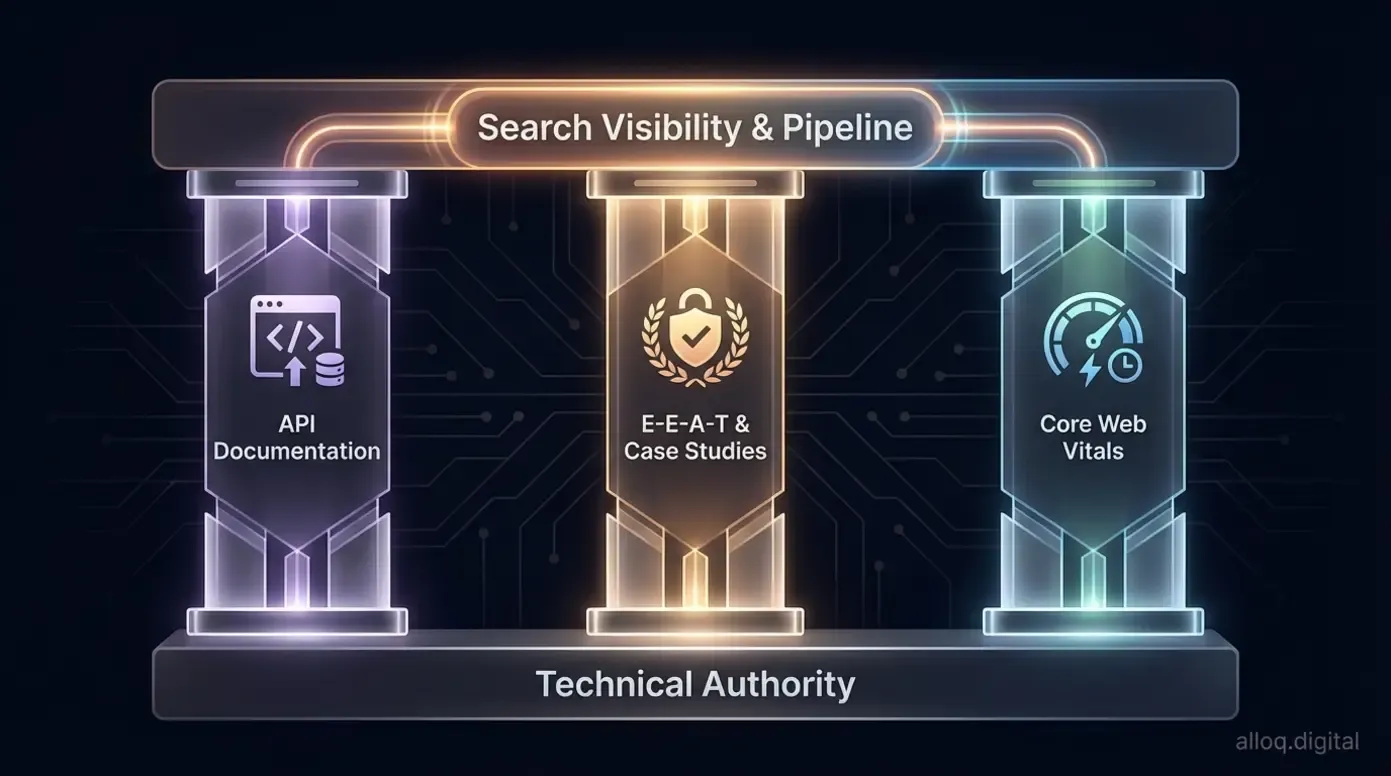 Digital authority for software companies rests on three interconnected pillars: optimized documentation, verifiable expertise, and technical site performance.
Technical excellence is non-negotiable for SEO for software companies selling to developers, CTOs, and engineering leaders. Your website’s performance and technical structure are the first signals a technical buyer evaluates—often before they read a single word of your marketing copy. A slow-loading documentation page or broken schema markup tells a developer everything they need to know about your engineering standards.
This section covers three pillars of technical authority: turning your existing documentation into a ranking asset, building E-E-A-T through case studies and digital PR, and ensuring your Core Web Vitals reflect the same quality as your product.
Developer-First SEO: Optimizing API Documentation
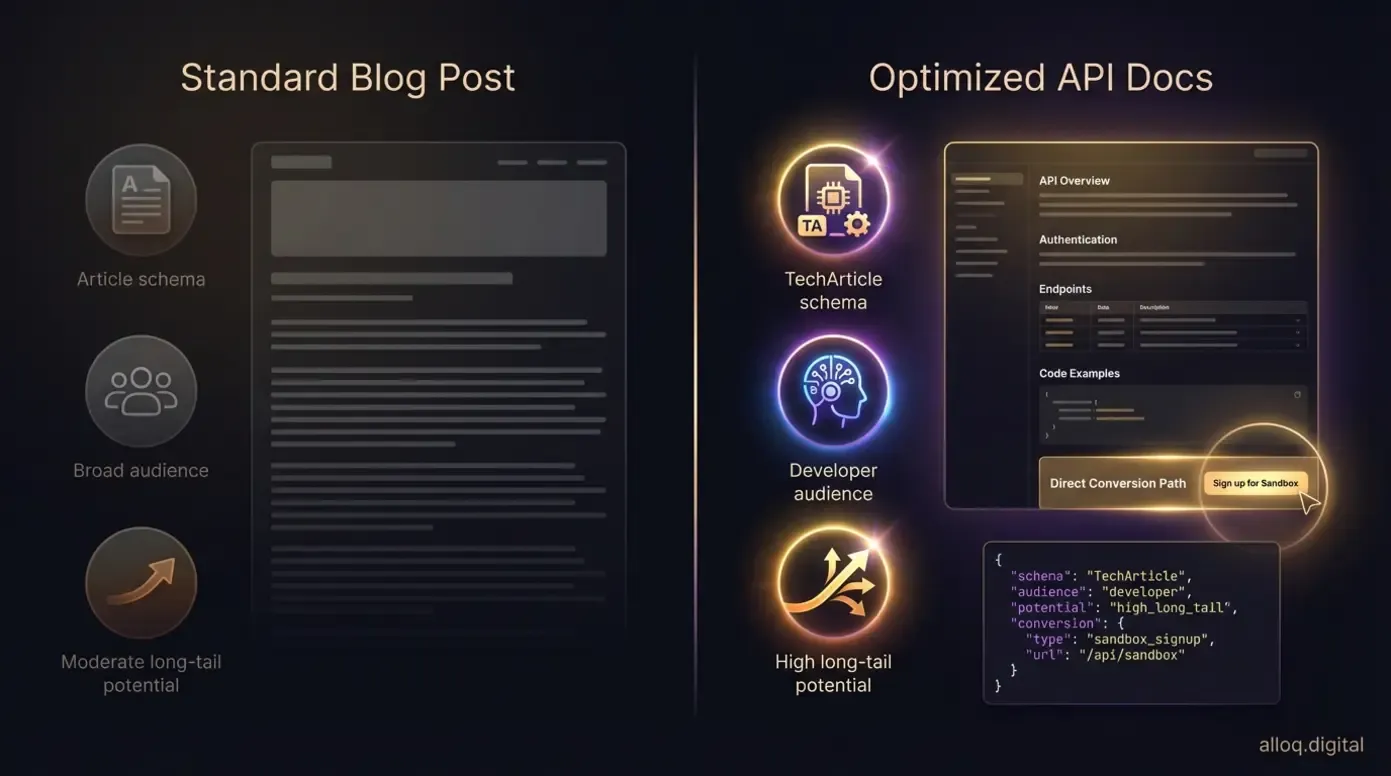 Optimized API documentation outperforms standard blog posts by targeting developer-specific queries with structured schema and direct conversion paths.
Most software companies treat documentation as a support resource, buried behind login walls or excluded from search indexing entirely. That is a missed opportunity. API references, SDKs, and integration guides attract exactly the audience you want: developers evaluating whether your product fits their stack. This approach is central to effective SEO for IT companies with technical products.
The key is treating documentation as a first-class SEO asset. Here is how optimized API documentation compares to a standard content approach:
| Factor | Standard Blog Post | Optimized API Documentation |
|---|---|---|
| Schema Type | Article or BlogPosting | TechArticle + SoftwareApplication |
| Primary Audience | Marketers, generalists | Developers, technical leads |
| Search Intent | Informational / broad | Specific / implementation-focused |
| Long-Tail Potential | Moderate | High (e.g., “OAuth2 refresh token endpoint”) |
| Conversion Path | Awareness → nurture | Direct → sandbox/trial signup |
To implement this effectively:
- Apply
TechArticleschema to every documentation page so search engines understand the content type - Ensure API references are indexable—remove
noindextags from public-facing docs - Structure URLs logically (e.g.,
/docs/api/v2/authentication) so crawlers can map your content hierarchy - Add code examples with syntax highlighting; developers search for implementation patterns, not abstractions
Stripe utilizes Markdoc to create interactive, high-performance developer documentation that ranks for thousands of technical queries. Their documentation isn’t a cost center—it’s a growth engine. Your technical SEO and performance foundations should follow a similar principle.
Building Trust (E-E-A-T) with Technical Case Studies
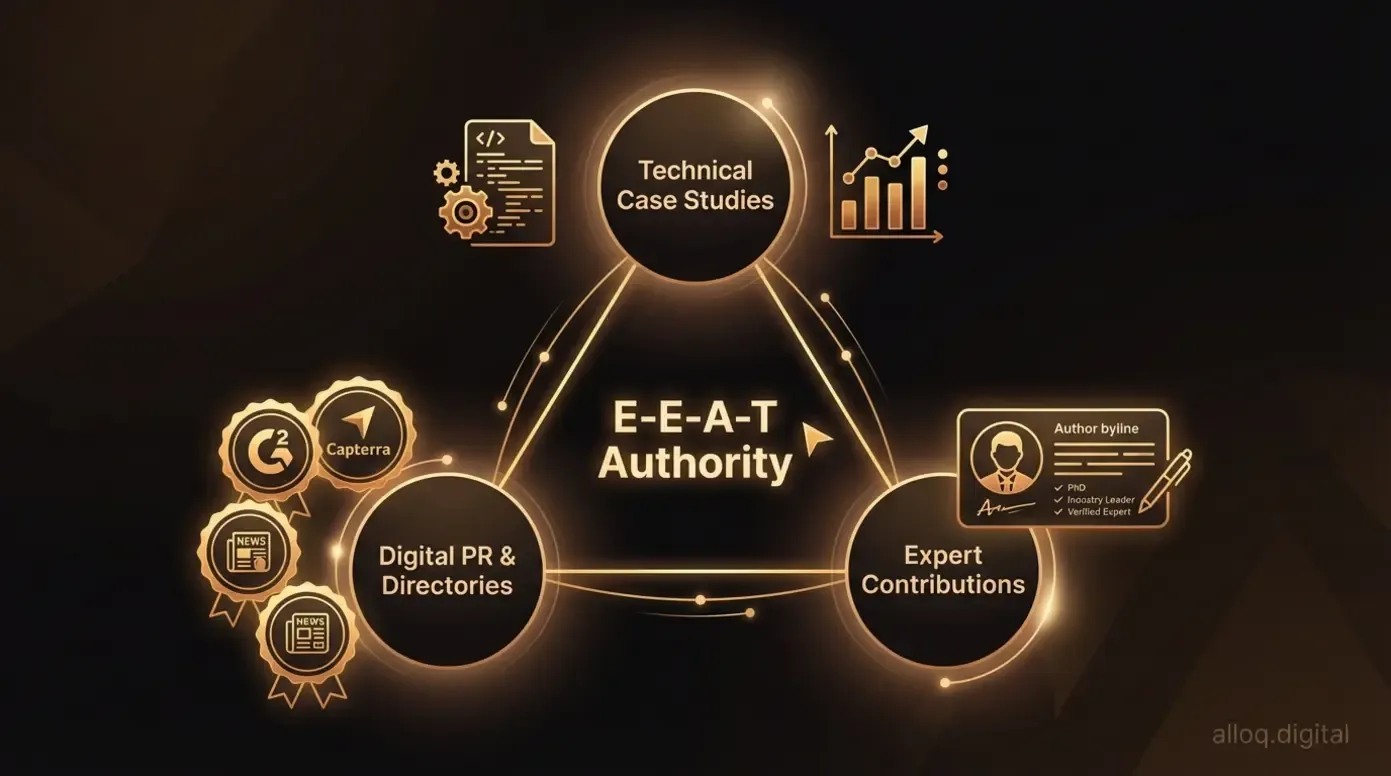 Building E-E-A-T for software companies requires three interconnected authority signals: verifiable case studies, platform presence, and expert-authored content.
A well-executed digital marketing strategy for software companies depends on more than keywords and schema. Search engines—and buyers—need proof that your expertise is real. For B2B software, that proof comes from three sources.
Technical case studies are your strongest E-E-A-T signal. A case study that shows how a specific client reduced deployment time by 40% using your platform, complete with architecture diagrams and measurable outcomes, provides evidence that no generic blog post can match. Publish these with named clients when possible, or anonymize with enough detail to remain credible.
Digital PR and industry directories extend your authority beyond your own domain. Secure profiles on G2, Capterra, and Clutch—these platforms carry significant domain authority and frequently appear in buyer research queries. Contribute expert commentary to relevant publications. Each mention and backlink signals to search engines that your company is a recognized participant in your category.
Expert contributions from your engineering and leadership teams close the loop. When your CTO publishes a technical breakdown of a migration project, or your lead architect explains a design decision, that content carries the kind of first-hand experience that search quality guidelines explicitly reward. Ensure author bylines include verifiable credentials and link to professional profiles.
Technical Health: Core Web Vitals for SaaS
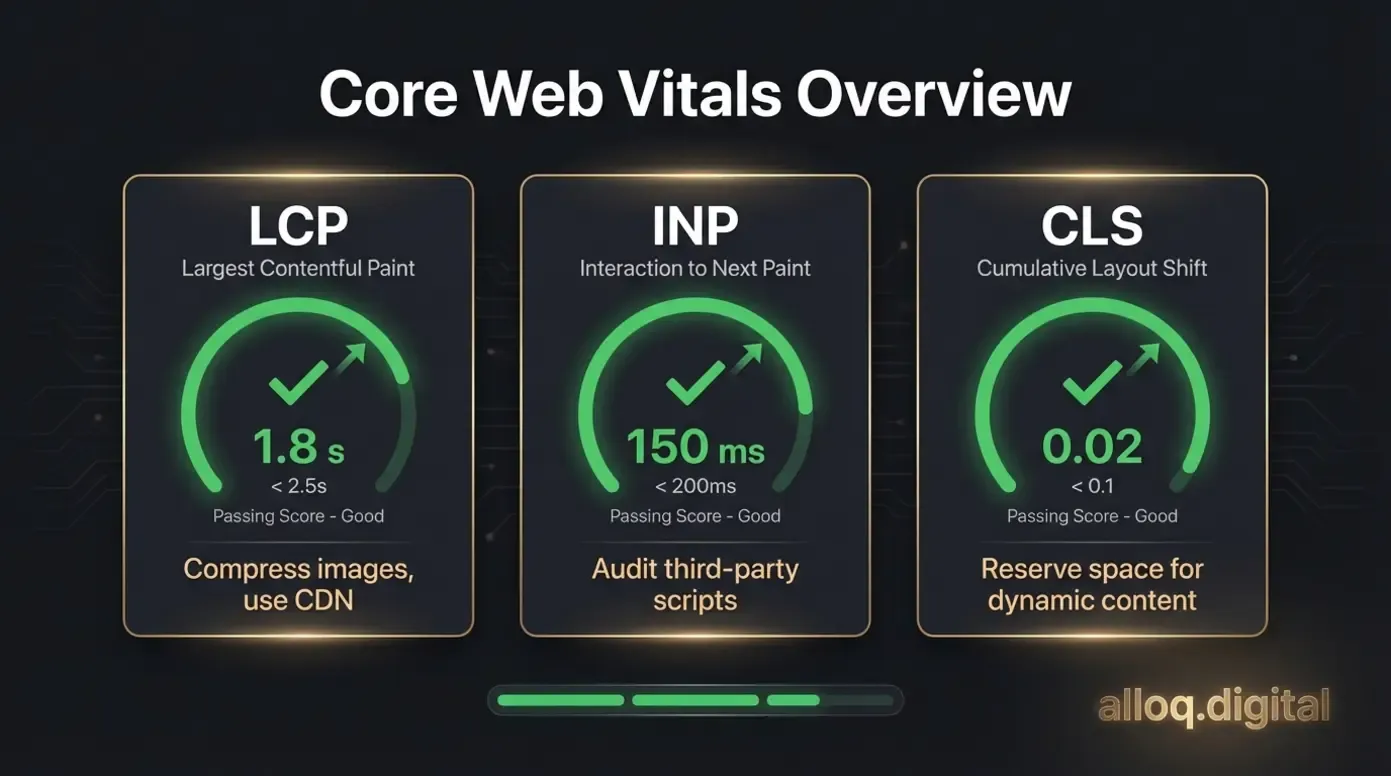 Monitoring LCP, INP, and CLS on your top landing pages ensures your site’s technical performance matches the quality standards technical buyers expect.
Your site speed sends a message. If your marketing site loads slowly, a technical buyer will question whether your product performs any better. Google’s official SEO documentation emphasizes clear site hierarchy and structured data as foundational ranking factors—but Core Web Vitals determine whether users actually stay.
Three metrics matter most:
- Largest Contentful Paint (LCP): Your main content should load within 2.5 seconds. Compress images, defer non-critical JavaScript, and use a CDN for global delivery
- Interaction to Next Paint (INP): Interactive elements should respond in under 200 milliseconds. Audit heavy third-party scripts that block the main thread
- Cumulative Layout Shift (CLS): Reserve space for images, embeds, and dynamic content to prevent layout jumps. A CLS score under 0.1 is the target
Run PageSpeed Insights on your top 10 landing pages monthly. Prioritize fixes on pages that drive the most organic traffic and conversions—your pricing page and primary feature pages deserve attention first.
Authority Support
The data reinforces why this specialized approach works. According to Gartner’s 2025 software buying trends research, software buyers typically engage 2.5 vendors over a 4.6-month evaluation period. That timeline means your content needs to appear at multiple touchpoints across nearly five months—not just once. A single blog post cannot carry that weight. A mapped content strategy across the full buyer journey can.
Simon, Founder & Technical Lead, frames it simply: “Delivering on promises matters more than making them. In technical projects, Handschlagqualität—the reliability of your word—determines whether a prospect becomes a long-term client. Your SEO content should reflect the same standard: specific, verifiable, and honest about what you can deliver.”
This level of specificity matters because it helps you make better decisions about where to invest limited resources. Rather than producing more generic awareness content, you can identify exactly which journey stage lacks coverage, which pages contribute to pipeline, and which technical assets need optimization. That precision is what separates a program that generates revenue from one that generates reports.
Common Pitfalls in Software SEO & When to Hire Experts
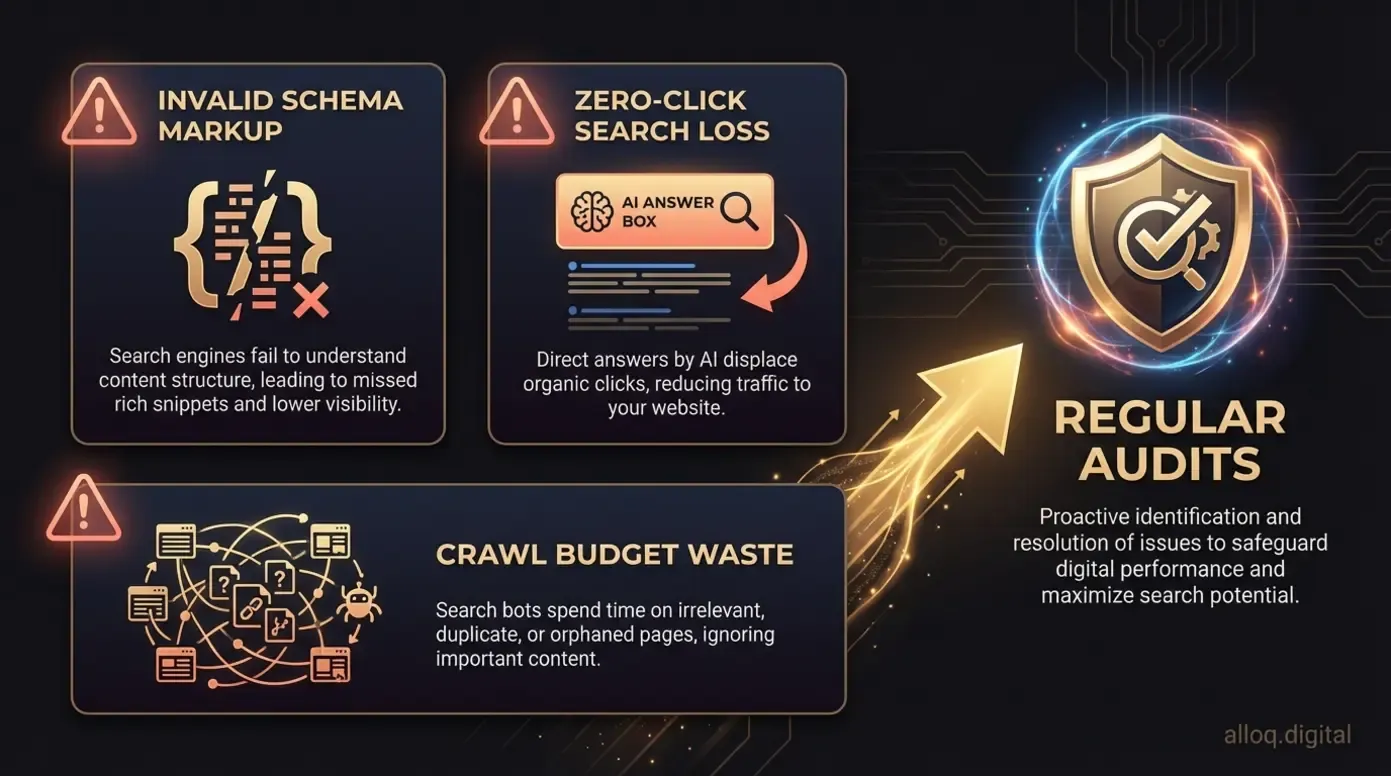 Technical SEO debt from invalid schema, zero-click erosion, and crawl waste quietly undermines organic performance — regular audits are the safeguard.
Even well-resourced software companies make SEO mistakes that quietly erode their organic performance. Acknowledging these risks honestly helps you avoid them—and know when to bring in specialized help.
The Risks of Ignoring Technical Debt
Technical SEO debt accumulates faster than most teams realize. Three risks deserve particular attention in 2025.
Invalid or outdated schema markup can actively hurt your rankings. If you implemented SoftwareApplication schema two years ago and never updated it, changes in Google’s structured data requirements may have rendered it invalid. Invalid schema doesn’t just fail to help—it can trigger manual actions or prevent rich results from appearing. Audit your structured data quarterly using Google’s Rich Results Test.
Zero-click searches present a growing challenge. As AI-generated answers in search results become more common, some queries that previously drove traffic to your site may now be answered directly in the search interface. This doesn’t mean SEO is less valuable—it means your content strategy must target queries where a click is still necessary, such as comparison pages, pricing lookups, and interactive documentation that AI cannot replicate.
Crawl budget waste from orphaned pages, duplicate content, and bloated JavaScript bundles means search engines may not even discover your most important content. A site with 10,000 pages and poor internal linking can perform worse than a focused site with 500 well-structured pages.
When to Hire a Professional vs. DIY
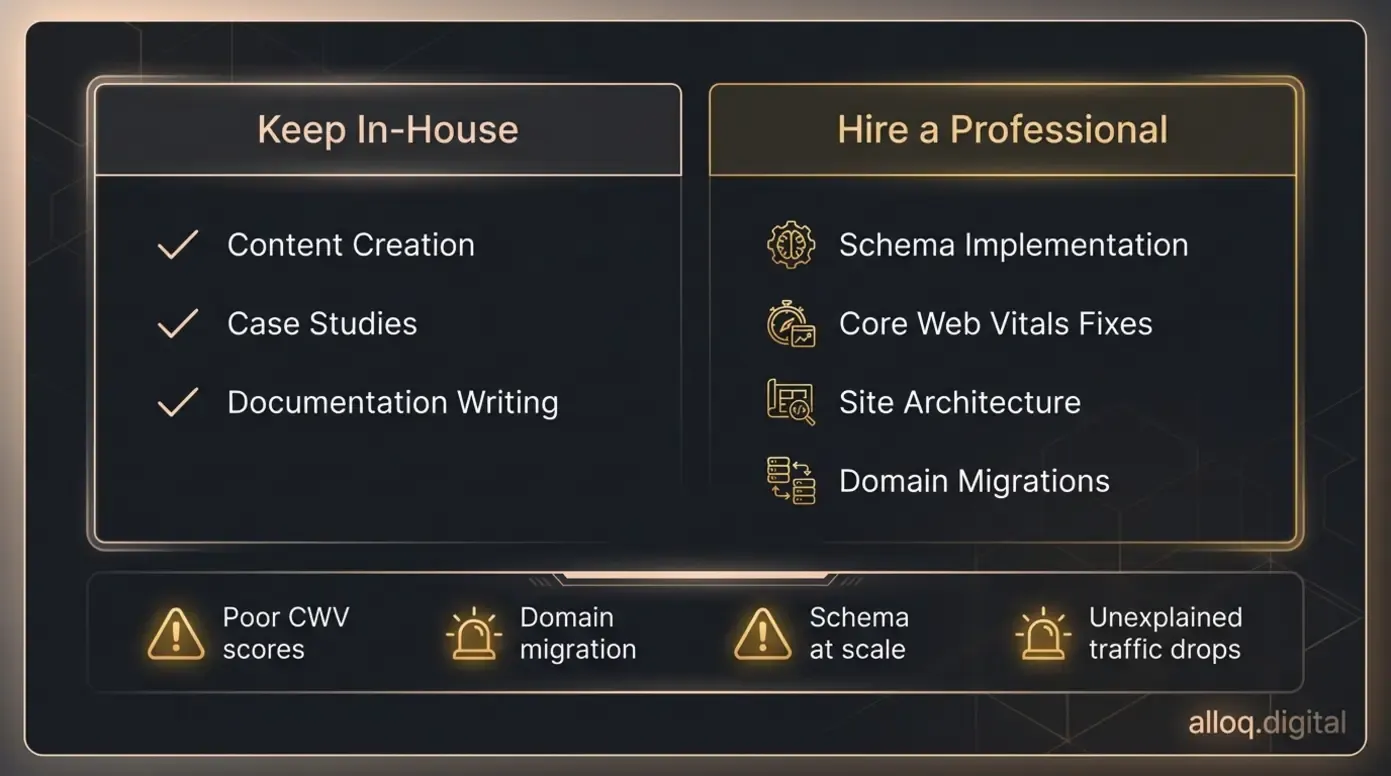 Content creation thrives in-house, but schema implementation, site migrations, and Core Web Vitals optimization often require specialized technical expertise.
Content creation can often stay in-house. Your team understands the product, the audience, and the technical nuances better than any outside writer. Blog posts, case studies, and documentation benefit from internal expertise.
Technical SEO is a different story. Schema implementation, Core Web Vitals optimization, crawl budget management, and site architecture require specialized development skills that most marketing teams don’t carry. If your site runs on a custom framework, the complexity increases further.
Consider bringing in a professional when:
- Core Web Vitals scores remain poor despite internal efforts
- You’re migrating domains, restructuring URLs, or launching a new platform
- Schema markup needs implementation or repair across hundreds of pages
- Organic traffic has dropped without a clear content explanation
The right time to evaluate outside help is before a problem becomes a crisis. Learn more about when to hire a professional for your technical SEO needs.
Frequently Asked Questions
Why is SEO for software companies different from general SEO?
SEO for software companies requires a specialized approach due to complex products and long B2B sales cycles. It involves targeting specific technical jargon and aligning content with a multi-stakeholder decision process that often spans several months. Unlike B2C, the primary goal is lead generation and pipeline contribution rather than immediate sales. For example, optimizing for “enterprise ERP integration” targets a very different intent than general keywords. Results depend on a consistent technical content strategy executed across the full buyer journey.
How should software companies choose SEO keywords?
Software companies should choose SEO keywords by mapping them directly to the Awareness, Consideration, and Decision stages of the buyer journey. Use informational “how-to” queries for awareness and high-intent comparison phrases like “Product vs Competitor” for decision-making. This ensures you capture leads at every maturity level. A balanced strategy targets both high-volume broad terms for visibility and specific low-volume conversion terms for pipeline impact.
What are the most important technical SEO factors for tech firms?
The most critical technical SEO factors for tech firms are Core Web Vitals, mobile responsiveness, and optimized technical documentation. Search engines prioritize fast-loading sites and those that use structured data (Schema) to define software applications and technical articles. API documentation should be indexable to attract developer traffic through long-tail queries. Regular audits ensure your technical foundation supports—rather than undermines—your content efforts.
How can software companies build domain authority?
Software companies build domain authority by publishing expert-led case studies and engaging in digital PR. Securing profiles on industry directories like G2, Capterra, and Clutch signals trust to both search engines and prospective buyers. Consistent contributions from recognized technical experts help establish E-E-A-T credentials that generic content cannot replicate. Quality backlinks from relevant tech publications further validate your standing in the industry.
What tools are best for tracking software SEO performance?
Effective tools for tracking software SEO include Google Search Console for indexing data and Google Analytics 4 for conversion tracking. These platforms allow you to monitor organic traffic and attribute specific demo sign-ups or trial activations to your content. Third-party tools like Semrush or Ahrefs are valuable for competitor analysis and keyword tracking. Integrating these tools with your CRM provides a comprehensive view of content-driven ROI across the full sales cycle.
Your Next Steps: From Framework to Pipeline
SEO for software companies in 2025 demands more than publishing blog posts and tracking keyword rankings. The Developer-First & Pipeline-Proven Framework covered in this guide addresses the specific challenges B2B software teams face: complex products, long sales cycles, technical buyers, and the constant pressure to prove marketing ROI.
The companies that win organic visibility are those that treat documentation as a growth asset, map content to every stage of the buyer journey, and measure results through attribution—not vanity metrics. Technical excellence in your SEO reflects the same standards your engineering team holds for your product. Buyers notice that consistency.
Start today with three concrete actions: audit your API documentation for indexing and schema compliance, map your first 10 target keywords to Awareness, Consideration, and Decision stages, and set up multi-touch attribution in GA4 to track content-assisted conversions. These three steps build the foundation for a program that generates measurable pipeline, not just traffic reports.